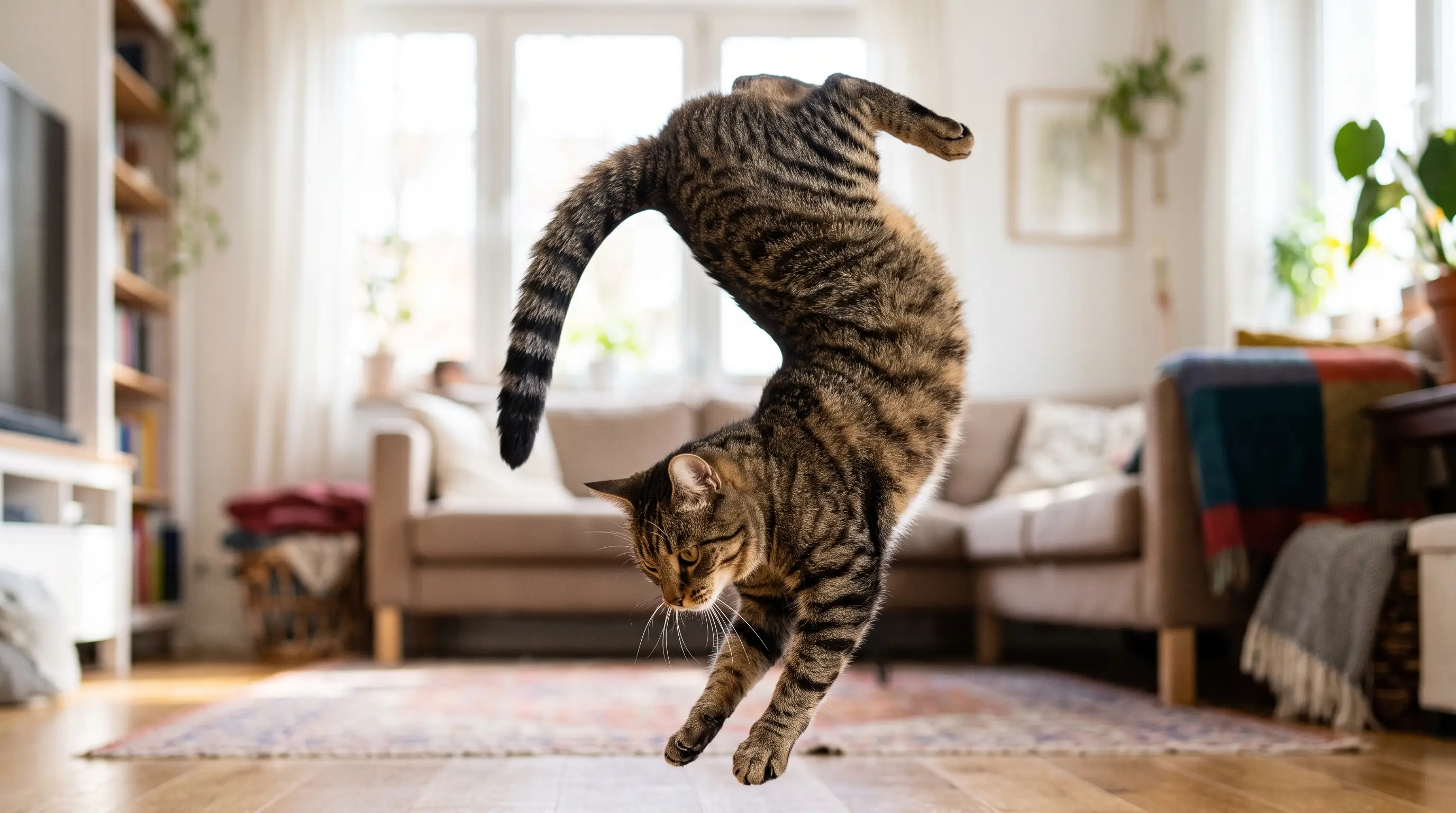
How cats land on their feet — and when they don't
Drop a cat — which you shouldn't — and something remarkable happens in the first third of a second: it fixes the horizon, folds its front legs, spins its front half, then its back half, arches, spreads, and arrives feet-down like a gymnast who has done this forever. It has: the routine is running by seven weeks old. The righting reflex fascinated physicists for a century because it looks like it breaks the laws of rotation. It doesn't — and it also doesn't make cats fall-proof, which is where this article stops being fun and starts being about window screens.
The twist that puzzled physics
The puzzle is real: a falling body with nothing to push against shouldn't be able to start rotating — angular momentum says so — yet a cat dropped back-down lands feet-down. Nineteenth-century scientists argued the cat must be pushing off the dropper's hands, until 1894, when Étienne-Jules Marey put a falling cat in front of a chronophotographic camera — sixty frames a second, scandalously advanced — and settled it. The images showed the trick: the cat is not rotating as one block. It bends at the waist and turns as two connected bodies.
The routine, frame by frame: eyes and inner ear fix which way is down; the spine bends; the front legs tuck in while the back legs extend, so the front half spins fast while the rear barely counter-rotates; then the move reverses — back legs tuck, front legs extend — and the rear half catches up. Net angular momentum: zero throughout. Physics honour: intact. It's the same principle a diver uses to twist from a straight jump, except the cat computes it in milliseconds, upside down, without a coach.
No tail required
The popular version credits the tail, swishing like a propeller. The bending-at-the-waist mechanism above does almost all the work — which you can verify by observing that Manx cats, born tailless, right themselves perfectly well. The tail contributes fine trim at the margins; the spine is the engine. What the routine does need is hardware: an exceptionally flexible spine with loosely attached shoulder blades, a vestibular system in the inner ear acting as gyroscope, and eyes cross-checking the horizon. Kittens run the first clumsy drafts at three to four weeks and have the full routine polished by six or seven — before they've finished learning to run.
The reflex needs one more thing: time. Below a certain height there simply isn't room to complete the turn, which is why very short falls — off a child's arms, off the sofa mid-squabble — can land a cat badly. The margin is small but real, and it foreshadows the section every cat owner should read twice.
The high-rise paradox
In 1987, vets at a New York animal hospital published a study of 132 cats that had fallen from buildings — and found something so counterintuitive it's still argued about: cats falling from above roughly seven storeys had fewer deaths and fewer severe injuries than cats falling from five or six. The proposed mechanism: a cat reaches terminal velocity — around 100 km/h — after about five floors of fall. Until then it's accelerating, tense, legs braced. Once acceleration stops, the vestibular system quiets, and the cat relaxes into a spread-eagled, flying-squirrel posture that spreads the impact across its whole body.
Honesty requires the caveat baked into the data: the study only counted cats brought to the vet. Cats that died on the pavement never entered the statistics, so the seven-storey survival curve is real but survivor-biased, and nobody should read it as reassurance. The honest summary: cats survive astonishing falls often enough to have a syndrome named after them — high-rise syndrome — and are injured by modest falls far more often than their reputation admits. Mid-height falls, second to fifth floor, are the genuinely dangerous band: fast enough to break bones, too short for the relaxed spread.
The part that isn't a party trick
High-rise syndrome has a season: warm weeks, open windows, unscreened balconies. The classic patient is a young indoor cat, intent on a pigeon, that shifts its weight on a windowsill it has sat on safely a hundred times. Cats don't fear heights the way we do and don't understand glass, ledges or momentum the way their confidence suggests. A falling cat this decade is overwhelmingly a window accident, not a misjudged leap.
The fixes are unglamorous: screens on tilt-and-turn windows (a tilted window is its own trap — cats slip into the wedge), netting on balconies, and no unsupervised sill access above the first floor. If a fall happens, a cat that walks away can still be carrying a fractured palate, a burst bladder or chest trauma under the adrenaline — the classic triad involves the chin, chest and legs — so the rule is a vet check after any fall from height, symptoms or none. And the everyday version of the same physics: don't let children carry the cat on stairs, and let a squirming cat go rather than gripping — a controlled slither from your arms is the safest fall it will ever make. For the wobbles that aren't normal — a cat that stumbles on flat ground, tilts its head, or circles — the problem is the gyroscope, not the fall, and why is my cat limping covers when a vet visit is urgent.
Nine lives, one spreadsheet
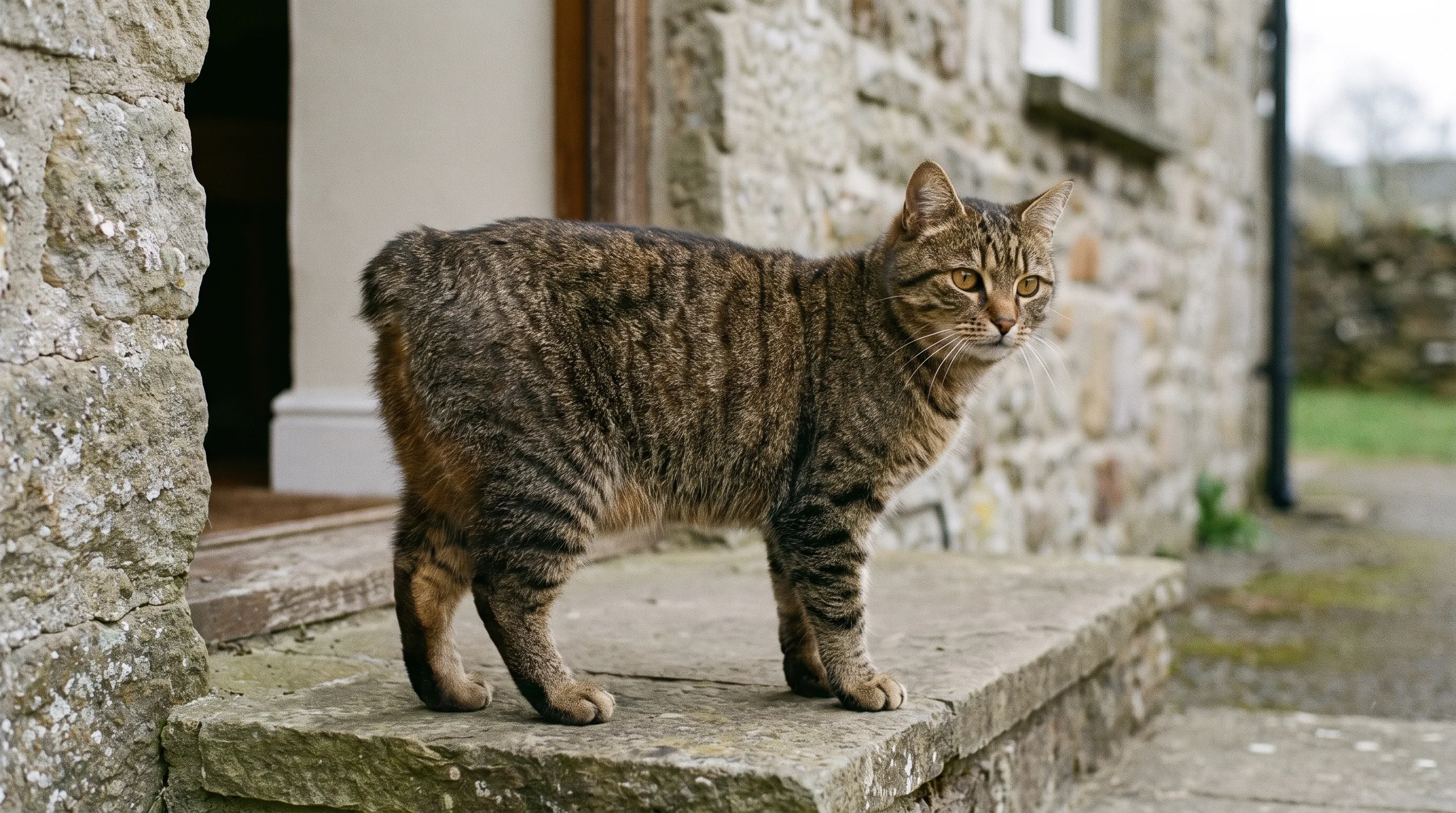
The righting reflex earned cats their nine-lives reputation, and it's worth putting the legend next to the ledger. The reflex is real, ancient, and shared across the family — leopards in trees and the wildcats in our own European wildcat coverage run the same routine, because a life spent hunting from height selects hard for landing well. The Manx proves the tail is optional; kittens prove the software ships pre-installed; Marey's sixty frames proved no physics was harmed.
But the spreadsheet says the reputation does cats no favours. Believing a cat "always lands on its feet" is how windows stay unscreened and balconies stay open. The truthful version fits in one sentence: a cat falling with enough height, enough warning and a working inner ear will very probably land feet-first — and can still be gravely hurt by the landing. Respect the gymnast. Screen the windows anyway.
Common questions
How do cats always land on their feet?
Via the righting reflex: the inner ear and eyes fix which way is down, then the cat bends at the waist and rotates its front and back halves in sequence — tucking one set of legs while extending the other — so it turns without violating conservation of angular momentum. The routine runs in about a third of a second and is fully developed by six to seven weeks of age.
Do cats need their tails to land on their feet?
No. The spine-bending mechanism does almost all the work — tailless Manx cats right themselves normally. The tail adds fine adjustment at the margins, but the flexible spine, free-floating shoulder blades and inner-ear gyroscope are the real machinery.
Can cats survive falls from high buildings?
Sometimes, remarkably — the 1987 New York study of 132 fallen cats found fewer severe injuries above roughly seven storeys, likely because cats reach terminal velocity after about five floors and relax into a spread posture. But that data only counted cats that reached a vet, and cats are seriously injured by modest falls constantly. High-rise syndrome is a real emergency, not a party trick.
What height is dangerous for a cat to fall from?
Two bands are worst: very short falls with no room to complete the righting turn, and the mid-height band around the second to fifth floor — fast enough to break bones, too short for the relaxed spread that helps at greater heights. No fall from height is safe; any cat that falls from a window deserves a vet check even if it walks away.
Do cats get hurt when they fall?
Often, yes. The classic high-rise triad is injuries to the chin and jaw (including fractured palates), the chest, and the legs — and internal injuries can hide behind adrenaline in a cat that seems fine. Feet-first landing spreads the impact; it doesn't delete it.
How do I stop my cat falling out of the window?
Screens on windows — including tilt-and-turn windows, whose tilted wedge is its own trap for cats — netting on balconies, and no unsupervised access to high sills in warm months, when most falls happen. Cats don't fear heights and don't understand glass or ledges; the fix is engineering, not training.
More in Cats

Why does my cat lick me? Grooming, love and salt
A cat's lick is mostly a compliment: you've been adopted into the grooming circle. What the sandpaper tongue is doing, why some cats overdo it, and when to gently opt out.
Why does my cat follow me everywhere, even the bathroom?
The supposedly aloof animal trailing you from room to room is behaving exactly as the attachment science predicts. Why cats shadow their person, the bathroom mystery, and the one change that needs a vet.
Do cats love their owners? The kidnap experiment says yes
Science ran the same attachment test on cats that it runs on human infants, and 64% passed. What the secure-base test found, why one earlier study disagreed, and how a cat actually says it.
Do cats miss their owners? They even track the clock
Cats greet you harder after four hours away than after thirty minutes — they know how long you were gone. What missing looks like in a cat, when it tips into separation anxiety, and how to leave well.
How cats choose their favourite person
It isn't whoever fills the bowl. The Swiss living-room study found one habit that predicts a cat's favourite better than food ever did — and the person who ignores cats has it by accident.
Cats know their names. They've decided not to answer
A Tokyo lab proved cats pick their own name out of a string of similar words — even from a stranger's mouth. What cats actually understand of what you say, and why the response is optional.