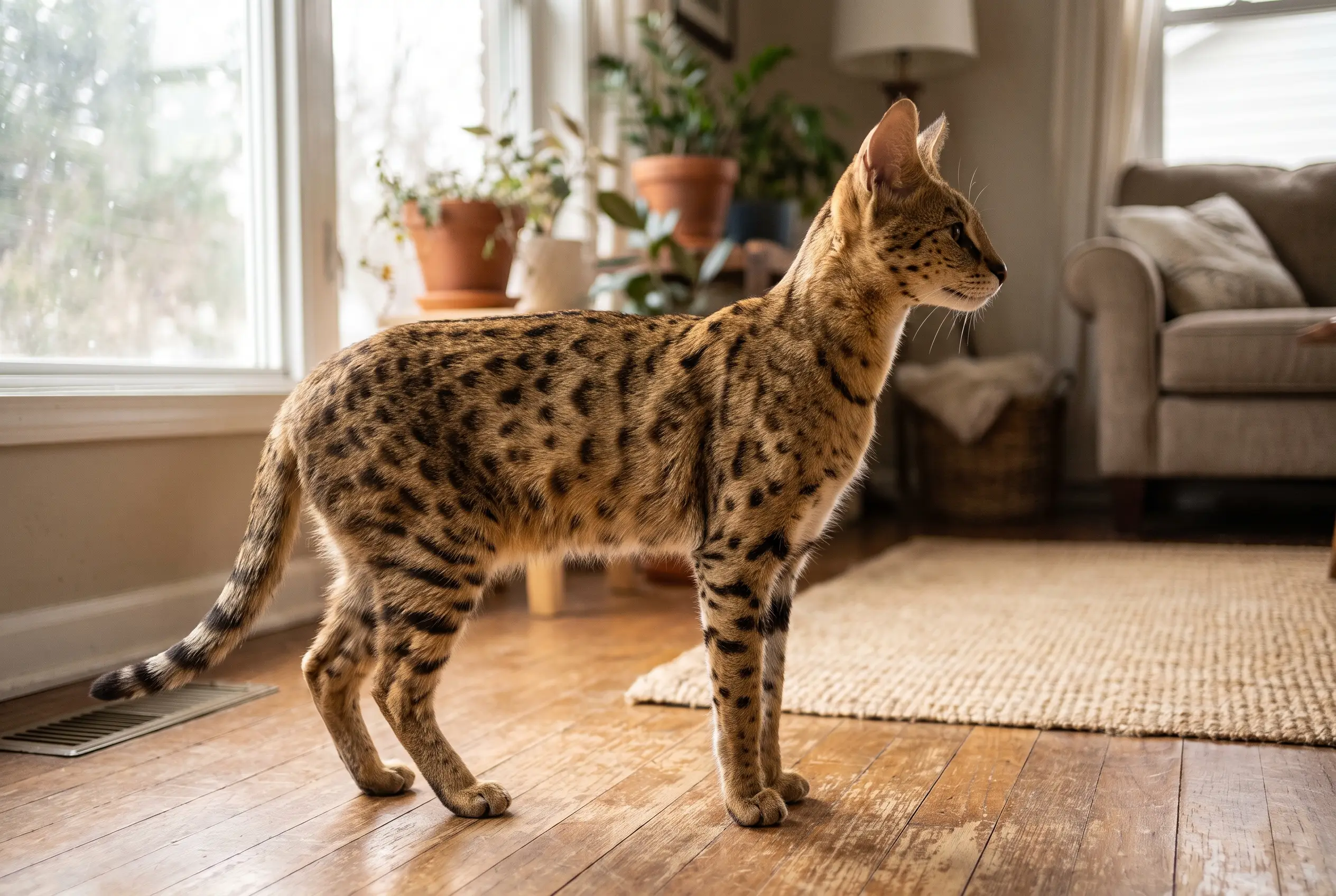
Savannah
The house cat with a serval for a grandparent, and the legs to prove it.
Vital stats
| Size | Large · tall, lean, long-legged |
| Weight | 4–8 kg · SBT (F4+); F1 hybrids can reach 18 kg |
| Life expectancy | 12–16 years — breed literature, not survey data |
| Energy | Very high — needs daily play and vertical space |
| Shedding | Low, coat is short and close-lying |
| Coat | Short, dense, always spotted — black or silver spotted tabby, or solid black and black smoke |
| Group | Shorthair |
| Origin | United States |
Breed traits
Friendliness
Care
Mind
The Savannah by the numbers
The Savannah facts owners search for most — price, lifespan, weight, shedding and colours, in one place.
Less common, so expect a waitlist and some travel to a reputable breeder — which pushes the price up. Ongoing costs stay modest — it eats little and routine vet care sits at the lower end.
We don't quote a single figure: the real price swings with breeder, region, bloodline and health testing — and a rescue costs a fraction of a breeder's litter. Adopting is almost always the cheapest route.
Temperament
How a Savannah behaves depends more on its filial generation than on anything else about the cat. An F1 is watchful, physically large, often reserved with strangers and children, and prone to marking — it needs an owner who has kept a genuinely large, strong-willed animal before, and most first-time cat owners should not get one. By F4 or F5, the serval percentage has dropped enough that the ordinary description applies: intensely bonded to one or two people, curious to the point of dismantling things, fond of running water, chatty with a chirping call inherited straight from the serval, and built to land on top of a wardrobe rather than sit in a lap. Every generation hunts hard — birds, rodents, and sometimes smaller housemates aren't safe around a Savannah — and every generation gets destructive when it's bored. A quiet household wanting a calm lap cat is the wrong home for any generation; a household with height, daily play time, and patience for a cat that treats a closed door as a puzzle is the right one.
Habits & quirks
Chirps like a serval
Savannahs keep the serval's high-pitched chirp alongside an ordinary meow, and use both — often chirping at birds through a window, or at a person it wants something from.
Jumps, doesn't just climb
A Savannah can clear roughly 2.4 m (8 ft) from a standing start, straight up onto a fridge or a door frame. Treat any open shelf as within reach.
Hunts anything smaller than it
The serval's drive stayed intact. Birds, rodents, and small housemates like hamsters or budgies are at genuine risk, not just in theory.
Follows water around the house
Running taps, a filled sink, even a bath left half-full will draw a paw, or the whole cat. It's one of the most reliable Savannah tells.
Care
| Health screening | Ask a breeder for HCM (hypertrophic cardiomyopathy) screening by cardiac ultrasound, and for testing or family history on PRA and pyruvate kinase deficiency. F1 and F2 kittens carry an elevated risk of liver shunt — get bloodwork and a vet check before six months. |
| Space and enclosure | Vertical space matters more than floor space: tall cat trees and secured high shelves for any generation, and for early generations often a legal requirement for a full outdoor enclosure rather than free roaming. |
| Exercise | Daily interactive play isn't optional. A Savannah that isn't tired out redirects that energy into counters, screens, and anything it can knock off a shelf. |
| Know the law before you buy | Check state, county, and even city law before bringing one home. Savannahs are banned outright in some US states, restricted to F4 or later in others, and F1–F4 hybrids are illegal in places like the Netherlands and Belgium. A reputable breeder asks where you live before selling. |
Life expectancy
This breed has a typical life expectancy of 12–16 years — breed literature, not survey data.
Similar breeds
Breeds with a similar build and background — worth a look if this one isn't quite the fit.
Common questions
What does F1, F2, F5 actually mean?
It's how many generations separate the cat from its serval ancestor. An F1 has a serval parent and is roughly half serval; each generation after that roughly halves the serval percentage again, so an F5 is in the low single digits and looks and acts like a large, spotted domestic cat. Only F4 and later — called SBT, for three generations of Savannah-to-Savannah breeding — can compete in a TICA show.
Is a Savannah the same as a Bengal?
No. Bengals come from the Asian leopard cat, are always several generations removed from that ancestor by the time they're sold as pets, and top out around 7 kg. Savannahs come from the African serval, can still be one generation removed (F1) when sold, and an F1 can weigh more than an adult Bengal twice over — the serval cross is recent and large in a way the Bengal's isn't.
Are Savannah cats legal to own?
It depends on where you live, generation by generation. Several US states ban the breed outright, others allow only F4 or later, and cities sometimes restrict what the state permits — New York State allows F5 and later, for instance, but New York City doesn't allow any. Australia bans the breed nationally. Check your specific state, county, and city before buying, not just the country.
Does the Savannah shed a lot?
Not much. The Savannah is a low-shedding breed, so loose hair around the home stays minimal. It still needs regular grooming, but you won't be fighting drifts of fur.
Are Savannah cats hypoallergenic?
No cat breed is truly hypoallergenic. The trigger is Fel d 1, a protein in a cat's saliva and skin that transfers to the coat during grooming and then travels on loose hair and dander — so a cat that sheds less, like the Savannah, spreads less of it around the house, but still produces it. If someone at home reacts to cats, spend real time with this breed before deciding, and no breeder should promise you an allergy-free cat.
Are Savannah cats good with children?
Often, in the right home. The Savannah is reasonably sociable and can settle well with children who already know how to handle a cat gently. Give it high perches and a room the kids don't own, and introductions go far better.
How much grooming does a Savannah need?
Very little. The Savannah handles its own coat and a comb once a week or so is plenty — mostly to catch loose hair before the cat swallows it. Claws, teeth and ears still want the usual checks, which is the part people skip on an easy-coated cat.
Stories featuring this breed
All stories →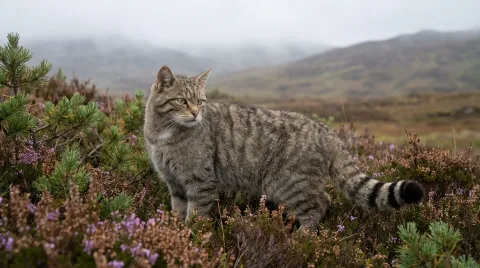
Scottish wildcat: not extinct, not a subspecies
The most-quoted fact about the Scottish wildcat misstates its own source. What the 2019 IUCN review really said, and where the cats stand in 2026.
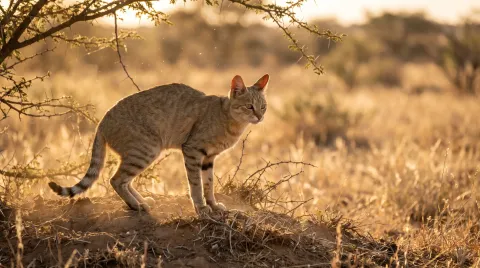
African wildcat: the real ancestor of your cat
Your cat descends from Felis lybica, a North African animal most people cannot name. In November 2025 the standard account of how it reached Europe broke.
Wildcat hybridisation: how a species gets absorbed
Even a low crossbreeding rate assimilates a wildcat population past halfway inside a century. Why "only a few hybrids" is not the reassurance it sounds like.