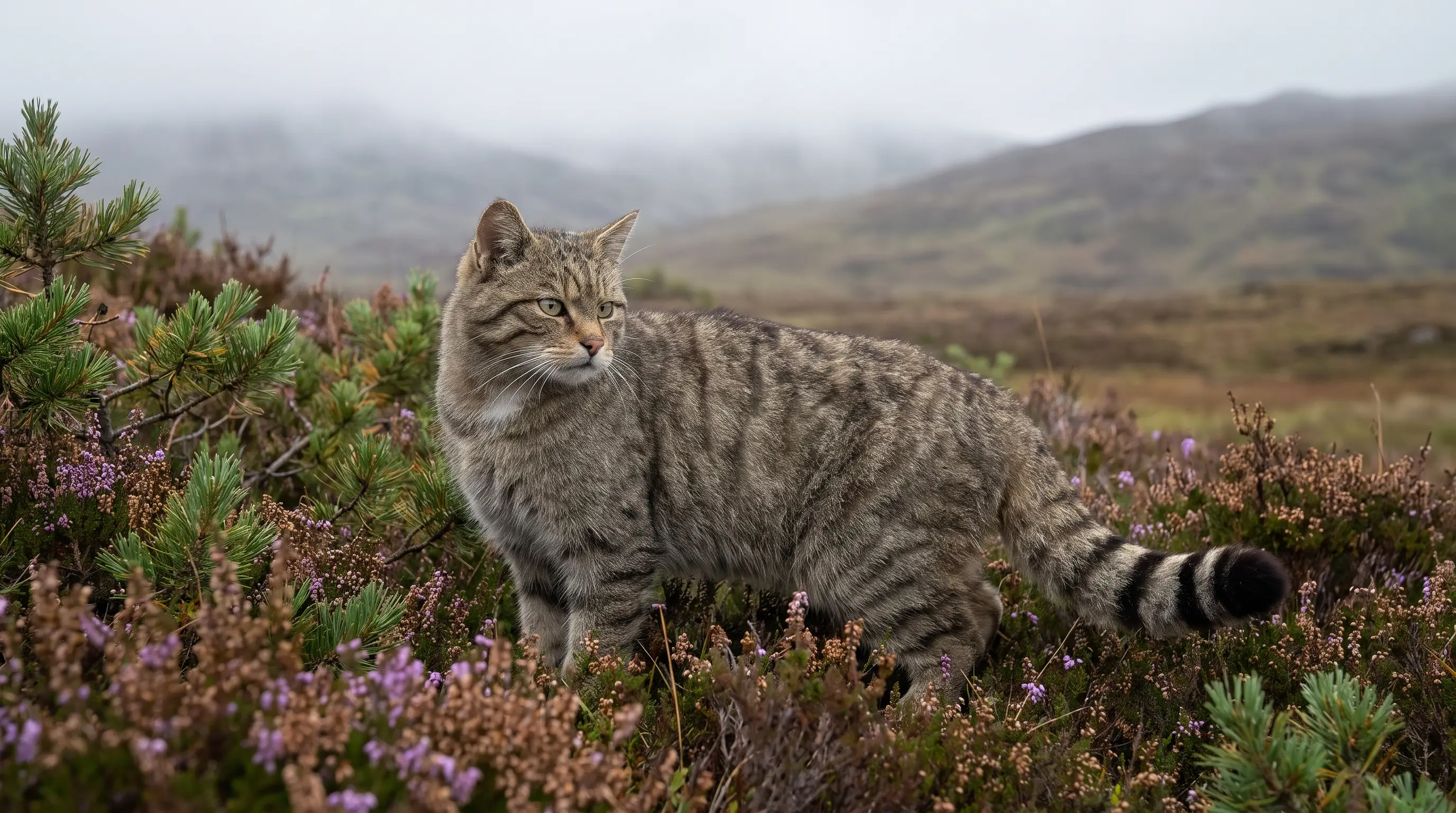
Scottish wildcat: not extinct, not a subspecies
The Scottish wildcat is not extinct. The phrase most often used to say it is, “functionally extinct”, does not appear in the report it gets attributed to: search the full text of the 2019 IUCN Cat Specialist Group review of wildcat conservation in Scotland and the word “functional” turns up zero times. The review’s own wording is bleaker and more exact than the paraphrase, which is a good reason to quote it instead. This is a field guide to where the Highland population of the European wildcat (Felis silvestris) actually stands: regionally Critically Endangered, judged no longer viable on its own, and currently being restocked from a breeding centre in the Highlands.
What the 2019 review actually said
The review was written by Breitenmoser, Lanz and Breitenmoser-Würsten of the IUCN SSC Cat Specialist Group, commissioned in spring 2018 by the Scottish Wildcat Conservation Action Plan Steering Group and published in February 2019. Its conclusion runs four sentences and deserves to be read whole: “All the robust information available indicates that the wildcat in Scotland is at the verge of extinction. Based on the available information, we consider the wildcat population in Scotland to be no longer viable. The number of wildcats is too small, the hybridisation too far advanced and the population too fragmented. We therefore conclude that it is too late to conserve the wildcat in Scotland as a stand-alone population.”
Elsewhere the authors state that “there is no viable population of wildcats left anywhere in Scotland”, and use “at the brink of extinction” and “on the verge of disappearance”. None of that means extinct, and none of it is the phrase the press settled on. The difference has practical weight. A population that cannot persist unaided is not a population you stop working on; it is one whose conservation strategy has to change shape, which is what happened next.
Critically Endangered, not extinct: three claims kept apart
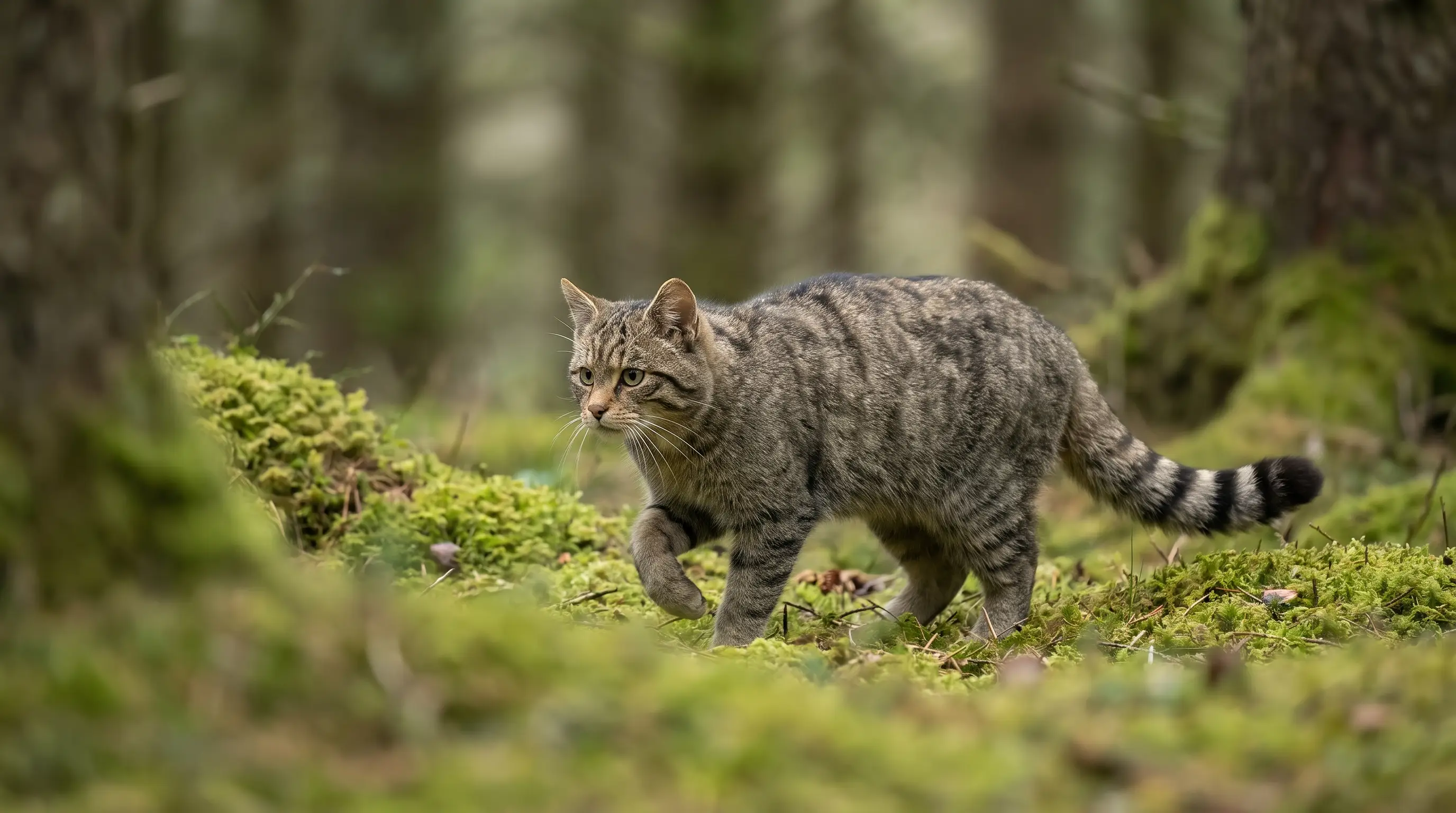
Critically Endangered is a formal category and the Scottish wildcat holds it regionally. It comes from the Red List for Britain’s terrestrial mammals compiled by Mathews and Harrower in 2020, an IUCN-compliant regional assessment produced for Natural England, Natural Resources Wales, NatureScot and JNCC. Regional is the operative word: Felis silvestris is listed globally as Least Concern, because the species remains widespread on the continent. An animal can be secure as a species and nearly gone in one country at the same time, and the species map makes that easy to see.
“No longer viable” is not a Red List category at all. It is the 2019 review’s judgement about whether the surviving animals could hold on without intervention. Extinct, meanwhile, is nobody’s assessment: free-living cats carrying wildcat ancestry persist in Scotland alongside the released cohort. England and Wales are the harder case, with no wildcats outside captivity. If you want the same animal in a country where the population is better placed, Italy has its own field guide, and the Scottish cat sits alongside seven other small wild cats worth knowing by sight.
Is the Scottish wildcat a subspecies? No
Not under current classification. It was described as a full species, Felis grampia, by Miller in 1907, later treated as Felis silvestris grampia, and then dropped: the 2017 revision by the IUCN SSC Cat Classification Task Force, led by Kitchener and colleagues in Cat News Special Issue 11, considered grampia “doubtfully distinct” and did not retain it. The 2019 review accordingly calls the Scottish animals a subpopulation of the European wildcat, citing work by Neaves and Hollingsworth in 2013 that found them genetically close to north-western continental specimens.
Losing a Latin name changes nothing about the conservation case, but it does change the rhetoric. Scotland does not hold a unique animal found nowhere else; it holds the last British edge of a European species. One related confusion is worth clearing up while we are here. The domestic cat does not descend from Felis silvestris: your domestic shorthair and Europe’s European shorthair trace back to Felis lybica, the African wildcat, a separate species. The two lineages split long before anybody kept a cat, and they are now interbreeding in the Highlands.
The hybridisation happened inside 70 years
Domestic cats have lived in Britain for over 2,000 years, but Scottish wildcats only started absorbing their genes within the last 70. That is the finding of Howard-McCombe and colleagues in Current Biology in 2023, under the title “Genetic swamping of the critically endangered Scottish wildcat was recent and accelerated by disease”. They compared 48 modern samples against 258 ancient and museum specimens from 85 archaeological sites spanning 8,500 years, and found Scottish wildcats exceeded 5% domestic ancestry only after 1956. The paper argues the collapse may have been pathogen-mediated, with disease reshaping how the two kinds of cat met. The mechanics of a hybrid swarm are their own subject.
The genetic time series is grim reading. Senn and colleagues, in Evolutionary Applications in 2019, tested three slices: of 60 historical cats from 1895 to 1987, 54 were wildcats; of 125 wild-living cats found dead between 1989 and 2016, 21 were wildcats against 87 hybrids and 17 domestics; of 19 cats sampled in a 2013–14 field survey, none were wildcats and all 19 were hybrids. Tiesmeyer and colleagues, in Conservation Genetics in 2020, found every Scottish sample in their set to be an F2 hybrid or a backcross.
The 2019 review’s description is the one to remember. Wild-living cats in Scotland “show a hybrid swarm structure, hence a continuum from domestic cats to pure wildcats. Such a situation has not been observed in any Felis silvestris population in continental Europe, where the domestic cat abundance is also high.” Across the five Priority Areas surveyed in 2017/18, wildcats to un-neutered hybrids ran at almost one to six. Sorting one from the other takes a genetic test, not a good look at the tail.
What Scottish Wildcat Action found before it ended
Scottish Wildcat Action ran from 2015 to 2020 and produced the evidence that ended its own strategy. Led by NatureScot with Scottish Government and National Lottery Heritage Fund backing, it set up six Priority Areas and cut to five when the first surveys found no wildcats at all in Strathavon. The design came from a 2014 population viability analysis by Littlewood and colleagues, which calculated that 40 wildcats at an even sex ratio had a 95% chance of lasting 50 years; each area was sized for 20 females.
The fieldwork was not thin. More than a million camera-trap images, 356 wild-living cats identified, 769 records from the public, 529 genetic samples tested, and 205 feral domestic and obvious hybrid cats trapped, neutered and vaccinated with the help of over 140 volunteers. Then the sentence in NatureScot’s 2023 final summary report that decided everything after it: “no samples taken from wild-living cats scored highly enough to be considered wildcats”. Saving Wildcats’ own retrospective puts it as surveys that “did not find evidence of significant, viable wildcat populations”.
This is also why the line between a wildcat and a feral cat is not a pedantic distinction in Scotland. An unowned cat in the hills may be a wildcat, a feral domestic, or anything on the continuum between them, and coat pattern alone will not settle it. In town the questions are different ones: what to do when you find a stray cat, and how a neutered cat’s needs change afterwards.
Saving Wildcats: 46 cats released, one death, wild-born kittens
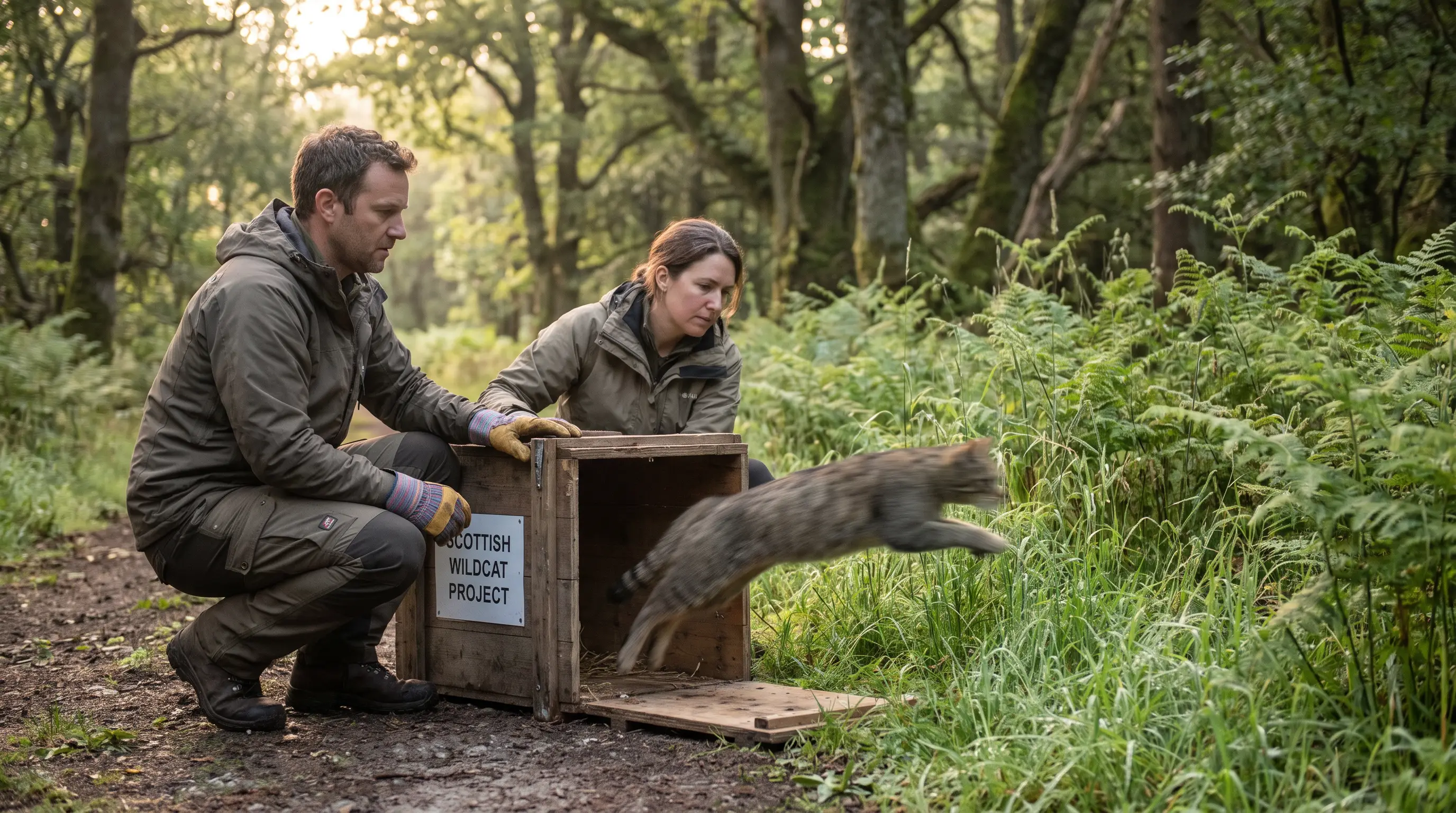
The response to the 2019 verdict was to stop treating the wild population as self-sustaining and start putting cats back into it. Saving Wildcats is led by the Royal Zoological Society of Scotland with NatureScot, Forestry and Land Scotland, the Cairngorms National Park Authority, Nordens Ark, the Junta de Andalucía, Cairngorms Connect, Cats Protection and the Game & Wildlife Conservation Trust, funded by the EU LIFE Programme and the Scottish Government’s Nature Restoration Fund among others. It built the UK’s first conservation-breeding-for-release centre at RZSS Highland Wildlife Park, with the stated aim of preventing “the extinction of wildcats in Scotland by breeding and releasing them into the wild” at a target of 20 cats a year. The centre produced 13 kittens in 2023 and 16 in 2024.
NatureScot approved the translocation licence in March 2023 and the first cats went out that mid-June, into undisclosed sites in the Cairngorms Connect area of the Cairngorms National Park, all fitted with GPS-radio collars. It was Britain’s first conservation translocation of wildcats. Nineteen went out in 2023, nine in 2024 and eighteen in 2025, so 46 cats in three seasons. Where they go matters as much as how many, because a wildcat needs a particular kind of wooded ground to hunt and den in.
The first cohort’s results are mixed, and RZSS has published them that way. One female died five weeks after release, of peritonitis; every other cat survived the first ten months. Two males have not been located since April 2024 and are thought to have dispersed out of the monitored area, leaving 16 tracked regularly a year on. Post-release health checks turned up very few signs of injury or disease and an average bodyweight gain of 20%, which is what a cat feeding itself well looks like. Trail cameras recorded the first wild-born kittens in late May 2024, with two females raising young to at least four weeks, and RZSS reports wild-living females producing litters in spring and summer of both 2024 and 2025.
How many Scottish wildcats are left
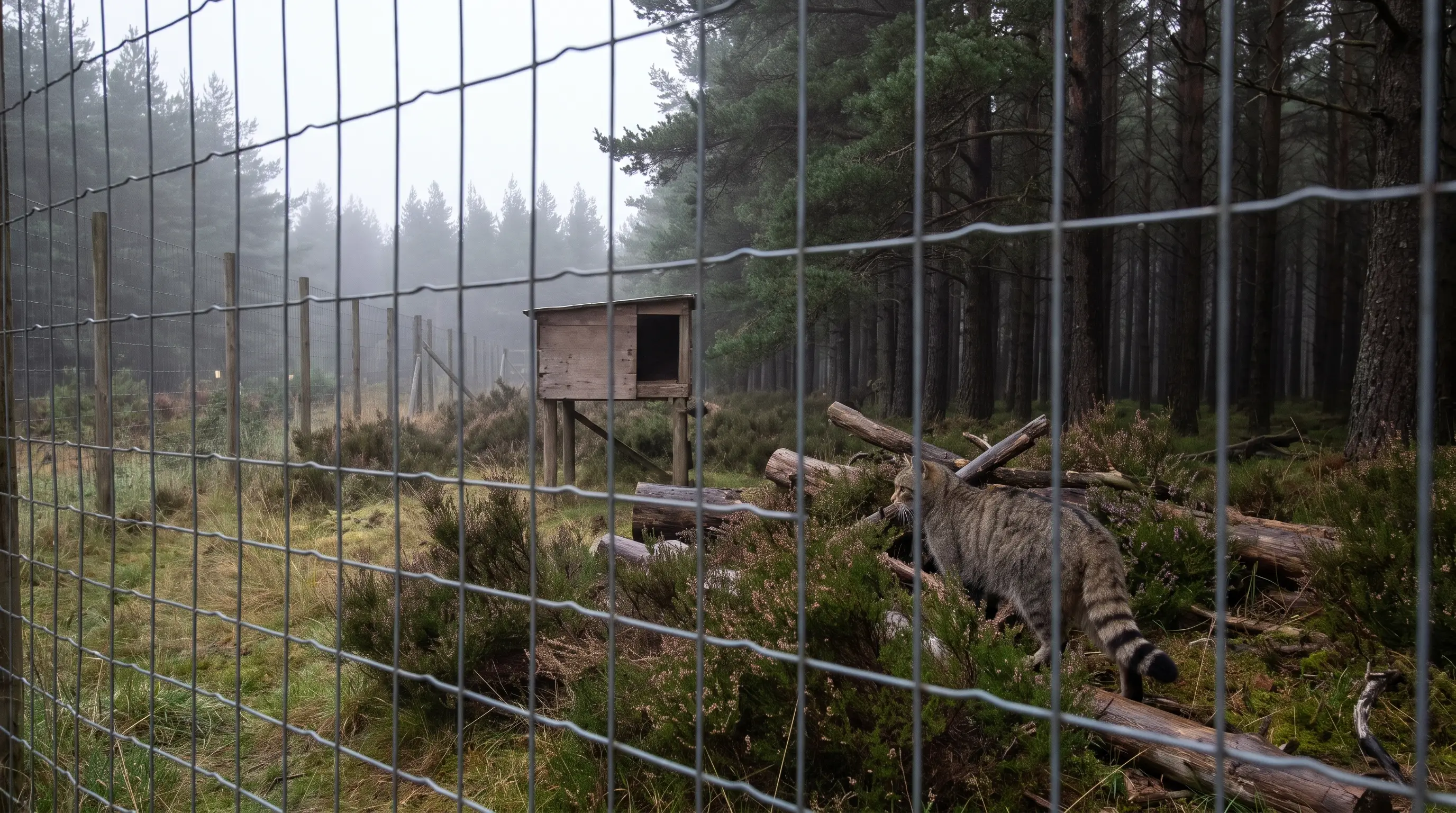
Nobody can give you a defensible number, and the reason is the reason the population collapsed. What is documented is the 46 released cats and the confirmed wild-born litters. Around them lives an uncounted free-living population strung along the domestic-to-wildcat continuum, and there is no post-release census because you cannot count animals you cannot reliably identify in the field. Genetic sampling is the only honest test, and it is slow, expensive and patchy.
Older estimates still circulate as though they were current, and they are not. Macdonald and colleagues extrapolated about 400 cats from museum skins in 2004; Kilshaw’s camera-trap work put the figure at 115 to 314 in 2015; Mathews and colleagues gave 200 in 2018 with a 95% confidence interval of 30 to 430, flagged as low reliability and declining. Roughly 80 Scottish wildcats were held in captivity as of 2016. Every one of those predates the finding that no viable wild population existed, so repeating any of them as today’s count is a category error. The 2019 review is blunt about one widely quoted third-party estimate, saying “the methodology used for this estimate remains unclear” and “there is no confirmed evidence for this statement.”
One last thing, because people search for it: “Scottish wildcat hybrid for sale” is a live query. Trading cats advertised as wildcat crosses profits from the animal’s scarcity while feeding the exact process that caused it, and the wildcat’s protected status in the UK makes the legal footing bad as well. If the appeal is a cat that looks wild, the Bengal and the Savannah are established breeds with documented lines, and there are plenty of others in the cat breed index. A wildcat is not a shy rescue cat that comes round with patience. It is a wild predator, and the rest of our wild-animal writing treats it as one.
Common questions
Is the Scottish wildcat extinct?
No. Wildcats live free in Scotland, including 46 cats released since 2023 and their wild-born kittens. The 2019 IUCN Cat Specialist Group review concluded the original population was “no longer viable” as a stand-alone population, which is a different claim from extinction, and the widely repeated phrase “functionally extinct” does not appear in that report at all.
How many Scottish wildcats are left?
There is no published post-release census, so any single figure you see is either out of date or unsourced. What is documented: 46 cats released since 2023, plus confirmed wild-born litters in 2024 and 2025, on top of an uncounted free-living population carrying mixed ancestry. A population you cannot identify without a genetic test is a population you cannot count.
Why are Scottish wildcats endangered?
Interbreeding with domestic and feral cats, on top of long-running habitat loss and persecution. Howard-McCombe and colleagues showed in 2023 that although domestic cats have been in Britain for over 2,000 years, hybridisation only took hold within the last 70, with Scottish wildcats passing 5% domestic ancestry after 1956.
Are Scottish wildcats related to domestic cats?
Yes, but not by descent. The house cat comes from Felis lybica, the African wildcat, while the Scottish animals belong to Felis silvestris, the European wildcat. The two species diverged long before domestication and can still interbreed, which is precisely the conservation problem in Scotland.
Is the Scottish wildcat a subspecies?
Not under current classification. It was named Felis grampia in 1907 and later treated as Felis silvestris grampia, but the 2017 revision by Kitchener and colleagues considered grampia “doubtfully distinct” and did not retain it. It is now treated as a subpopulation of the European wildcat.
Can you own a Scottish wildcat?
No. It is a protected wild species in the UK, and the captive animals are conservation breeding stock held by zoos, not pets. Cats advertised as Scottish wildcat hybrids are domestic cats, and buying them works against the species rather than for it.
See also
More in Wild
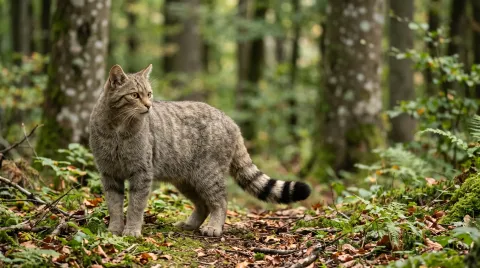
European wildcat: the cat Europe cannot count
Felis silvestris was only assessed as a species in its own right in 2022, and its official population trend is one word: unknown.
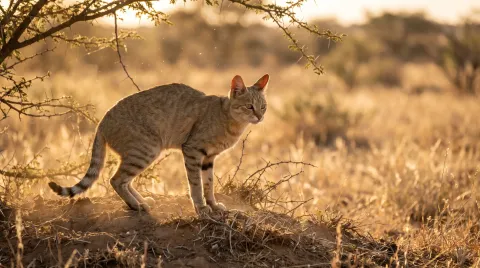
African wildcat: the real ancestor of your cat
Your cat descends from Felis lybica, a North African animal most people cannot name. In November 2025 the standard account of how it reached Europe broke.
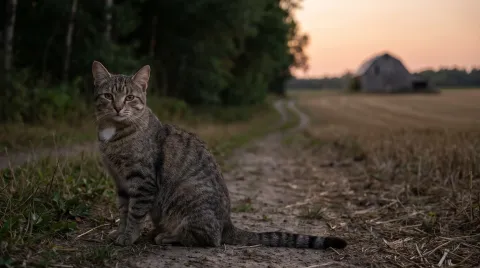
Wildcat hybridisation: how a species gets absorbed
Even a low crossbreeding rate assimilates a wildcat population past halfway inside a century. Why "only a few hybrids" is not the reassurance it sounds like.
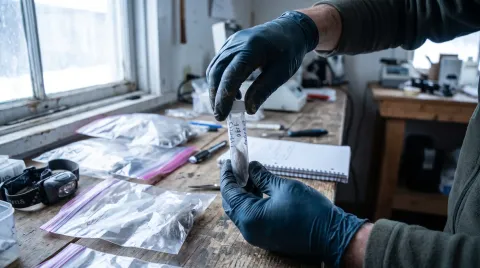
European wildcat vs domestic cat: how to tell
You cannot do it by eye. On the same cats, coat scoring rated 0.854 and the genome 0.984, and the strict visual cut-off loses real wildcats.
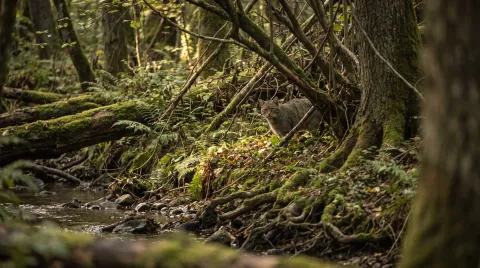
The forest a European wildcat actually needs
Woodland to shelter and den in, open edge to hunt over, and corridors between the two. What the radio-tracking and genetics really show.
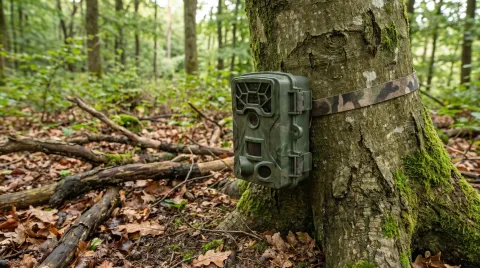
Wildcat conservation: law, cameras and cryptic extinction
How you save a species you cannot count: the law, the genetics labs, and the honest gap between what works and what is only worth trying.