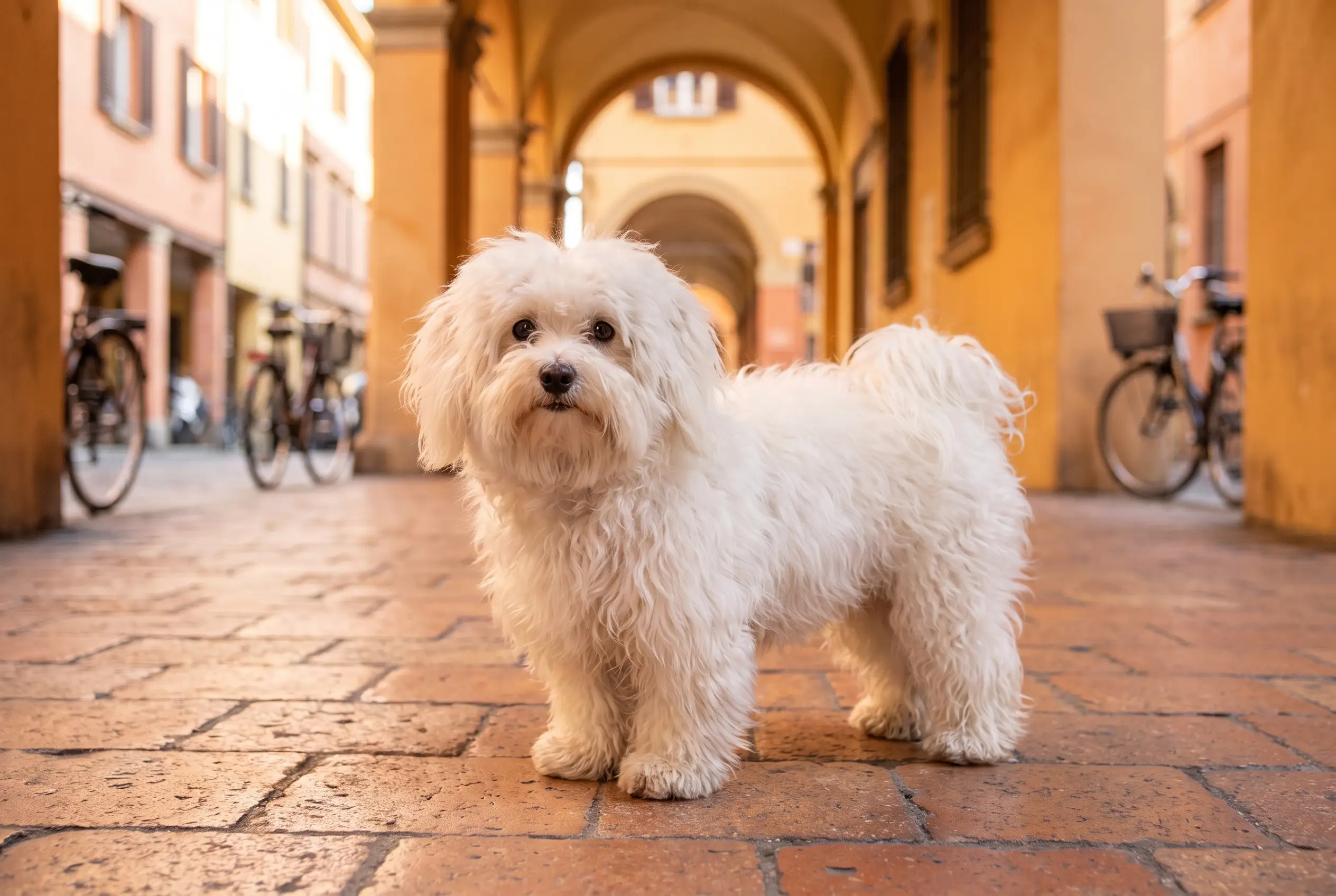
Bolognese
A calm white companion from Bologna, painted by Titian and happiest at your side.
On these lists: Dogs for seniors
Vital stats
| Size | Small · 25–30 cm |
| Weight | 2.5–4 kg |
| Life expectancy | 12–14 years |
| Energy | Low — short walks and indoor play |
| Shedding | Very low — single coat that mats without brushing |
| Coat | Pure white · long, single, cottony flocks |
| Group | Toy · Companion (FCI №196) |
| Origin | Bologna, Italy |
| FCI group | 9 — Companion and Toy Dogs · FCI 196 |
Breed traits
Friendliness
Care
Mind
The Bolognese by the numbers
The Bolognese facts owners search for most — price, lifespan, weight, shedding and colours, in one place.
Less common, so expect a waitlist and some travel to a reputable breeder — which pushes the price up. Ongoing costs stay modest — it eats little and routine vet care sits at the lower end. Its coat also needs a professional groom every few weeks — a real line in the budget.
We don't quote a single figure: the real price swings with breeder, region, bloodline and health testing — and a rescue costs a fraction of a breeder's litter. Adopting is almost always the cheapest route.
Temperament
For a toy breed the Bolognese is unusually calm and level-headed: it watches a room quietly, warms to strangers slowly and saves its real devotion for its own people. It's clever and reads mood well, which makes gentle training easy and harsh handling counterproductive. The one firm requirement is company — this is a dog bred over centuries to sit in a lap, and long hours alone don't suit it.
Habits & quirks
Room to room
It follows its person from kitchen to sofa to bathroom door, rarely more than a few steps behind.
Slow to greet
With strangers it hangs back and watches first, warming up in its own time rather than rushing in.
Low gear
A short walk and a little play are plenty; the rest of the day is happily spent dozing nearby.
Left alone
Long solo stretches are the hard part — boredom and pining show up as barking or clinginess.
Health
The Bolognese is a small, generally sturdy companion with no long list of breed-specific problems to screen for, so its health comes down to steady everyday care. The coat is the daily job — single and cottony, it sheds almost nothing but mats to the skin without a brush-through several times a week. Like most small breeds it does well with routine dental care, and its real need is not medical at all: this is a dog bred for company, and long stretches alone are what it genuinely doesn't cope with.
Nutrition
| Brushing | The single coat sheds little but mats easily; brush and comb through to the skin several times a week. |
| Company | Bred to be a companion, it does best in a home where someone is around most of the day. |
| Exercise | Short daily walks and indoor games cover it; this isn't a dog that needs a big run. |
| Trimming | Book a groomer every couple of months for a tidy-up and bath to keep the white coat clean and manageable. |
A Bolognese is small and low-energy, so it doesn't take much food to keep one going — which is exactly why the portions need watching. Weigh a small-breed meal rather than filling the bowl by eye, count any treats used in training into the day, and keep it trim; a couple of extra biscuits go a long way on a dog this small. That's about it: no special demands here beyond not letting a calm little companion quietly gain weight.
Puppy guide
A Bolognese puppy bonds hard and fast, and the kindest thing you can do early is teach it that being alone for a while is normal and safe — this is the breed's one real weak spot, and it's far easier to prevent than to fix. Start gentle, reward-based training from the start; it's clever and reads your mood, so it learns quickly and takes harsh handling badly. Get it used to being brushed and handled as a puppy, well before the adult coat comes in, and socialise it calmly so a naturally reserved dog grows up confident rather than clingy.
Training
The Bolognese is intelligent and genuinely wants to please, which makes gentle, reward-based training easy — keep the sessions short, kind and positive and it picks things up well. It can be a little sensitive and a little stubborn, so firmness backfires where patience works; ask, reward, and don't make a battle of it. House-training is the usual small-breed test of consistency, and the one lesson worth real effort is teaching it to settle happily alone for reasonable stretches.
Life expectancy
Bolognese live 12–14 years. The Bolognese is a long-lived little companion, and keeping one at the top of its range is mostly a matter of the basics done well: a trim weight, teeth and coat looked after, regular gentle exercise, and the company it was bred for. A Bolognese that isn't left alone too long and isn't allowed to get heavy tends to stay well for many years.
Similar breeds
Breeds with a similar build and background — worth a look if this one isn't quite the fit.
Breeds that look like this
Common questions
Do Bolognese dogs shed?
Very little — they have a single, non-shedding coat, which is why many allergy sufferers tolerate them well. The trade-off is brushing: that coat mats quickly without regular grooming.
Are Bolognese good apartment dogs?
Yes. They're small, quiet and low-energy, and a couple of short walks a day suit them. The one condition is company — they don't cope well with long hours alone.
Are Bolognese easy to train?
They're intelligent and eager to please, and respond well to gentle, reward-based training. They can be sensitive and a little stubborn, so keep sessions short and kind rather than firm.
Is the Bolognese hypoallergenic?
No dog is truly hypoallergenic, but the Bolognese comes closer than most: its low-shedding coat releases less of the dander that triggers allergies. Many allergy sufferers manage well with this breed, but spend time around one before committing.
Is the Bolognese good with children?
Generally yes. The Bolognese is a friendly, people-loving breed that usually does well with children when raised and socialised well. As with any dog, teach children to be gentle and supervise around toddlers.