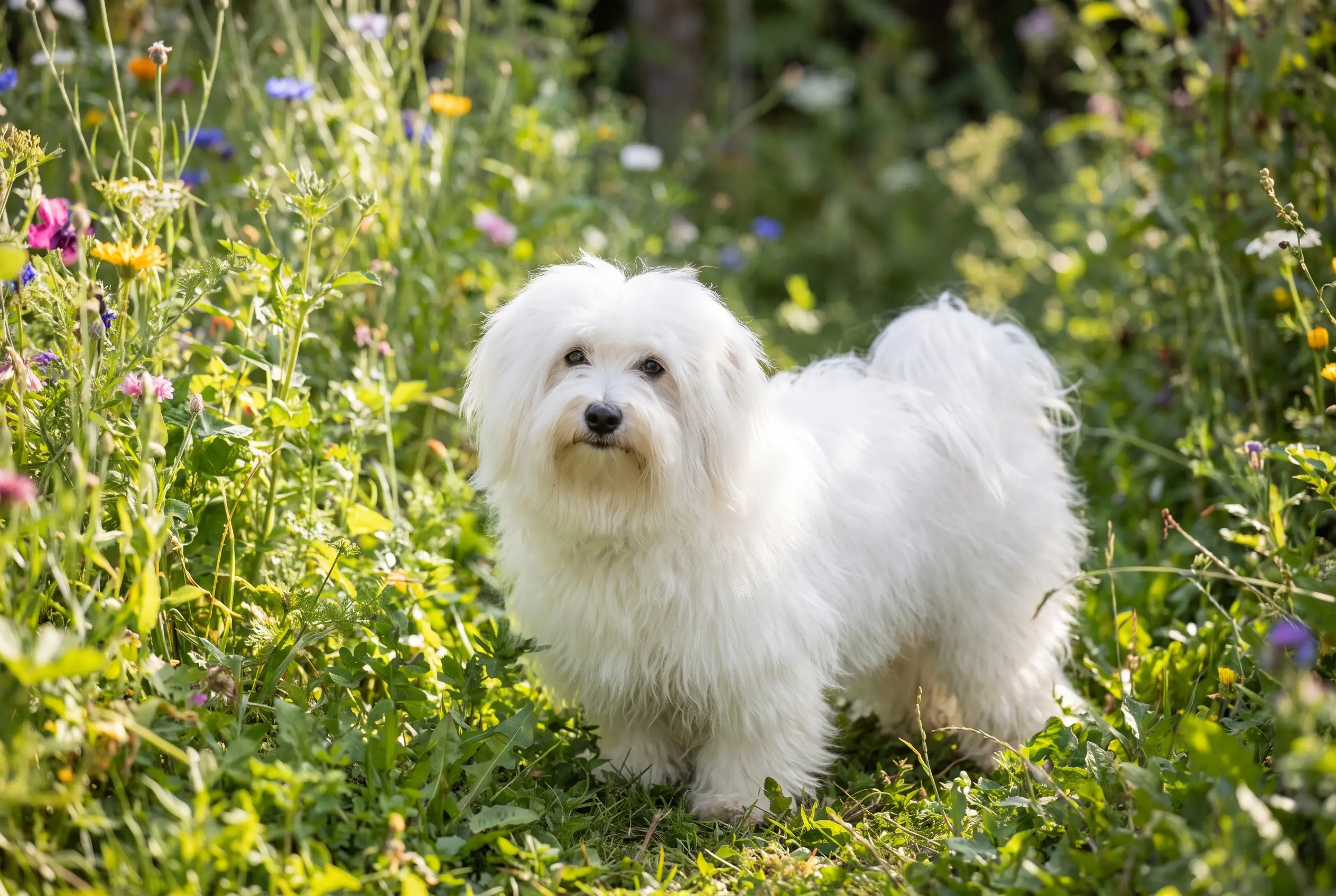
Coton de Tulear
A cloud of cotton with a comedian's timing.
On these lists: Dogs for apartments · Dogs for first-time owners · Dogs for seniors · Dogs for anxiety
Vital stats
| Size | Toy · 22–28 cm |
| Weight | 3.5–6 kg |
| Life expectancy | 14–17 years |
| Energy | Moderate — 30–45 min/day |
| Shedding | Minimal |
| Coat | Long, cotton-textured single coat · white |
| Group | Non-sporting · FCI №283 / AKC |
| Origin | Tuléar, Madagascar |
| FCI group | 9 — Companion and Toy Dogs · FCI 283 |
Breed traits
Friendliness
Care
Mind
The Coton de Tulear by the numbers
The Coton de Tulear facts owners search for most — price, lifespan, weight, shedding and colours, in one place.
Widely bred, so you can usually find a litter from a registered breeder without a long wait. Ongoing costs stay modest — it eats little and routine vet care sits at the lower end. Its coat also needs a professional groom every few weeks — a real line in the budget.
We don't quote a single figure: the real price swings with breeder, region, bloodline and health testing — and a rescue costs a fraction of a breeder's litter. Adopting is almost always the cheapest route.
Temperament
Companion to Madagascar's port town of Tuléar for centuries, the Coton was bred for exactly one job — delighting people — and it approaches that job like a professional. Expect a bright, adaptable clown that invents games, walks on its hind legs for applause, greets every guest as a fan, and quietly falls apart if left alone too long.
Habits & quirks
The two-legged strut
Many Cotons walk and hop on their hind legs when excited — a signature party trick, entirely self-taught.
The audience check
Mid-game, it glances back to make sure you're watching; comedy needs witnesses.
Happy chatter
Cotons grumble, chirp and 'talk' along with conversation without proper barking.
Beach genes
Descended from port-town dogs, many retain an un-toylike enthusiasm for sand and shallow water.
Health
The Coton is a small companion breed with a well-earned reputation for living a long time, and there is no dramatic inherited illness to manage — which makes the everyday things the real health work. Keep it lean, because a few hundred grams matter on a dog of four or five kilos. Look after the teeth the way you would on any small breed, since crowded little mouths are prone to dental trouble; get a puppy used to having them brushed. Keep the cottony coat brushed right down to the skin so mats never get the chance to pull at the skin underneath. And take the breed's need for company seriously: a Coton left alone too much is not just unhappy, it is a welfare problem, so choose a breeder who raises them well and plan a life with people in it.
Nutrition
| Grooming | Brush the cottony coat to the skin three to four times a week — it mats fast, especially during the puppy coat change. |
| Company | This breed is people-dependent; long empty days lead to misery and noise, so plan for togetherness. |
| Exercise | Two or three cheerful walks plus play cover it — the Coton adapts to your pace remarkably well. |
| Training | Quick, willing and sensitive; keep sessions upbeat and this dog will learn nearly anything for a laugh. |
A Coton is a small dog with a small stomach, so accuracy matters more than quantity — measure the meals, keep treats sensible, and you will feel ribs under all that coat. Extra weight is easy to hide under a cotton coat and hard on a little frame, so go by feel, not by the pleading. Feed a food built for small breeds and small mouths, split across the day if the dog does better on two meals, and keep fresh water always in reach. Nothing about feeding this breed is complicated once you are honest about portions.
Puppy guide
A Coton puppy comes with two jobs for you, and both start on day one. The first is the coat: the puppy coat mats fast, especially as it changes, so brush right down to the skin several times a week and make it a game the pup enjoys rather than a fight. The second is company — build up time alone slowly and deliberately now, while it is easy, because this is a people-dependent breed that can slide into real separation anxiety if it never learns that being left is survivable. Socialise widely, keep early training upbeat, and let the clown in the puppy come out.
Training
Training a Coton is mostly a matter of keeping it fun. This is a quick, willing, sensitive little dog that was bred for one job — delighting people — and it will learn almost anything if there is a laugh or a treat in it. Keep sessions short and upbeat, skip anything heavy-handed, since a sensitive dog shuts down under it, and lean into the showman: many Cotons will happily learn to walk on their hind legs or run a whole routine for an audience. The one lesson worth real effort is calm time alone, taught gently and early, so the sociable brain never tips into anxiety.
Life expectancy
Cotons de Tuléar live 14–17 years. The Coton is one of the longer-lived breeds you can own, and the care that gets it there is refreshingly plain: a lean weight on that little frame, teeth kept clean, a coat kept free of mats, and — just as important for this breed — enough company that it never lives in the low-grade stress of being alone too much. Look after those, and a Coton keeps its comic energy well into old age.
Similar breeds
Breeds with a similar build and background — worth a look if this one isn't quite the fit.
Breeds that look like this
Common questions
Do Cotons de Tuléar shed?
Barely — the single coat drops very little hair, which is why the breed suits many allergy-aware homes. The trade-off is mat-prone cotton that needs brushing several times a week.
Can a Coton be left alone during the workday?
Not happily — this is a companion breed that needs its people and can develop separation anxiety. Build up alone-time gradually and arrange midday company if you work long hours.
Are Cotons de Tuléar yappy?
Less than most small breeds — they'll announce visitors and chatter happily, but constant barking isn't typical. Enough company and stimulation keeps them quiet.
Is the Coton de Tulear hypoallergenic?
No dog is truly hypoallergenic, but the Coton de Tulear comes closer than most: its low-shedding coat releases less of the dander that triggers allergies. Many allergy sufferers manage well with this breed, but spend time around one before committing.
Is the Coton de Tulear good with children?
Generally yes. The Coton de Tulear is a friendly, people-loving breed that usually does well with children when raised and socialised well. As with any dog, teach children to be gentle and supervise around toddlers.
Is the Coton de Tulear easy to train?
Yes. The Coton de Tulear is one of the more trainable breeds — quick to learn and keen to work with you, which makes reward-based training straightforward. Start early, keep it positive, and it picks things up fast.