Do dogs dream? What the twitching and paddling mean
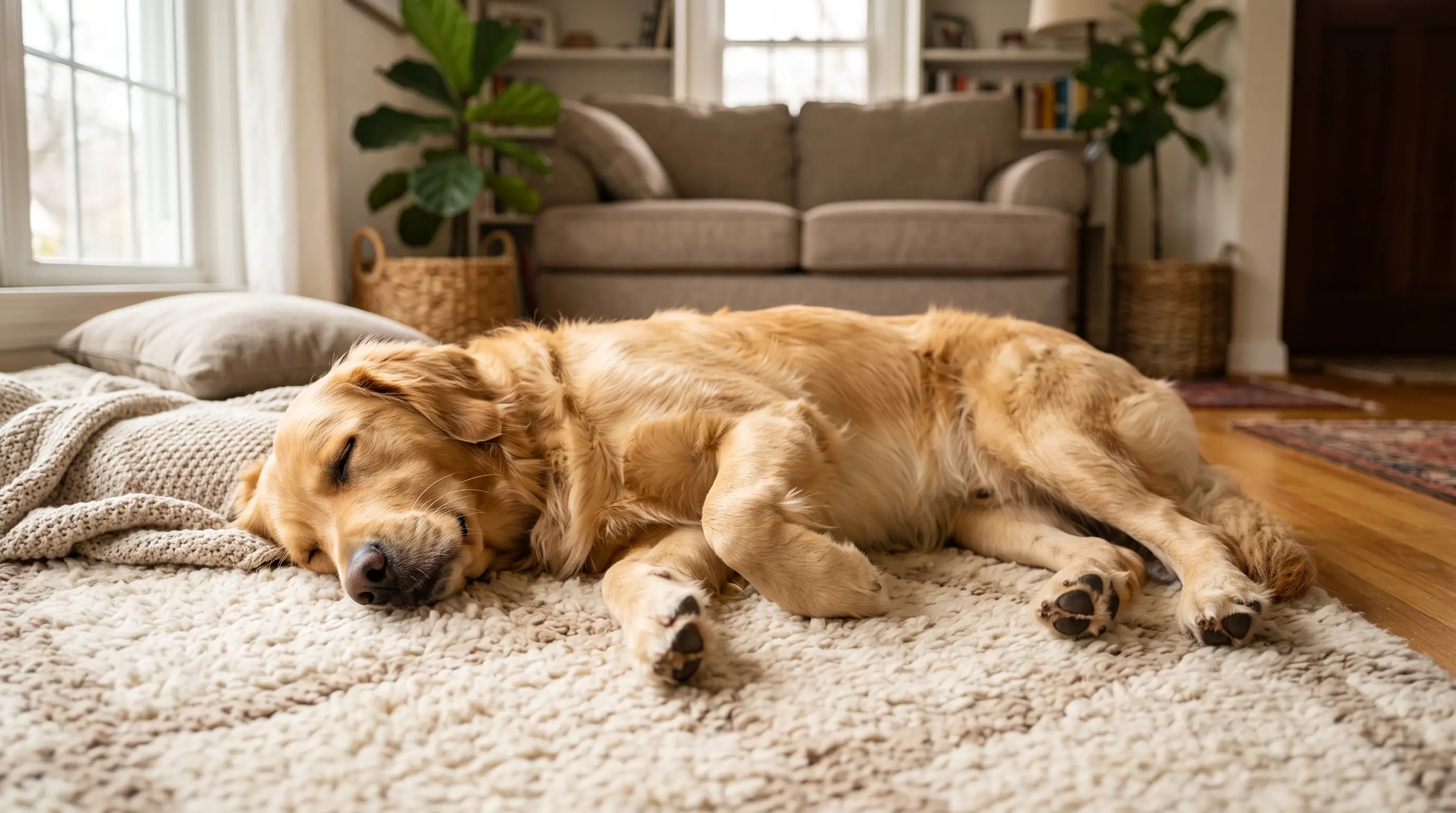
Your dog is asleep on the rug, paws paddling, a muffled woof escaping every few seconds. Yes, they are dreaming — and we know it from an experiment that had nothing to do with dogs. What follows is what is actually happening in that head, what the twitching means, and the one pattern that is worth a vet visit rather than a photograph.
Yes, dogs dream — and a cat experiment proved it
Dogs have the same sleep architecture people do, including REM, the stage where dreaming happens. That much has been clear from EEG recordings for decades. The interesting part is how we know they dream about something rather than simply cycling through a stage.
In the late 1950s and 1960s the French neuroscientist Michel Jouvet worked out that a small region of the brainstem, the pons, paralyses the body during REM — a safety catch that stops you acting out whatever your brain is doing. Jouvet then disabled that region in cats. The cats stayed asleep, but they got up. They stalked invisible prey, arched their backs, pounced at nothing on the floor. Their brains were running cat software, and with the safety catch off, their bodies performed it.
That is the strongest evidence we have that a sleeping animal is not just idling. It is doing something, and what it does is species-typical. A dog with the catch off would not stalk. It would probably chase, dig, greet and sniff.
So the twitching is the dream leaking out
The paddling paws, the whisker flickers, the muffled woofs — that is the safety catch not quite holding. The paralysis is close to total but imperfect, and the small muscles at the ends of the body are the ones that leak: paws, whiskers, eyelids, the tip of the tail. What you are watching is a version of the real behaviour with the volume turned almost all the way down.
Which is why the leaks are worth a moment of attention. A dog that spent the afternoon chasing a ball tends to paddle. A dog that met a new person tends to make greeting noises. It is not proof, but the shapes line up, and there is a real mechanism underneath: a 2017 study at Eötvös Loránd University in Budapest recorded dogs’ sleep EEG after a training session and found their sleep patterns changed — and that they performed better on the same task after sleeping. Dogs consolidate what they learned while they sleep, the way we do.
So the paddling is not random noise. It is, at least sometimes, the day being filed.
Puppies twitch most, and so do the very old
If you have ever wondered why a puppy sleeps like a faulty machine, this is it: the brainstem mechanism that holds the body still during REM is not fully developed yet, so far more of the dream gets through. Very old dogs twitch more for the opposite reason — the same mechanism works less well than it used to. The dogs in the middle of life are the quiet sleepers.
A few other things that surprise people. Dogs sleep twelve to fourteen hours a day, but almost never in one block; their sleep is fragmented into naps, which is why they can be flat out and then fully operational at the sound of a fridge door. They also reach REM far quicker than we do — a human takes over an hour to get there, a dog can be dreaming within twenty minutes, which is why a ten-minute nap on your foot can contain a whole chase.
The psychologist Stanley Coren has reported a size pattern worth knowing about: small dogs appear to dream more often but in shorter bursts, while large dogs dream less frequently and for longer. A Border Collie may run a long film; a Chihuahua flicks through several short ones.
Do dogs have nightmares — and should you wake them?
Almost certainly yes, and almost always no. If dogs dream about their days, some of those dreams will involve the things that frighten them, and a dog can whimper, growl or startle in its sleep. It passes in seconds.
The old advice to let sleeping dogs lie is mechanically sound. A dog woken abruptly out of REM is disoriented for a moment and does not know where it is or who is touching it, and that is the moment a startled dog snaps — even a gentle one, even yours, even a soft Labrador Retriever who has never once put teeth on anybody. If you must interrupt, use your voice from a short distance and let them surface on their own. Do not shake a dreaming dog awake.
There is one exception, and it is the reason this article has a serious paragraph in it.
The one pattern that is not a dream
A dream and a focal seizure can look alike for the first second and then stop looking alike. It is worth knowing the difference before you are standing over your dog at two in the morning deciding whether to film it or phone someone.
A dream is loose and intermittent. The paddling comes in bursts with gaps between them, the body stays floppy, the breathing stays roughly normal, and your dog can be roused by their name — they will lift their head, look mildly annoyed, and go back to sleep.
A seizure is rigid and relentless. The limbs go stiff rather than loose, the paddling is rhythmic and does not pause, the dog does not respond to their name or to touch, and there is often drooling, or urination, or a jaw that chomps. Afterwards they are disoriented for minutes rather than seconds — pacing, bumping into things, apparently blind.
If what you are watching matches the second description, film it if you can and call your vet. A phone video of thirty seconds is worth more to a vet than any description you will manage over the phone. If it matches the first, put the phone down and let them finish the chase.
Common questions
Do dogs dream?
Yes. Dogs have REM sleep, the stage in which dreaming happens, and EEG recordings confirm their sleep cycles closely resemble ours. Experiments on cats in the 1960s, where the brainstem region that paralyses the body during REM was disabled, showed the animals acting out species-typical behaviour in their sleep — the clearest evidence that a dreaming animal is doing something, not just idling.
Why do dogs twitch in their sleep?
Because the paralysis that normally holds the body still during REM sleep is not perfect, and small movements leak through. It shows up in the extremities first — paws, whiskers, eyelids, tail tip — which is why a dreaming dog paddles rather than runs.
Do dogs have nightmares?
Very likely. Dogs appear to dream about their own days, so unpleasant experiences can turn up in sleep, and a dog may whimper, growl or startle. It usually passes within seconds and needs no intervention.
Should I wake my dog from a bad dream?
Generally no. A dog woken abruptly out of REM is briefly disoriented and may snap before it knows where it is. If you have to interrupt, say their name from a short distance and let them wake on their own rather than touching them.
Why do puppies twitch more than adult dogs?
The brainstem mechanism that suppresses movement during REM sleep is not fully mature in puppies, so much more of the dream reaches the muscles. Very old dogs twitch more for the opposite reason — that same mechanism becomes less effective with age.
How can I tell if my dog is dreaming or having a seizure?
A dreaming dog is floppy and intermittent and can be roused by their name. A seizing dog is stiff and rhythmic, does not respond to voice or touch, may drool or urinate, and is disoriented for minutes afterwards. If it looks like the second, film it and call your vet.
More in Dogs
Do dogs love their owners? What the science measured
Yes — and unusually for a question about feelings, we have the receipts: oxytocin loops, attachment tests and brain scans. What dog love is made of, and what it looks like from the sofa.
Why do dogs eat grass? The myth, the data, the real risks
It's rarely self-medication and almost never a missing nutrient — the biggest survey ever run on grass-eating dogs retired both stories. What's actually going on, and when to pay attention.
Dog zoomies: why dogs suddenly sprint like maniacs
The tucked tail, the mad loops, the gleeful eyes — zoomies have a scientific name, a set of reliable triggers, and exactly one thing you shouldn't do about them.
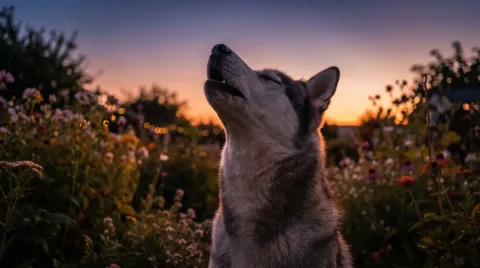
Why do dogs howl? Sirens, solitude and the wolf inside
The howl is long-distance radio inherited from wolves — and no, the siren isn't hurting your dog's ears. What each howl broadcasts, and the one kind that's a message for you.
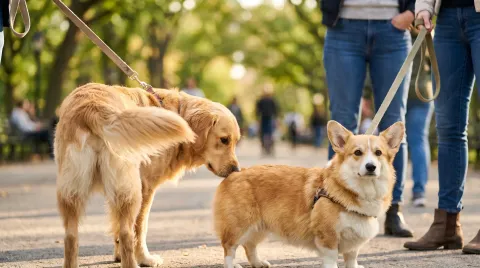
Why do dogs sniff each other's butts? The chemical handshake
It's not rude — it's the most information-dense greeting in the animal kingdom. What's actually in the message, the equipment that reads it, and the etiquette your dog is following.
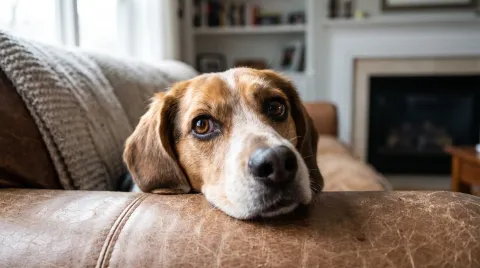
Why does my dog stare at me? Every stare, decoded
Affection, forecasting, negotiation, security detail — a dog's stare is never empty. What each one means, including the famous bathroom vigil, and the one stare to take seriously.