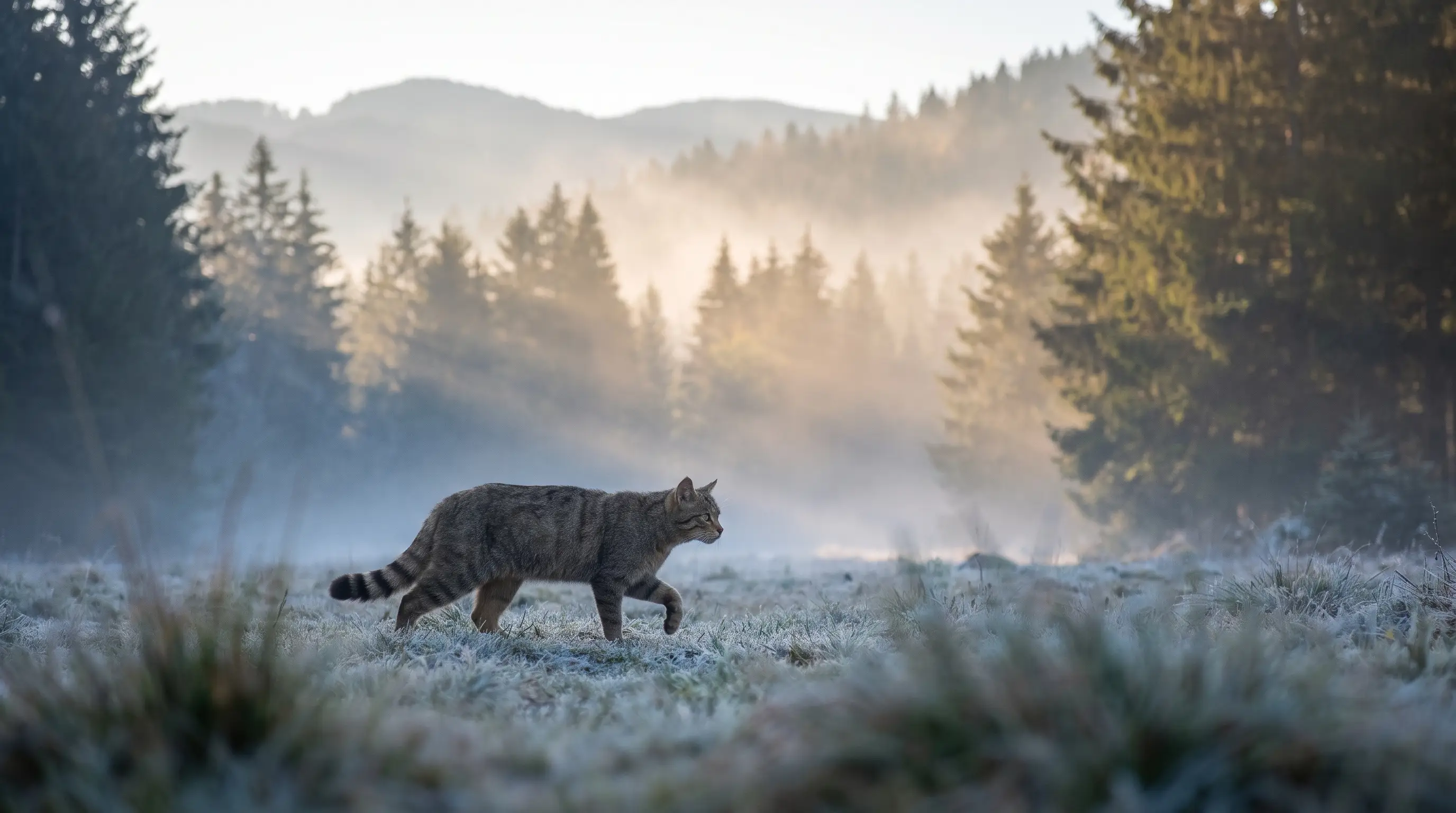
Where do wildcats live? The two-species map
The wildcat is not one animal, and it does not live in one place. Since the 2017 revision by the IUCN/SSC Cat Classification Task Force, the name covers two species: the European wildcat (Felis silvestris), which lives in Europe, Anatolia and the Caucasus, and the African and Asiatic wildcat (Felis lybica), which ranges across Africa and Asia and is the ancestor of every domestic cat. In the United States, confusingly, "wildcat" usually means neither of those. It means the bobcat, and no Felis wildcat lives anywhere in the Americas.
What people actually mean by "wildcat"
The word does several jobs at once, which is why the map is confusing before you start. "Wildcat" is an aircraft, a college mascot, and, across most of the United States, the everyday name for the bobcat (Lynx rufus). The bobcat is a real wild cat, but it sits in a different genus, and it is not the animal biologists mean when they write about Felis wildcats. There is no Felis wildcat native to North or South America at all.
A wildcat is also not a stray. A feral cat is a domestic cat gone wild, born from Felis catus and living without an owner. A wildcat has never been domesticated. The two can look alike at a glance and can even interbreed, which is a large part of why counting wildcats is hard, but they are separate things. If you have found a cat in your garden, it is almost certainly a feral cat rather than a wildcat, wherever you live.
Two species, redrawn in 2017
For a long time the wildcat was treated as a single species with many subspecies scattered across three continents. Kitchener et al. 2017, the classification produced by the IUCN/SSC Cat Classification Task Force in Cat News Special Issue 11, cleaned that up. It recognised 41 cat species and 77 subspecies in total, and it split the old Felis silvestris in two.
Felis silvestris now means only the forest wildcats of Europe, Anatolia and the Caucasus. Felis lybica means the bush and steppe wildcats of Africa and Asia, and it carries an extra title: it is the sole ancestor of the domestic cat. Your domestic shorthair is Felis catus, the domestic form of Felis lybica, so the cat asleep on your sofa is a lightly tamed African wildcat by descent. Telling a true wildcat from a hybrid is a job for genetics rather than fur pattern, which is why the 2017 map is drawn from DNA as much as from museum skins.
Where the European wildcat lives
Felis silvestris lives across Europe and east into adjoining Russia, the Caucasus and Anatolia. The revision proposes two subspecies, and both should be read as provisional. F. s. silvestris covers Europe, including Scotland and Sicily; F. s. caucasica covers the Caucasus and Anatolia, and it is a proposed rather than settled unit. Formerly the wildcat was found across most of Europe and it is absent only from Fennoscandia.
The IUCN assessment groups the surviving cats into five metapopulations: Western and Central Europe; the Apennine peninsula and Sicily, where the population is expanding; Eastern-Central and South-eastern Europe, roughly twenty countries that remain badly under-studied; the Iberian peninsula, which is declining and fragmented; and Turkey with the Caucasus. The Italian wildcat sits in that expanding Apennine group, and the Scottish wildcat in the Western European one. All of them need the same thing, which is connected woodland with cover and prey, and most of the work to keep them is law, land and captive breeding.
Crete is the awkward island. The IUCN's own pages disagree with each other about which species its cats belong to. The usual reading is that Crete's wildcats are Felis lybica lybica, an ancient human introduction rather than a native European population, but that assignment is disputed and worth stating as unsettled rather than fact.
Where the African and Asiatic wildcat lives
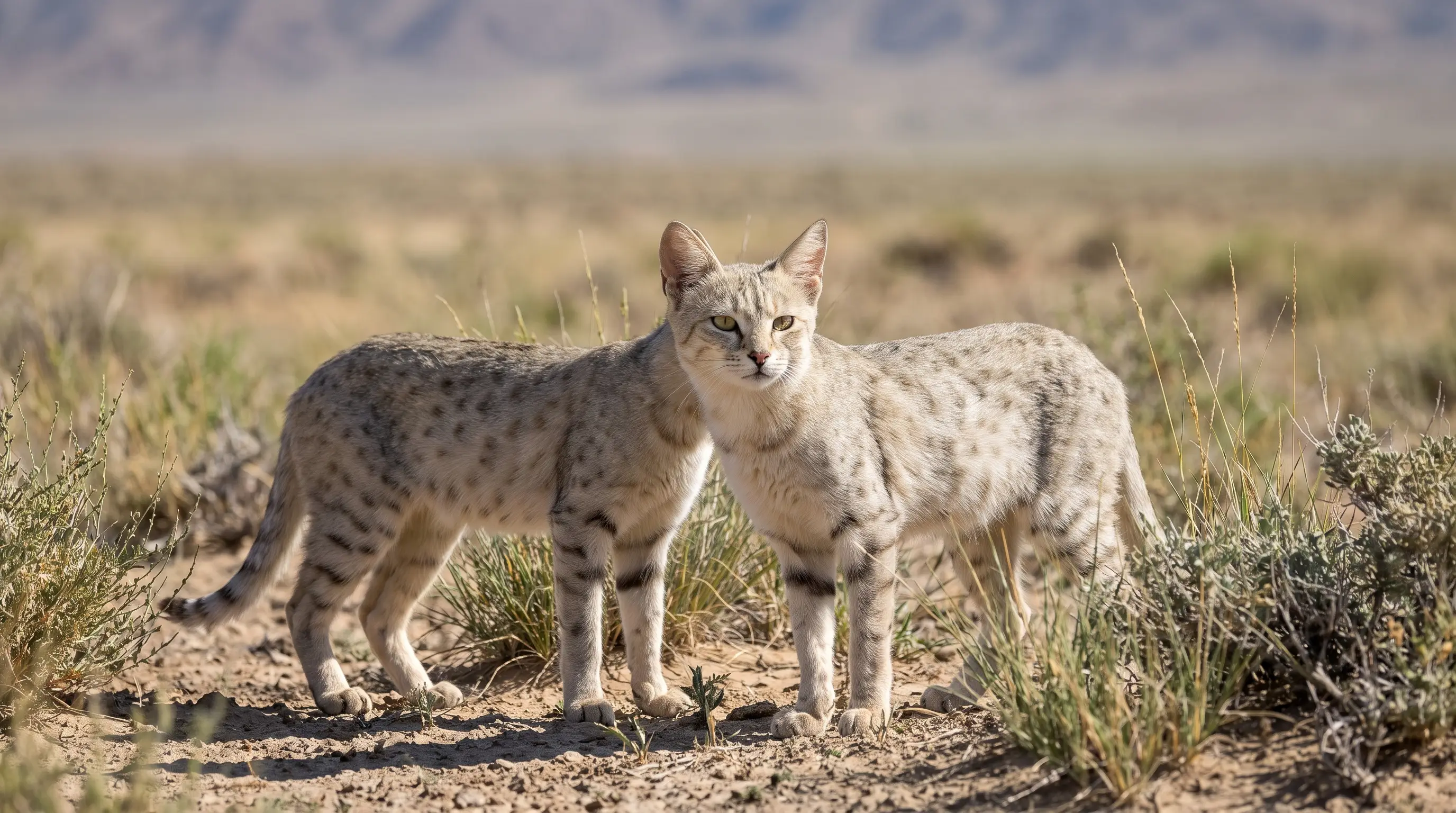
Felis lybica is the most widely distributed wild cat on Earth. It lives across most of Africa outside the Sahara core and the central rainforest belt, and on through the Arabian peninsula, Iran, Afghanistan, Pakistan and India into China and Mongolia. It is absent only from closed tropical rainforest, thin on the ground in true desert, and it climbs to about 3,000 metres. The IUCN calls it one of the most common felid species, though its population trend is recorded as unknown.
The revision tentatively recognises three subspecies. F. l. lybica covers East, West and North Africa, the Arabian peninsula and the Middle East, plus the islands of Corsica, Sardinia and Crete, and it grades into the Asiatic form around western Iran. F. l. cafra covers southern Africa, with a soft boundary somewhere around Mozambique or Tanzania. F. l. ornata, the Asiatic wildcat pictured here, covers south-west and Central Asia, Afghanistan, Pakistan, India, Mongolia and China, and it wears more prominent dark spots and stripes than its African cousins. Because Felis lybica is your cat's wild ancestor, breeds shaped in this range keep a wild look. The Egyptian Mau carries the spotting, and the ticked coat of the Abyssinian reads as pure bush cat. If you want the whole family of small hunters this one belongs to, we have a field guide to eight small wild cats. The reflective eyeshine that lets all of them hunt at dawn is the same trick your cat uses, and there's a piece on why cats' eyes glow.
The fuzzy boundary, and two names that didn't survive
The line between the two species is not a line. It is a fuzzy zone running through Iran, Turkey and the Caucasus, where Felis silvestris, F. l. lybica and F. l. ornata all approach each other. Recent genetics point to Iran as the place where lybica gives way to ornata, and the two species probably overlap in Anatolia and the Caucasus. The IUCN assessment openly asks for more genetic work there before anyone draws a firm border.
The 2017 revision also retired two names that field guides still print. Felis lybica sarda, the supposed Sardinian wildcat, is not a valid subspecies; the cats on Sardinia belong to F. l. lybica, which fits the pack on the Sardinian cat. Felis silvestris grampia, the supposed Scottish wildcat, is not valid either; Scottish cats belong to F. s. silvestris. So if you ask "is the Scottish wildcat its own subspecies?", the honest answer under the current map is no, even though the population is distinct enough to be worth saving. What makes Scotland's cats hard to define is the hybrid swarm that has blurred them with domestic cats.
The Chinese mountain cat, and why "European" might reach Tibet
The most unsettled part of the map is a cat that few people have seen. The Chinese mountain cat (Felis bieti) lives on the edge of the Qinghai-Tibet Plateau, and taxonomists cannot agree what it is. Kitchener et al. 2017 treated it as a full, separate species. A 2021 genomic study by Yu et al. in Science Advances, built on 51 nuclear genomes from 270 specimens, argued instead that it is a wildcat conspecific, F. s. bieti, meaning a subspecies of the European wildcat, and that it played no part in cat domestication in China.
The two big catalogues have not followed. Both the IUCN Red List and the Mammal Diversity Database still list Felis bieti as a full species. So the score sits at 2017 species, 2021 subspecies, and the standard references unmoved. It is best treated as an open question rather than a settled fact. The corollary is the fun part. If the 2021 reading is right and bieti really is a subspecies of Felis silvestris, then the honest answer to "where does the European wildcat live?" stretches from Scotland to the Tibetan plateau. For the rest of the small cats caught up in arguments like this, our guide to the small wild cats is the place to start.
The countries that lost their wildcats, and the few getting them back
Some of the map is written in absence. England and Wales lost their wildcats entirely, first to deforestation and then to nineteenth-century predator control, and by the second half of that century the species survived in Britain only in Scotland. That Scottish remnant is now best described not as extinct but as no longer a viable wild population, held back by the hybrid swarm rather than by a lack of individuals.
A few countries are quietly reversing the loss. The Netherlands had the wildcat down as regionally extinct, then watched it come back: a first record in 2002, the Vijlenerbos colonised in late 2013, and breeding cats in South Limburg now. Austria records the species as regionally extinct too, but with vagrants and Italian cats spreading north into it. The Czech Republic was called "possibly extinct" in 2015, and field records since suggest a tentative return, though that is reported rather than confirmed in the literature. Belgium, France, Germany, Slovakia, Switzerland and Scotland were all recolonised after the nineteenth-century collapse, over roughly the first half of the twentieth century. The pattern is the same everywhere it works, which is woodland allowed to grow back and persecution allowed to stop. If you want the wider picture of Europe's returning predators, the wild stories collection covers wolves as well as cats, and the conservation piece covers what actually brings a wildcat back.
Common questions
Where do wildcats live?
It depends which wildcat. The European wildcat (Felis silvestris) lives across Europe, Anatolia and the Caucasus; the African and Asiatic wildcat (Felis lybica) lives across most of Africa and Asia and is the most widely distributed wild cat on Earth. No Felis wildcat lives in the Americas.
Where do African wildcats live?
The African wildcat, Felis lybica, lives across most of Africa outside the Sahara core and the central rainforest, plus the Arabian peninsula and the Middle East. It is absent only from closed rainforest and thin in true desert, and it climbs to about 3,000 metres.
What are the types of wildcats?
Since the 2017 IUCN revision there are two species: Felis silvestris, the European wildcat, with the proposed subspecies silvestris and caucasica; and Felis lybica, the African and Asiatic wildcat, with three tentative subspecies, lybica, cafra and ornata. The Chinese mountain cat may be a third type or a subspecies of Felis silvestris, which is unresolved.
What's the difference between Scottish and European wildcats?
There is no species-level difference. Scottish wildcats are the same species as other European wildcats, Felis silvestris silvestris; the old subspecies name grampia is not valid under the 2017 revision. Scotland's population is distinct and endangered mainly because it has hybridised heavily with domestic cats.
What's the difference between a bobcat and a wildcat?
A bobcat (Lynx rufus) is a North American lynx, a different genus, recognisable by its short tail and ear tufts. A wildcat is a Felis species from Europe, Africa or Asia and looks far more like a large domestic tabby. In US usage "wildcat" often means the bobcat, but the two are not close relatives.
What wild cats live in North America?
North America has the bobcat, the Canada lynx, the puma and the jaguar in the south, plus the ocelot near the Mexican border. It has no Felis wildcat at all, so the European and African wildcats live nowhere in the Americas.
See also
More in Wild
European wildcat: the cat Europe cannot count
Felis silvestris was only assessed as a species in its own right in 2022, and its official population trend is one word: unknown.
Scottish wildcat: not extinct, not a subspecies
The most-quoted fact about the Scottish wildcat misstates its own source. What the 2019 IUCN review really said, and where the cats stand in 2026.
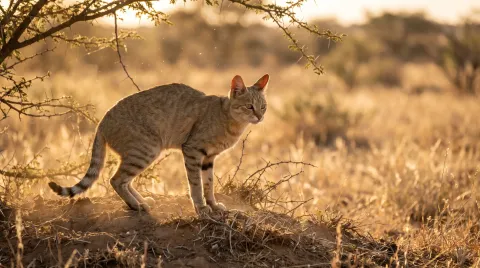
African wildcat: the real ancestor of your cat
Your cat descends from Felis lybica, a North African animal most people cannot name. In November 2025 the standard account of how it reached Europe broke.
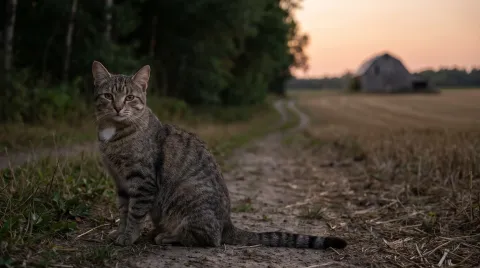
Wildcat hybridisation: how a species gets absorbed
Even a low crossbreeding rate assimilates a wildcat population past halfway inside a century. Why "only a few hybrids" is not the reassurance it sounds like.

European wildcat vs domestic cat: how to tell
You cannot do it by eye. On the same cats, coat scoring rated 0.854 and the genome 0.984, and the strict visual cut-off loses real wildcats.
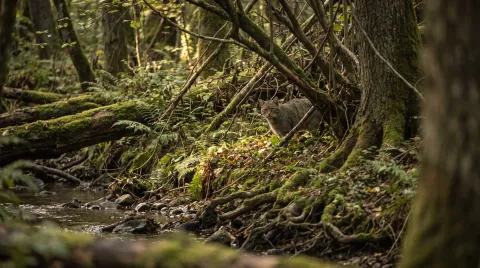
The forest a European wildcat actually needs
Woodland to shelter and den in, open edge to hunt over, and corridors between the two. What the radio-tracking and genetics really show.