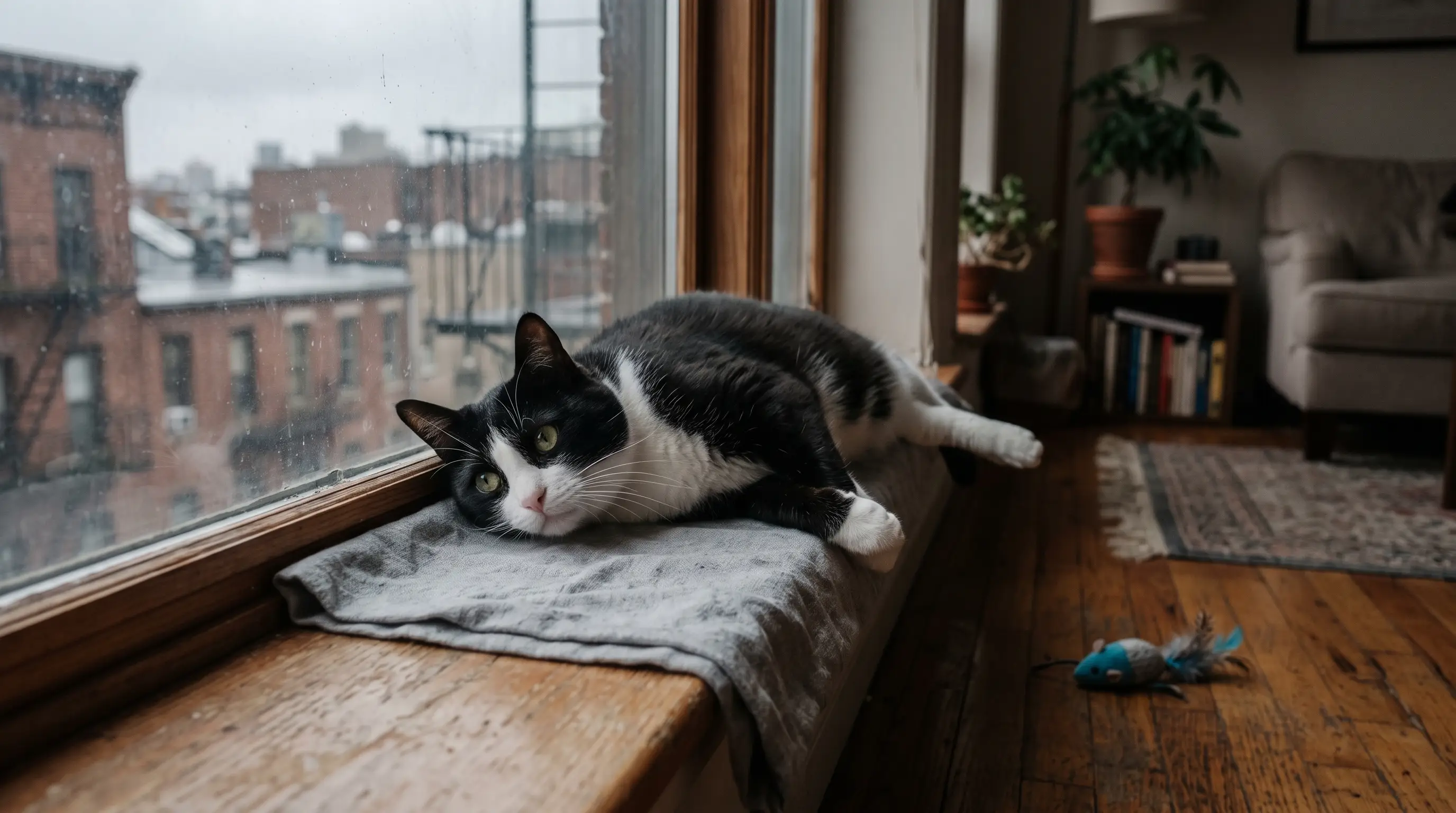
Is my cat bored? What an indoor cat actually needs
A bored dog demolishes the sofa and everyone diagnoses it instantly. A bored cat sleeps two extra hours, eats from stress, grooms a thin patch into its flank and gets labelled lazy — or greedy, or neurotic — while the actual problem goes unnamed. Indoor cats live safer, longer lives than outdoor ones, but the deal quietly deletes the hunting, patrolling and problem-solving their brains were built to run daily. Here's how under-stimulation actually shows in a cat, how to tell it from illness and low mood, and the enrichment programme that fixes most of it without buying anything with a plug.
What boredom looks like in a cat
Almost never like boredom. The signs run in two directions, and households usually notice only one. The loud direction: destructiveness beyond routine scratching, counter-surfing raids, ambushes on your ankles, over-the-top demands at dawn — surplus predatory energy inventing its own events, the same arithmetic behind the zoomies and the pen going off the desk. The quiet direction is easier to miss and more common: sleeping even beyond a cat's generous baseline, eating as an activity rather than from hunger, over-grooming a flank or belly thin, and a flat, checked-out watchfulness owners read as calm.
The overlap with real trouble is deliberate on the cat's part — hiding problems is what cats do — so run the order the vet would: appetite up with weight up and no other change points at boredom-eating; over-grooming plus tray changes or withdrawal belongs to the stress signs owners miss; and a cat that stops playing and stops grooming and retreats is not bored but flat — closer to depression, and worth a vet conversation, because pain and illness write exactly that sentence too.
The job your flat deleted
The indoor deal is genuinely good — traffic, fights, disease and the misery documented in the predation arithmetic all argue for it — but be honest about what it removes. An outdoor cat's day is a career: patrol the territory, read the scent bulletins, stalk four or five small hunts, manage the neighbour dispute, nap in six locations on rotation. The indoor version of that day, unfurnished, is a bowl that's always full and a corridor that never changes. Nothing in the cat's wiring got the memo.
That's the entire theory of enrichment: rebuild the career indoors. Not as luxury — as the substitute for a workload the animal is built to carry. The good news, and the reason this article recommends no products, is that nearly all of it is furniture rearrangement, cardboard and fifteen minutes a day.
The programme: hunts, heights, theatre
Hunts. Two or three wand-toy sessions a day, run like hunts — stalk, chase, catch, "kill", then food — with the last one before bed. This is the single highest-value intervention, and the mechanics are in the zoomies guide. Add foraging: part of the daily ration through food puzzles, or simply scattered and hidden around the flat, so eating goes back to being work. A cat that empties a bowl in ninety seconds was built to spend hours acquiring those calories.
Heights and territory. Vertical space effectively doubles a small flat: cleared windowsills, a shelf route, a tall scratching tree at the window. Rotate the terrain — toys live in a drawer and appear in threes, boxes come and go per the box economics, a paper bag is an event. Theatre. A window perch over a street with birds and pedestrians is daytime television; a bird feeder placed in view is prestige drama. Add smell, the sense we always forget: catnip and silvervine on rotation (what they do, and why a third of cats shrug, is in the catnip story), a herb planter, the outside world brought in on your shoes.
What not to do, and when it's not boredom
Three honest cautions. A second cat is not an enrichment product. It sometimes works wonderfully; it's also a fifteen-year commitment that can double the stress in the house if the match is wrong — weigh it with the one-or-two evidence and, if you proceed, run the introduction protocol properly. Screens are seasoning, not diet — bird videos entertain some cats briefly, but a hunt that never ends in a catch can frustrate more than it feeds; the same goes for laser pointers unless the dot finally "dies" on a treat or toy the cat can hold. And more food is never the answer — boredom-eating plus a generous scoop is how indoor cats end up carrying the weight that shortens the safer life you chose for them.
Finally, keep the differential honest. Enrichment fixes under-stimulation; it doesn't fix pain, hyperthyroid restlessness in older cats, or genuine low mood after a loss or upheaval. A cat that doesn't respond to two weeks of a real programme — real hunts daily, terrain changes, foraging — isn't failing at enrichment. It's telling you the problem was never boredom, and the next appointment is at the vet, with the checklist from the stress signs owners miss in hand.
Common questions
How do I know if my cat is bored?
Look in two directions. Loud: destructiveness, ankle ambushes, counter raids, dawn demands — surplus hunting energy inventing events. Quiet, and more often missed: extra sleeping, eating as an activity, over-grooming a patch thin, and a flat watchfulness that reads as calm. A cluster of these in a healthy indoor cat with little to do points at under-stimulation.
Do indoor cats get bored?
They can, because indoor life quietly removes an outdoor cat's entire workload — patrolling, scent-reading, several small hunts a day. The indoor deal is still the safer one; it just needs the job rebuilt indoors through daily play-hunts, foraging for food, vertical territory and things worth watching.
Is my cat bored or depressed?
Bored cats still engage when something good happens — they play when the wand toy comes out, investigate a new box. A flat cat that stops playing, stops grooming and withdraws is past boredom, and that same picture is also how pain and illness present. A cat that doesn't respond to two weeks of genuine enrichment needs a vet, not more toys.
How do I entertain an indoor cat while I'm at work?
Set the stage before you leave: food hidden or in puzzles so eating is foraging, a window perch with real traffic to watch (a bird feeder in view is prime programming), rotated toys that appear in small batches, boxes and paper bags as recurring events, and vertical routes to patrol. Then pay the energy debt with a proper play-hunt when you're home.
Do cats get bored of their toys?
Yes — a toy that lives on the floor stops existing within days. Keep most toys in a drawer and rotate a few at a time; novelty is most of a toy's value. The wand toy is the exception: it stays interesting because you animate it, and it should live out of the cat's reach between hunts.
Should I get a second cat so mine isn't bored?
Only as a considered decision, not as an enrichment purchase. A well-matched companion genuinely helps some cats; a poor match doubles the household's stress for fifteen years. Weigh energy levels and ages, and introduce through the slow, scent-first protocol — never a surprise meeting.
More in Cats
Why does my cat lick me? Grooming, love and salt
A cat's lick is mostly a compliment: you've been adopted into the grooming circle. What the sandpaper tongue is doing, why some cats overdo it, and when to gently opt out.
Why does my cat follow me everywhere, even the bathroom?
The supposedly aloof animal trailing you from room to room is behaving exactly as the attachment science predicts. Why cats shadow their person, the bathroom mystery, and the one change that needs a vet.
Why does my cat meow at night? And how to make it stop
Night calling is a solvable problem with a short list of causes: a crepuscular body clock, a lesson you accidentally taught, an unneutered announcement, or — in older cats — a medical flag that comes first.
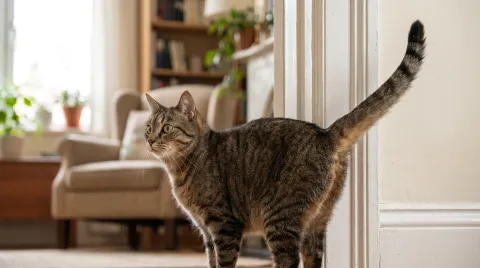
Why is my cat spraying? What it means and how to stop it
Spraying isn't a litter-box failure — it's a message about territory, written in urine. How to tell it from peeing, what's behind it, and the fixes that hold.
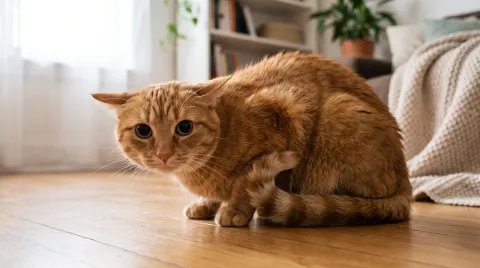
Why is my cat aggressive? Causes and how to calm it
Cat aggression isn't a personality — it's a diagnosis with about six usual suspects, and each one has a different fix. Work through them in order and the biting usually explains itself.
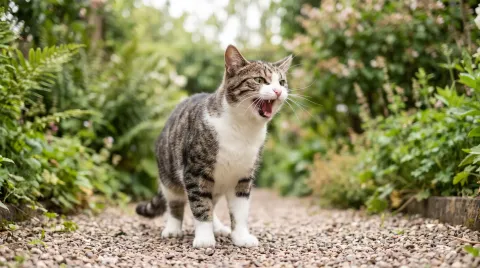
Why do cats hiss? What it means and what to do
A hiss is not an attack — it's the thing a cat does to avoid one. What the sound actually is, what triggers it, and why the polite answer is always to back off.