Teaching your cat tricks: the first five
Cats train every bit as well as dogs. What they do not do is work for your approval — a cat that has just done something clever and been told it is wonderful has been paid in a currency it does not accept. Pay in food, keep the sessions shorter than you think, and never repeat a cue the cat is ignoring. These five come in this order because each one builds the next, and the last of them is the only one that is genuinely useful.
Before the first trick: the rules that make it work
Train before a meal, never after — a full cat is a cat with no reason to talk to you. Use something small and genuinely good, a scrap of chicken or a lick of a squeezy treat, rather than the biscuits already in its bowl. And keep sessions to two or three minutes, three or four times a day if you can. Cats disengage long before they get tired, and the single most common mistake is carrying on past the point where the cat was still enjoying it.
Mark the moment. A clicker is ideal because it is fast and always sounds the same, but a short sharp word works if you are consistent. Click the instant the cat does the thing, then deliver the treat — the click is what tells the cat which of the hundred things it was doing earned the food. If you have never used one, clicker training a cat covers the mechanics properly. Never punish, never repeat a cue the cat is ignoring, and always stop while it still wants more.
1 · Target — the one that teaches everything else
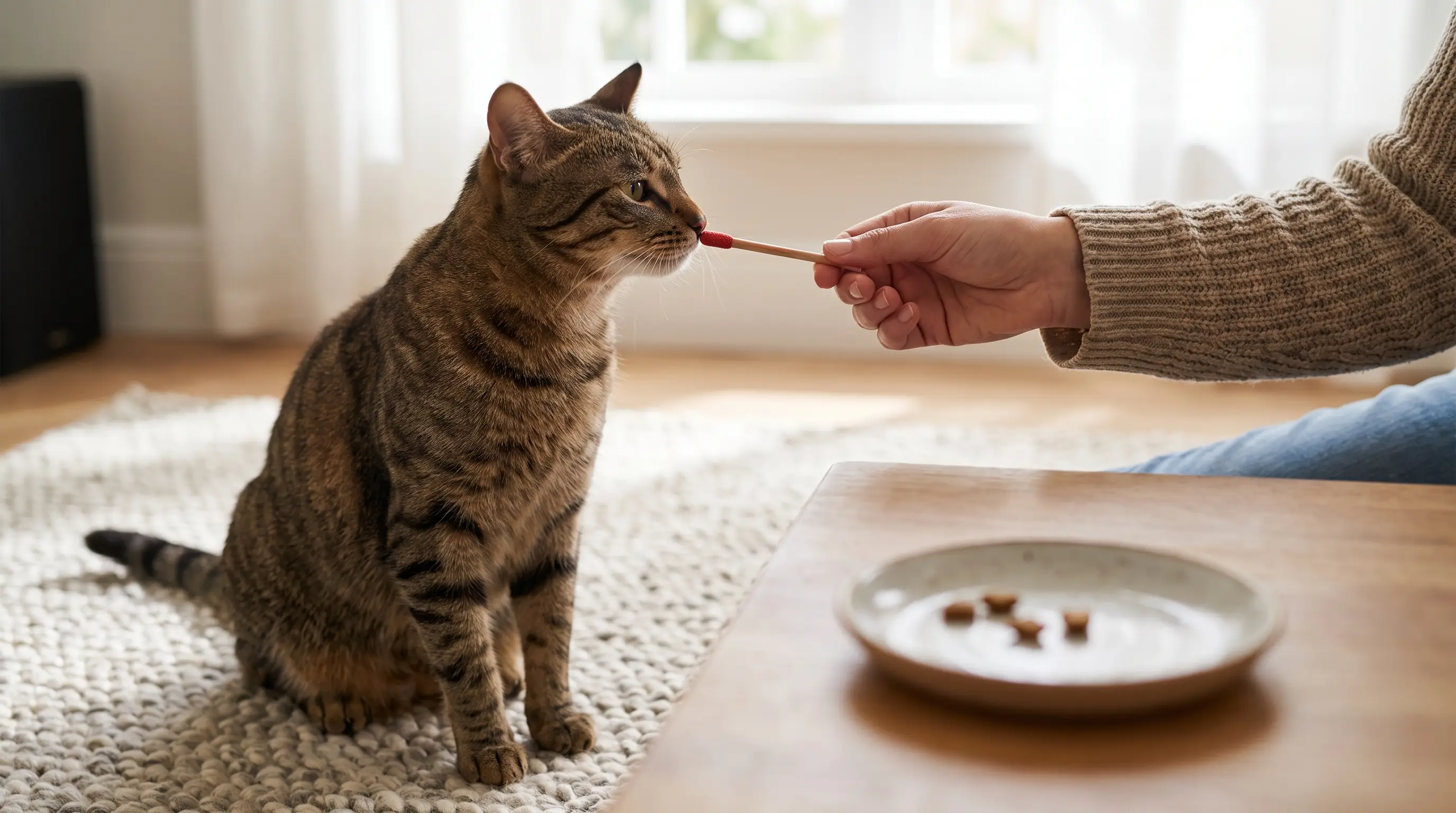
Target is the foundation and it is worth doing first even though it looks like nothing. Hold out a target — a chopstick, a pen, the end of a wooden spoon — a few centimetres from the cat's nose. Cats investigate novel objects, so it will lean in and sniff it within a few seconds. The moment its nose touches, click and treat.
Repeat ten times, then start moving the target: a little to the left, slightly higher, further away, so the cat has to take a step. What you now have is a way to move your cat anywhere without touching it, which is how the next three tricks get taught and, incidentally, how you get a cat into a carrier without a wrestling match.
2 · Sit — without ever pushing the cat
Hold the target just above and slightly behind the cat's head. To keep its nose on it the cat has to tip its head up and back, and the easiest way for a cat to do that is to lower its back end. The moment the bottom touches the floor, click and treat.
Never push a cat into a sit. Physically placing an animal teaches it that hands make things happen to it, which is the opposite of what you are building here. Once it is sitting reliably for the target, start saying "sit" just before you move the target, and after a couple of dozen repetitions drop the target and use only the word. That gap — cue first, then lure, then cue alone — is how every one of these becomes a real trick rather than a food-following exercise.
3 · High five — the one that looks hardest and is not
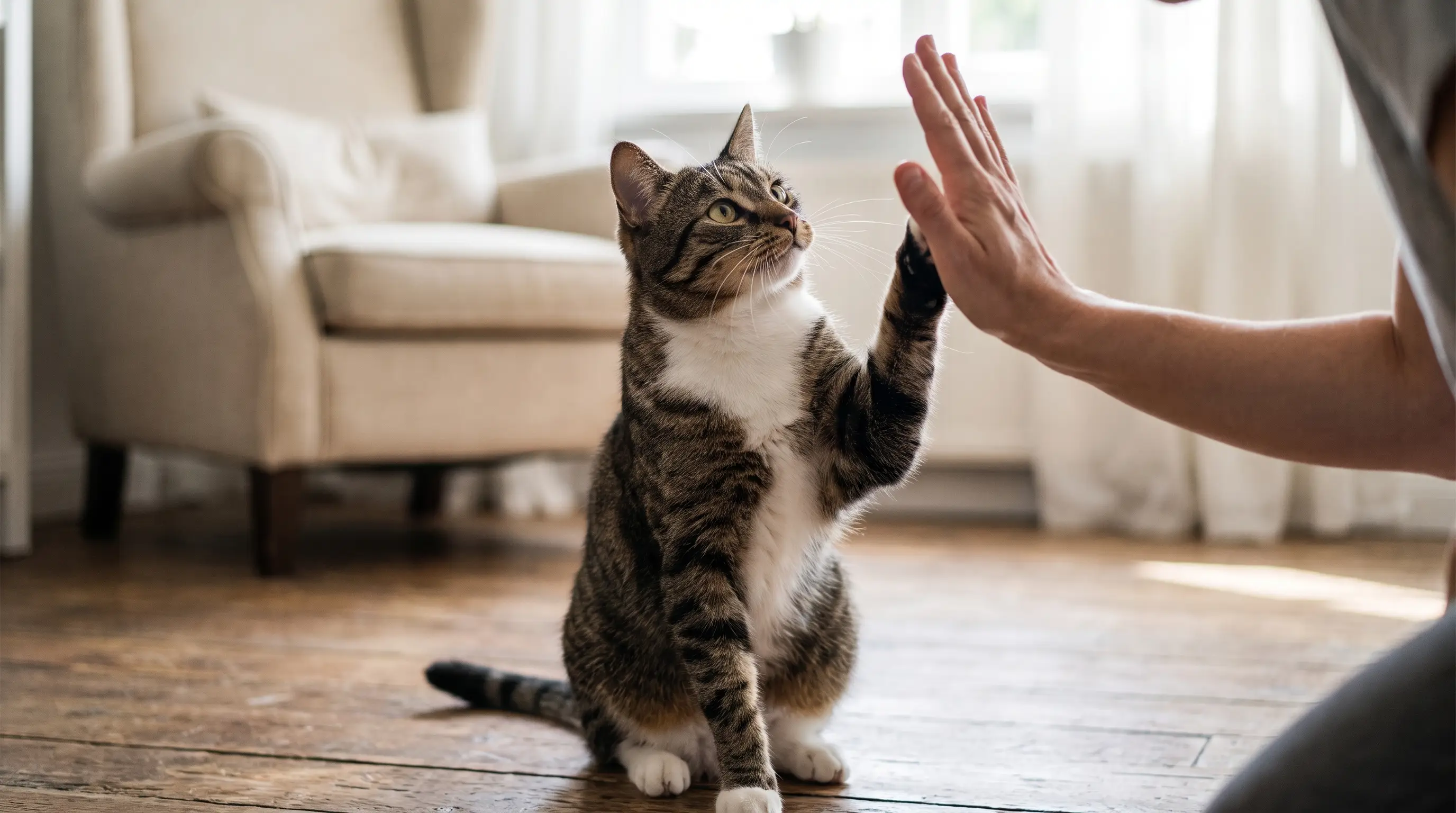
Start from the sit. Hold a treat in a closed fist just above the cat's nose, close enough that it can smell it. Most cats will sniff, then paw at your hand — that is the behaviour. Click the paw lift, open your hand, pay.
Once the paw comes up reliably, swap the closed fist for a flat open palm at the same height and click when the paw touches it. Add the word once that is working. Cats that are heavy paw-users get this in a session or two; cats that prefer to bite at your fist need you to be slower with the fist and quicker with the click. Do not raise your hand higher to make it more impressive — a cat that has to stretch will stand up instead, and you will have taught something else.
4 · Spin — pure target work
With the cat standing, hold the target at nose height and move it in a slow circle around the cat. It follows the target round, and the whole body comes with it. Click when it completes the turn, then treat. If it loses interest halfway, your circle was too big or too fast — go smaller and slower, and click half a turn until that is easy.
Add the cue word, then start making the target movement smaller and smaller until it is just a small circle of your finger. This is the trick that makes people think a cat has been trained by a professional, and it is genuinely the easiest of the five.
5 · Come — the only one that might matter one day
Recall is the one worth real effort, because a cat that reliably comes when called is a cat you can get out of a hiding place at the vet or back inside before dark. Pick a sound that means nothing else — a specific whistle, a click of the tongue, or the noise you make when you shake the treat tub. Make the sound, then immediately give a treat. Do not call the cat, do not wait for it to do anything: sound, then food, twenty or thirty times over a few days.
Once the sound alone brings the cat running, start making it from the next room, then from upstairs, then from the garden door. The rule that keeps it working for years: never use the sound for something the cat dislikes. Call it once to put it in a carrier or give it a pill and you have spent the whole thing. Keep it for good outcomes only, top it up with a free treat every week or two, and it will still work in five years' time.
When a cat says no
A cat that walks away has ended the session, and that is information rather than failure. Look at what preceded it — usually the session ran too long, the treat was not worth it, or the cat had already eaten. Sessions that end because you stopped first are the ones that build a cat who comes running when the clicker appears.
Some cats take longer, and breed has less to do with it than age and confidence: a kitten with no fear of new objects learns faster than a nervous adult, though the adult gets there. If your cat is frightened rather than uninterested — flattened ears, wide eyes, backing off — stop and read what its body is telling you before trying again. And if it simply stares at you as though you have suggested something beneath it, that is not a training failure either. That is a cat.
Common questions
Can cats really be trained to do tricks?
Yes, and they learn quickly — they just do not work for praise. Cats train on food, in very short sessions, with the moment marked by a clicker or a consistent word. The most common reason people think cats cannot be trained is that they tried after a meal, went on too long, or paid in approval.
What trick should I teach a cat first?
Target — touching its nose to a stick or a pen. It looks like nothing and it is the foundation: it gives you a way to move the cat anywhere without touching it, which is how sit, spin and high five all get taught, and how a cat goes into a carrier without a fight.
How long should a cat training session be?
Two or three minutes, three or four times a day. Cats disengage long before they tire, and the biggest mistake is carrying on past the point where the cat was still enjoying it. Always stop while it still wants more.
What treats work best for training a cat?
Something small and genuinely good — a scrap of chicken, a lick of a squeezy treat — rather than the biscuits already in its bowl. Train before a meal, never after: a full cat has no reason to negotiate with you.
How do I teach my cat to come when called?
Pick a sound that means nothing else, make it, and immediately give a treat — sound then food, twenty or thirty times, without calling or waiting for the cat to do anything. Then build distance. The rule that keeps it working: never use that sound for something the cat dislikes, like a carrier or a pill.
My cat walks away mid-session. What am I doing wrong?
Usually the session ran too long, the treat was not worth it, or the cat had already eaten. A cat leaving has ended the session, which is information rather than failure. If it looks frightened rather than bored — flattened ears, wide eyes, backing off — stop and start much smaller next time.
More in Cats
How to help a cat that is terrified of fireworks
A safe room for the night itself, and a graded sound protocol to run in the months before it. What actually works, and what makes a frightened cat worse.
How to train a cat to walk on a harness
Some cats take to a harness and some never will — and forcing it backfires. How to introduce one properly, the gear that matters, and the honest limits.

How to stop a cat scratching the furniture
Scratching is a normal, necessary cat behaviour, not misbehaviour, so the fix is redirection rather than punishment. The setup that actually gets a cat choosing the post over the sofa.
How to litter train a kitten (and fix accidents)
Kittens come pre-wired to use a tray. Set the box up right, let instinct do the work, and know what to check the day it goes wrong.
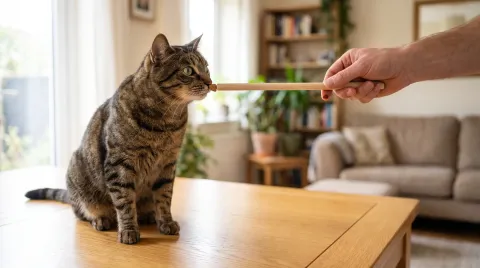
Clicker training a cat: the honest beginner's guide
Cats are far more trainable than their reputation suggests. With a clicker, tiny treats, and short sessions, almost any cat will learn.
Why is my cat spraying? What it means and how to stop it
Spraying isn't a litter-box failure — it's a message about territory, written in urine. How to tell it from peeing, what's behind it, and the fixes that hold.