
Wildcat conservation: law, cameras and cryptic extinction
Most wildcat conservation is not about fences. The hardest problem for the European wildcat (Felis silvestris) is that you cannot reliably count it: it looks more and more like the tabby asleep on someone's sofa, because it breeds with domestic cats until the wild genome thins out. The 2015 IUCN assessment named the danger plainly, calling the aim to save the species from 'cryptic extinction before it is too late'. Cryptic, not visible. That single idea explains why the money goes into cameras and lab time rather than barriers, and why the law defends a category, the pure wildcat, that keeps getting harder to point at.
Why a wildcat is so hard to count
A wildcat vanishes not by dying out but by blending in. As it interbreeds with domestic and free-roaming cats, its distinctive markings and its genome both dilute, so a survey that only records sightings can miss the collapse entirely. This is the core of cryptic extinction: the animals are still there, still catchable on camera, but fewer and fewer of them are genetically wild. The 2015 IUCN assessment, which covered the whole complex before the 2017 taxonomic split, put the unsolved problem at the centre, that distinguishing wildcats from domestic cats becomes near impossible once introgressive hybridisation is extensive.
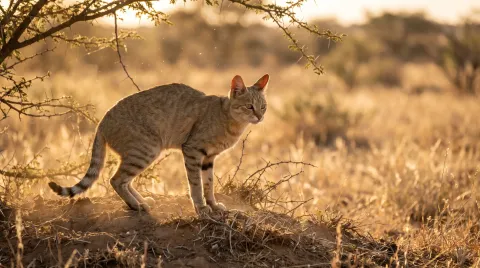
The confusion runs deep in the naming, too. Felis silvestris is the European wildcat; Felis lybica, the African and Asiatic wildcat, is the ancestor of the house cat, first assessed as its own species in 2022. The domestic cat descends from the African wildcat, not the European one, which is exactly why a European wildcat and a stray can produce fertile offspring and why telling them apart takes more than a good look. The full story of that blurring sits in the hybrid swarm problem, and the practical test for a single animal in how you actually tell a wildcat from a hybrid.
What the law actually protects
The law protects the pure wildcat, and it lists the species heavily. In the EU, Felis silvestris sits on Annex IV of the Habitats Directive (92/43/EEC), the tier for species of Community interest in need of strict protection. It is not on Annex II, and that is the detail most pages get wrong. On top of that it is CITES Appendix II, Bern Convention Appendix II, and Annex A of the EU Wildlife Trade Regulations (Reg. 338/97), which bars commercial trade more tightly than the CITES listing alone would.
Status depends on where you draw the boundary. Globally the Red List calls the species Least Concern, reassessed after the 2017 split, with the population trend recorded as unknown; the pre-split 2015 assessment had described the trend as decreasing. At EU level the 2013 to 2018 Article 17 reporting is worse, listing it as Near Threatened. National categories are worse still in places: Near Threatened in Spain, with earlier assessments at Vulnerable; Endangered in Albania, Bulgaria and Poland; and, in the 2023 Portuguese mammal Red Book, upgraded from Vulnerable to Endangered, with an area of occupancy under 500 km² and no species-specific programme of its own. In the UK it is a European Protected Species, protected in Scotland under the Conservation (Natural Habitats &c.) Regulations 1994 and in England and Wales under the Conservation of Habitats and Species Regulations 2017. A Bern Convention case file on the lack of protection of the Scottish wildcat shows the question reached treaty level. The trouble is enforcement of a category you cannot always identify in the field.
Cameras and lab time do most of the work
If you cannot count wildcats by looking, you count their genes. Systematic genetic monitoring with diagnostic markers is the method that catches cryptic extinction while there is still something to save, and it is one of the few measures the field agrees has evidence behind it. The clearest case is a Swiss long-term study by Nussberger, Hertwig and Roth in 2024: a systematic genetic survey picked up both a doubling of occupancy and a rise in introgression at the same time, a mixed signal a sightings-based distribution survey would have missed completely.
Italy runs the most built-out version of this. ISPRA's national Felis DB combines genetics, morphometrics, camera trapping, GPS tracking, necropsy and pathogen data, and manages four genetically distinct wildcat populations as separate units. That granularity matters because the northern Apennine ridge is recolonising, and as the wildcat expands it meets an expanding population of free-roaming cats, which raises the risk of the two mixing. The regional picture, including the Sardinian cat, runs through the Italian wildcat field guide, and the wider map through where every wildcat species lives.
The measure with the strongest evidence: connected forest
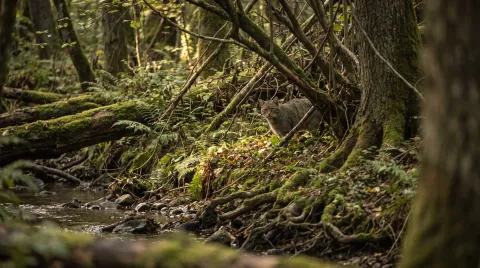
The single best-supported intervention is habitat, specifically forest that joins up. The 2023 EUROWILDCAT consensus statement (Nussberger et al., Frontiers in Ecology and Evolution) sorted the toolkit into what has evidence and what does not, and put habitat recovery and connectivity firmly in the first group: genetic integrity is highest in regions with higher forest cover and larger distances to human settlements. Keep wildcats in deep, connected woodland away from villages, and the wild genome holds; push them into fragmented edges near people, and the mixing accelerates. What a wildcat needs from that forest is set out in the forest a wildcat needs.
Germany has turned this into a plan. BUND's Wildkatzenwegeplan sets out a vision for a 20,000 km network of forest corridors linking isolated populations, an aspiration rather than something built, but one aimed at the mechanism the evidence supports. The Portuguese Red Book points the same way, recommending road-crossing structures and the conservation of Mediterranean scrub and forest, though there the wildcat rides on the Iberian lynx conservation plan rather than having a plan of its own.
The thin bets: neutering and trap-neuter-return
Some measures are done because they are the realistic option, not because the evidence is strong. The EUROWILDCAT statement is honest about this: neutering domestic cats in wildcat habitat, and controlling free-roaming populations through trap-neuter-return, are recommended despite limited evidence that they protect the wild genome at scale. The logic is sound, fewer unneutered cats near the forest should mean fewer chances to interbreed, but the proof that it moves the genetic needle is thin, and the Portuguese Red Book goes further still, listing sterilisation, awareness and culling together as feral-cat control options.
This is where wildcat conservation touches ordinary cat ownership. The gap between a wildcat and a feral cat is the whole problem in miniature: one is the species being saved, the other is part of what threatens it, and near a wildcat forest a roaming, unneutered pet or a fed colony cat is a genetic liability. That is why the standard advice, neuter your cat, and if you take in a stray get it neutered, doubles as a conservation act on the edge of wildcat range. If you have picked one up, what to do when you find a stray cat and feeding a neutered cat both cover the practical side. It is worth being clear-eyed that a well-run domestic shorthair household near the woods does more for the wildcat than any single lab result.
Scotland: the warning, and the pens that answer it
Scotland shows what happens when the counting comes too late. The 2019 review by Breitenmoser, Lanz and Breitenmoser-Würsten for the IUCN SSC Cat Specialist Group concluded that the Scottish population is no longer viable as a stand-alone population and currently resembles a hybrid swarm; the group has also called it virtually extinct. On the GB regional Red List (Mathews and Harrower, 2020) the wildcat is Critically Endangered in Scotland. The full account of that collapse is in the Highland population and its collapse.
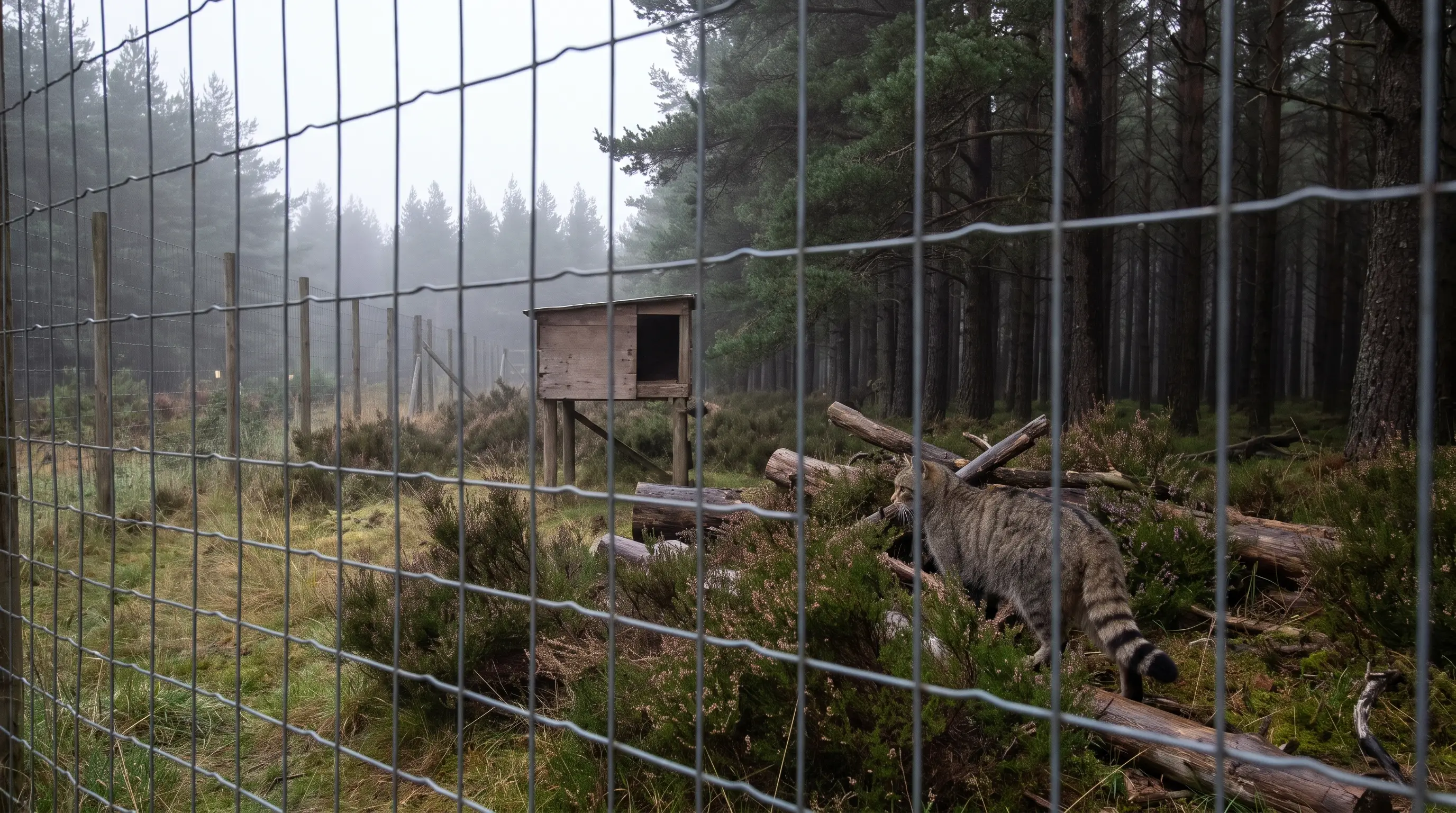
The response has been to rebuild from captivity. The Saving Wildcats project, led by the Royal Zoological Society of Scotland with NatureScot, Forestry and Land Scotland, the Cairngorms National Park Authority, Nordens Ark, the Junta de Andalucía, Cats Protection and the Game & Wildlife Conservation Trust, and funded by the EU LIFE Programme and the Scottish Government's Nature Restoration Fund, runs a conservation-breeding centre at RZSS Highland Wildlife Park. Enclosures like this one, with cover, log piles and raised den boxes, are designed to keep captive-bred kittens wary of people so they stand a chance once released. It is expensive, slow, and an admission that monitoring alone did not save the population in time.
Releases in the Cairngorms, and the hopeful contrast
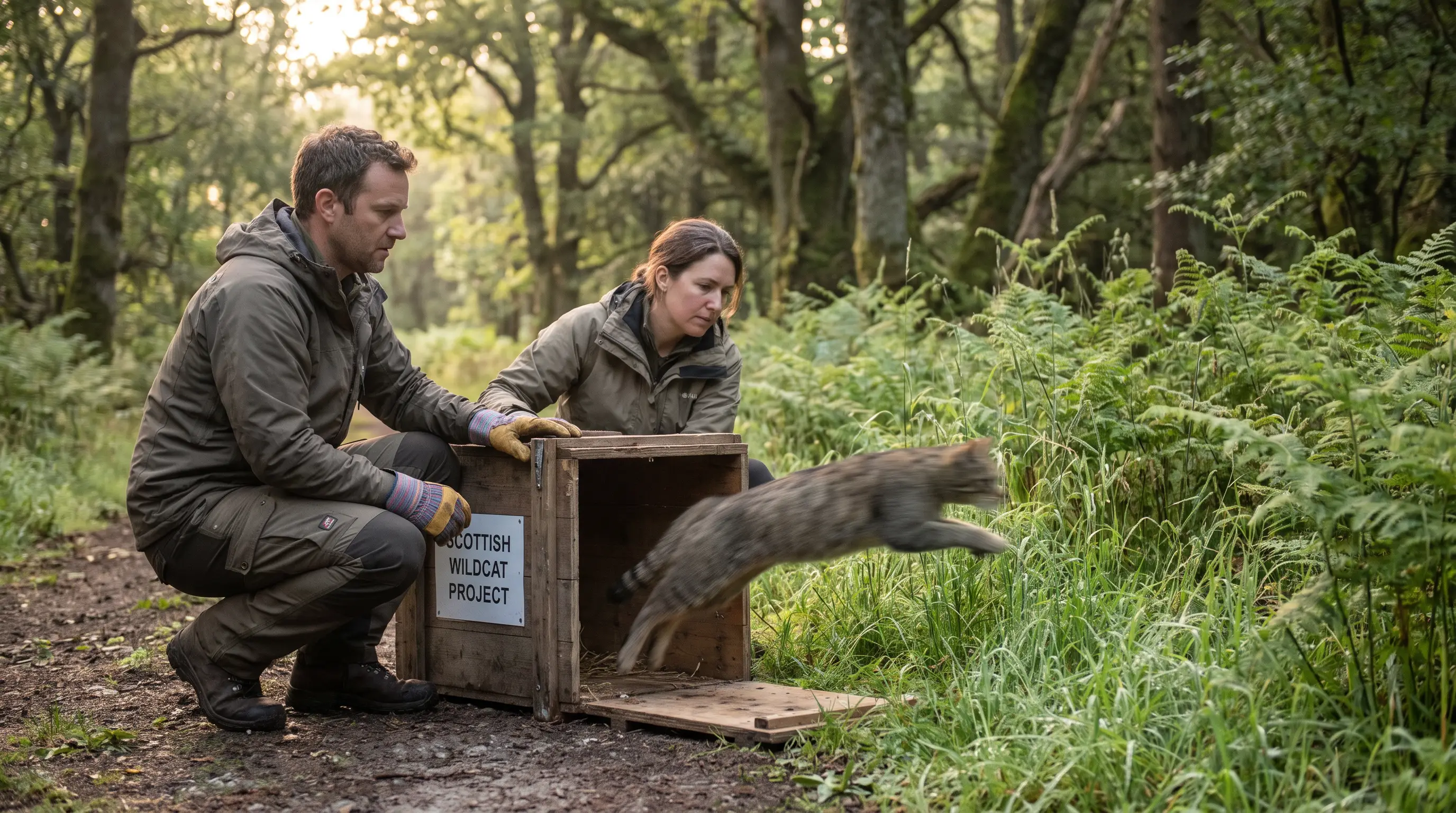
The Scottish releases have begun, and early signs are cautiously good. Saving Wildcats started releasing animals into the Cairngorms in 2023, with a target of around 20 a year; 18 went out in 2025, 46 in total, and wild-living females produced litters in both 2024 and 2025. Litters in the wild are the first real test that captive-bred cats can live and breed on their own, though the same forces that emptied the Highlands, roads, fragmentation and free-roaming cats, still apply.
Central Europe offers the steadier picture. In Germany, BUND has run Rettungsnetz Wildkatze since 2004 and Wildkatzensprung from 2012, gathering over 7,000 genetic samples, identifying over 2,000 wildcats and mobilising over 2,600 volunteers, the kind of sustained genetic baseline that catches trouble early rather than at the swarm stage. Set against Scotland, and against the Swiss survey that saw occupancy and introgression rise together, the lesson is consistent: connected forest plus systematic genetics is what keeps a wildcat population wild. The wider family of small cats this work sits among runs through the small wild cats, and the broader wildlife file lives in the wild stories index.
Common questions
Are wildcats extinct in Scotland?
Not formally, but the IUCN SSC Cat Specialist Group's 2019 review concluded the Scottish population is no longer viable on its own and currently resembles a hybrid swarm, and has described it as virtually extinct. It is listed as Critically Endangered in Scotland on the 2020 GB regional Red List.
Are wildcats endangered?
It depends where you draw the line. Globally the European wildcat is Least Concern, but at EU level the Article 17 reporting records it as Near Threatened, and national categories run to Endangered in Albania, Bulgaria, Poland and Portugal, and Critically Endangered in Scotland.
Are wildcats protected by law?
Yes, heavily. In the EU the European wildcat is on Annex IV of the Habitats Directive, CITES Appendix II, Bern Convention Appendix II, and Annex A of the EU Wildlife Trade Regulations; in the UK it is a European Protected Species, protected in Scotland under the Conservation (Natural Habitats &c.) Regulations 1994 and in England and Wales under the Conservation of Habitats and Species Regulations 2017.
Why are Scottish wildcats critically endangered?
Chiefly because of interbreeding with domestic and free-roaming cats, which dilutes the wild genome faster than the population can be counted, compounded by habitat loss and fragmentation. The 2019 review found the population no longer genetically viable on its own.
How many wildcats will be released and when?
Scotland's Saving Wildcats project began releasing captive-bred wildcats into the Cairngorms in 2023, aiming for roughly 20 a year. It released 18 in 2025, 46 in total so far, and wild-living females produced litters in 2024 and 2025.
How do we know if a cat is a wildcat?
Not by looks alone, which is the whole difficulty. Reliable identification now depends on genetic testing with diagnostic markers, backed by camera trapping and body measurements, because hybrids can closely resemble pure wildcats.
See also
More in Wild
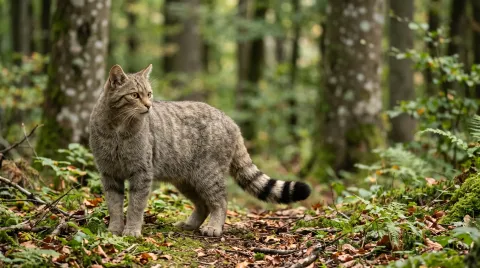
European wildcat: the cat Europe cannot count
Felis silvestris was only assessed as a species in its own right in 2022, and its official population trend is one word: unknown.
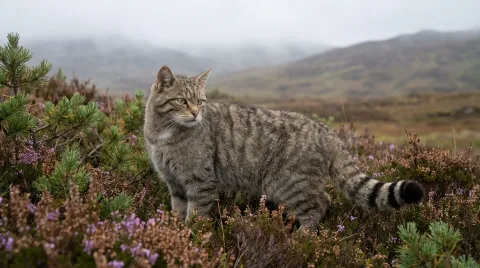
Scottish wildcat: not extinct, not a subspecies
The most-quoted fact about the Scottish wildcat misstates its own source. What the 2019 IUCN review really said, and where the cats stand in 2026.
African wildcat: the real ancestor of your cat
Your cat descends from Felis lybica, a North African animal most people cannot name. In November 2025 the standard account of how it reached Europe broke.
Wildcat hybridisation: how a species gets absorbed
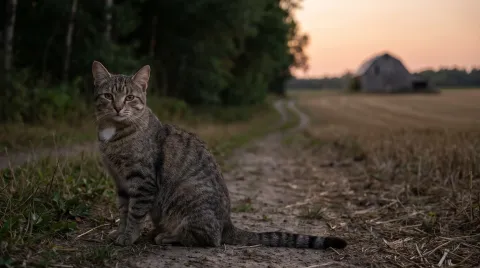
Even a low crossbreeding rate assimilates a wildcat population past halfway inside a century. Why "only a few hybrids" is not the reassurance it sounds like.

European wildcat vs domestic cat: how to tell
You cannot do it by eye. On the same cats, coat scoring rated 0.854 and the genome 0.984, and the strict visual cut-off loses real wildcats.
The forest a European wildcat actually needs
Woodland to shelter and den in, open edge to hunt over, and corridors between the two. What the radio-tracking and genetics really show.