European wildcat vs domestic cat: how to tell
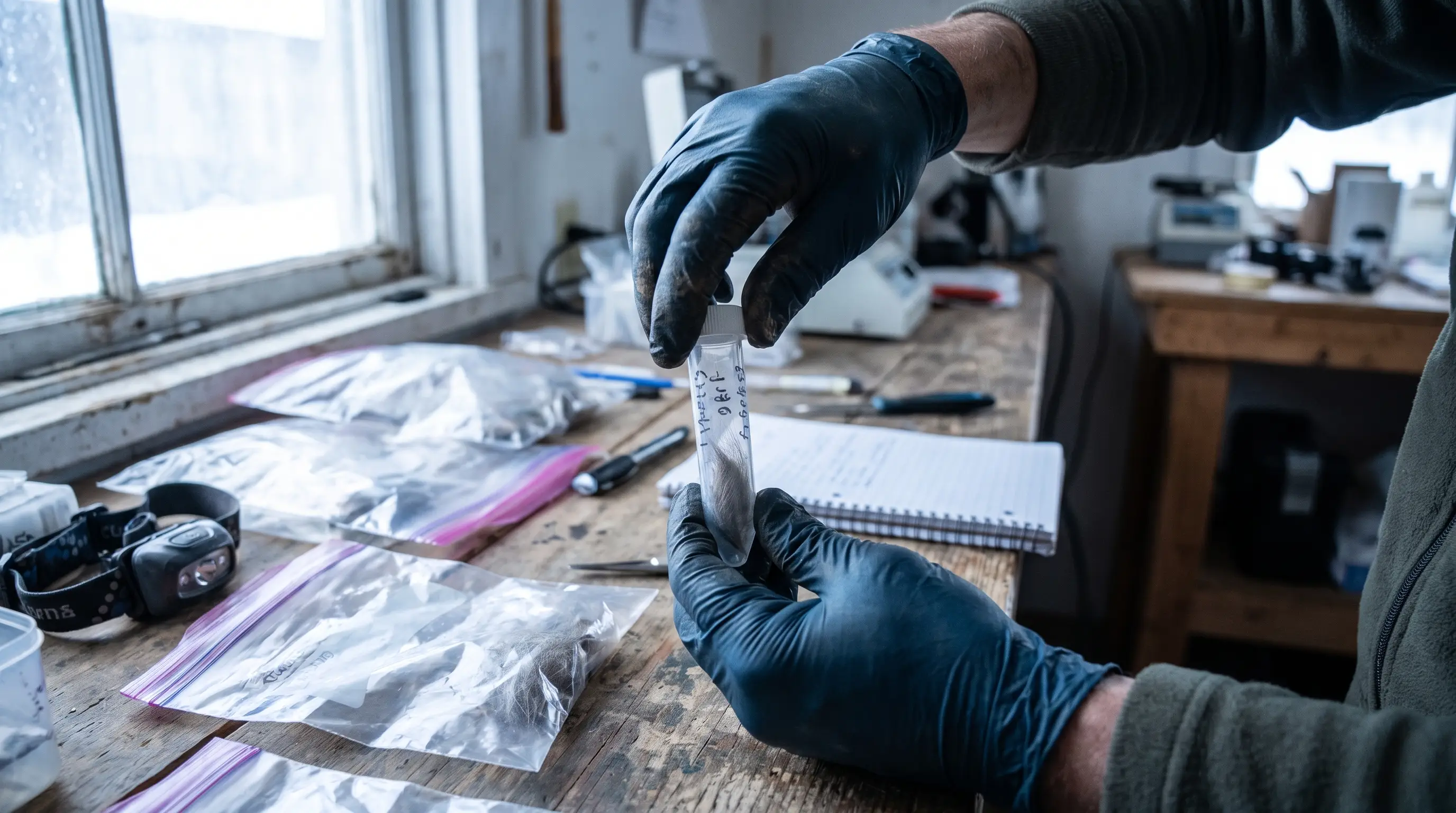
No one can reliably tell a European wildcat from a domestic cat by looking at it, and the size of the gap has been measured. Howard-McCombe and colleagues, writing in Molecular Ecology in 2021, put both tests through the same statistical mill on the same animals: the seven-character coat score used in the field returned an area under the curve of 0.854, while a 35-marker genetic test returned 0.984. The coat score is good enough to be worth taking into a forest. It is also loose enough that its strict version throws away real wildcats. That arithmetic is why identifying the Scottish wildcat and its continental relatives moved into a laboratory.
The seven marks that separate a wildcat from a house cat
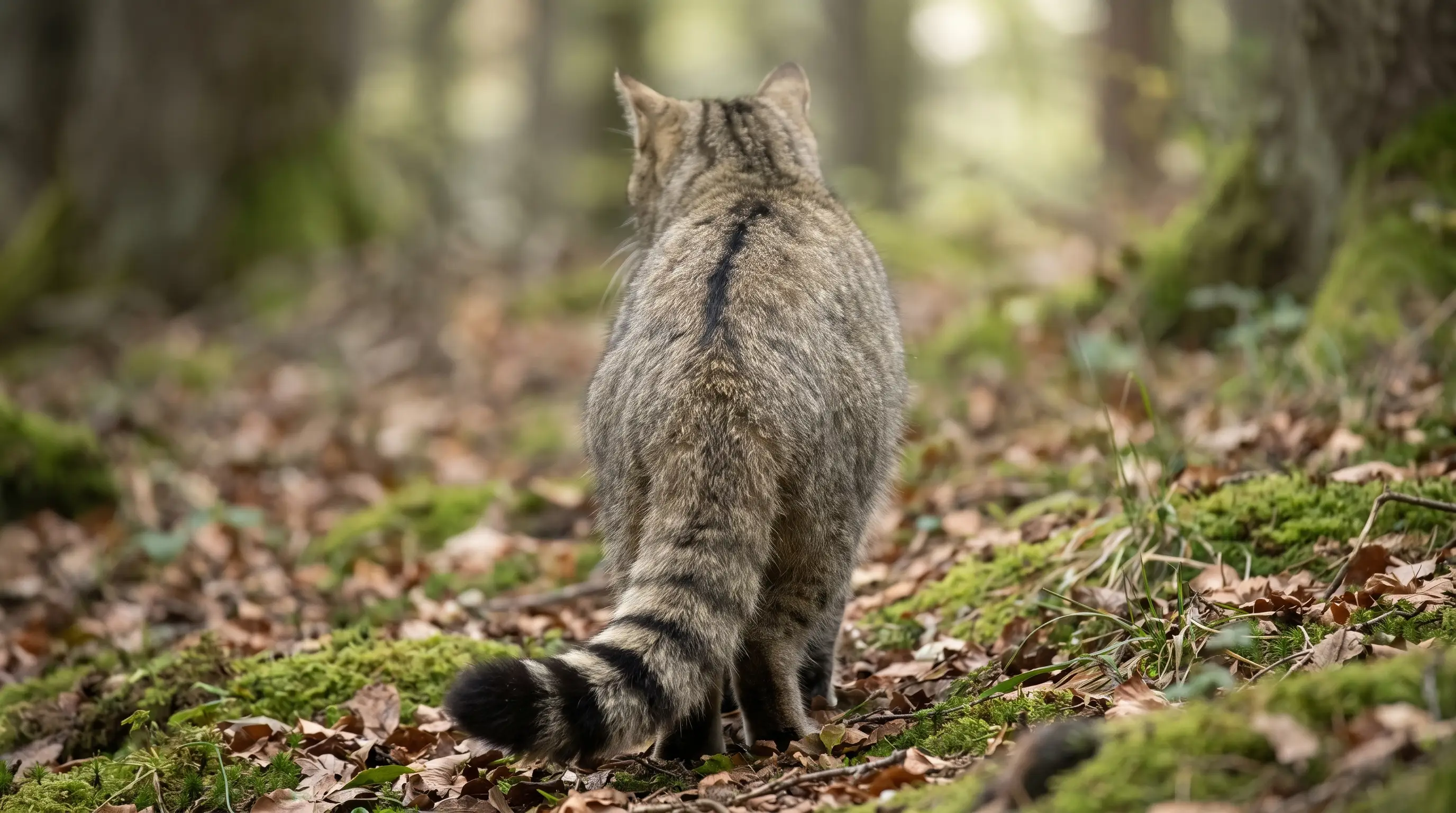
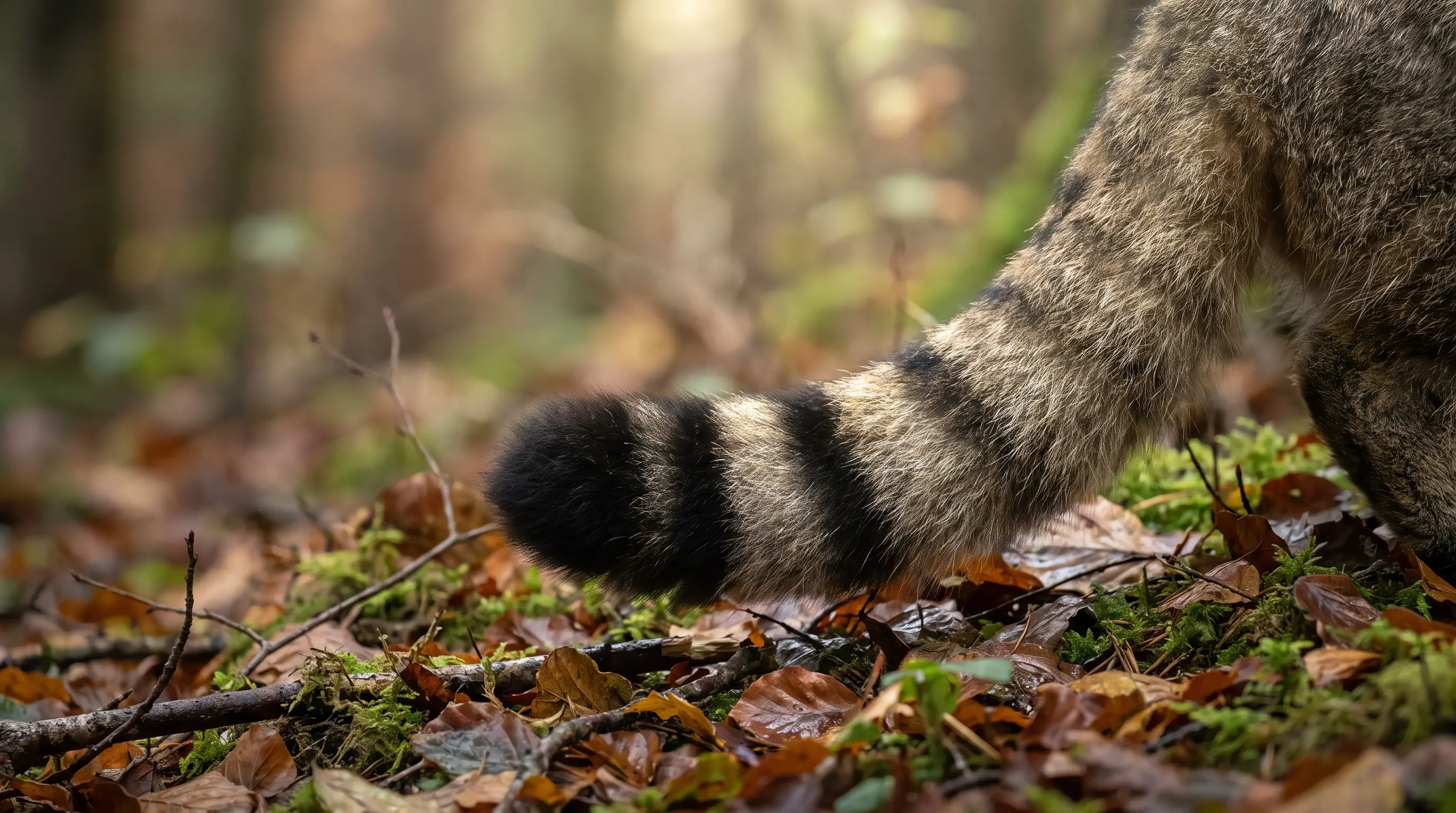
Field identification rests on seven coat characters, and they all come out of one 2005 study. Kitchener and colleagues, in Animal Conservation, measured 20 pelage characters, 40 skull parameters and intestinal length, and found seven coat features that significantly discriminate the two. Those seven are the extent of the dorsal stripe, the shape of the tail tip, how distinct the tail bands are, whether the flanks and hindquarters carry broken stripes, whether they carry spots, and the shape and number of stripes on the nape and on the shoulders.
Each character is scored 1 for a domestic-looking cat and 3 for a wildcat-looking one, so a cat's seven-point pelage score runs from 7 to 21. Then come the thresholds, and there are several. Kitchener set a strict cut-off at 19 or above, plus a relaxed one at 14 or above provided no single character scored 1. Field workers also use an operational threshold of 17, which exists to absorb recorder error on poor camera-trap images. Three thresholds for one test is itself a finding: where you draw the line changes which cats count.
The eye scores 0.854, the genome scores 0.984
Two tests, one set of cats, and a clear winner. Howard-McCombe and colleagues sequenced 129 individuals at 6,546 ddRAD loci and then ran ROC analysis on the 35-SNP genetic test and the seven-point pelage score side by side. The genetic test scored an AUC of 0.984. The pelage score scored 0.854.
The error counts say more than the AUCs do. At a pelage threshold of 17, the coat score produced 9 false negatives and 6 false positives. Raise the bar to 19 and the false positives collapse to a single one, but the false negatives climb to 19. The 35-SNP test made 2 false negatives and 4 false positives on the same animals. So a programme that picks the strict visual cut-off is choosing to write off nineteen real wildcats rather than wrongly admit one cat that is not one.
Senn and colleagues had already found the same shape of problem in Evolutionary Applications in 2019. Of 75 cats the genetics called wildcats, only 58 would also have been caught by the pelage score, and 17 of them scored below 17. Five cats failed in the opposite direction, passing the coat test and failing the genetic one. Their own verdict is blunt: “the fine-scale predictive value of 7PS on Q₃₅ is low.”
What a camera trap cannot see
A photograph fails twice over: once because the cat will not pose, and once because the animals that matter do not look like hybrids at all. Kilshaw and colleagues, in Oryx in 2015, scored wild-living cats from camera-trap images and found the pelage characters were often impossible to assess, because the cats did not expose key features such as the neck and shoulder stripes. Of 13 individually identifiable cats, 4 scored as pure wildcats and 9 as hybrids.
The second failure is structural. Tiesmeyer and colleagues, in Conservation Genetics in 2020, screened 926 Felis samples from 13 European countries at 86 ancestry-informative SNPs, 14 microsatellites and ten mitochondrial and Y-chromosome markers. They detected 51 hybrids, and only 4 of those were F1. The other 47 were F2s or backcrosses: animals several generations removed from their domestic ancestor, carrying a shuffled fraction of its genome under a coat that can read as entirely wild. Nuclear SNPs beat microsatellites specifically at catching those old-generation backcrosses, which are the same cats a photograph misses. Repeated over generations, that is how domestic DNA stops being a visible first-generation event and becomes a permanent component of the wildcat genome, which is the whole of the hybrid problem across Europe.
The cat on the other side of the comparison
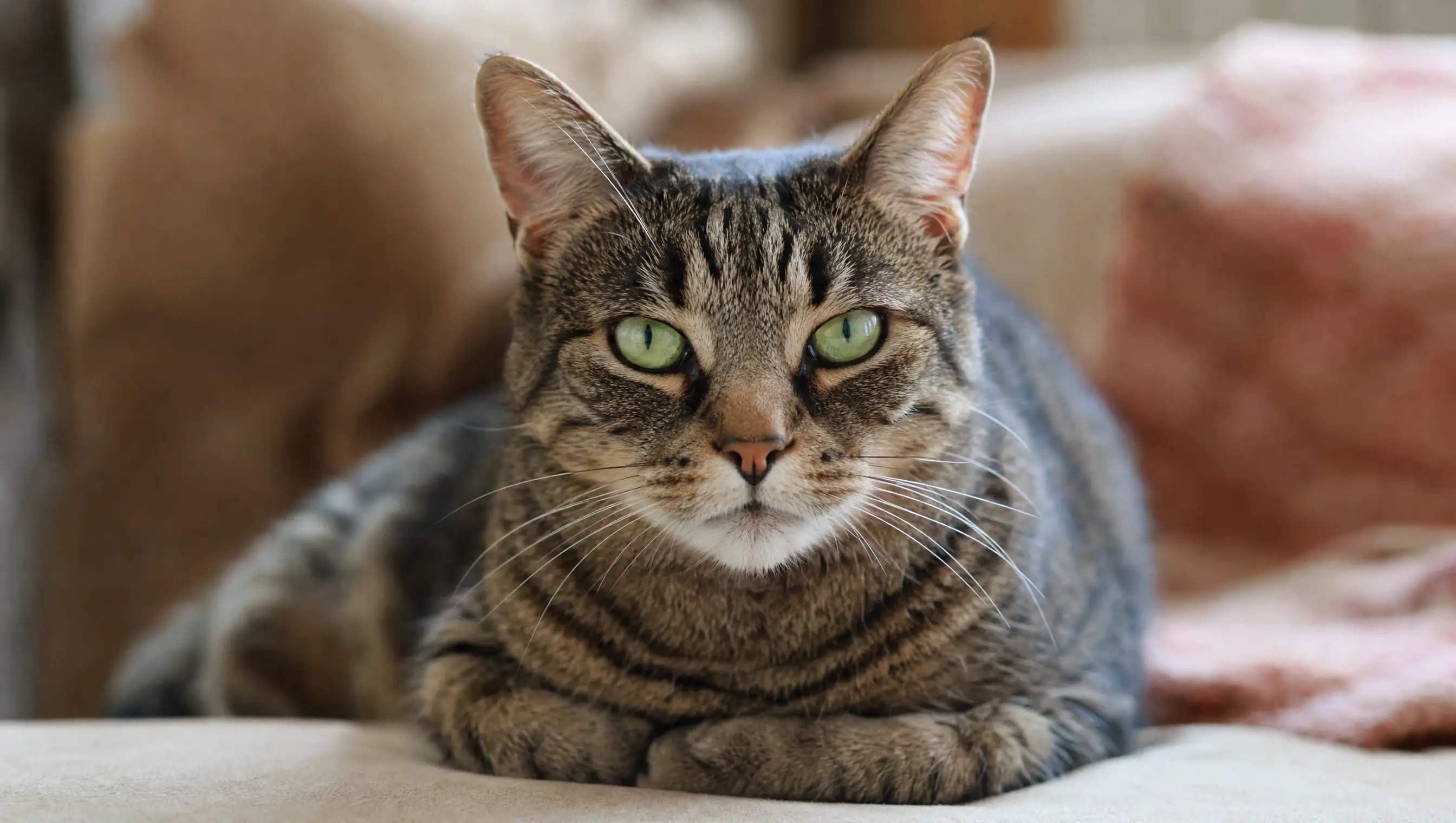
The animal a wildcat gets mistaken for is usually a grey-brown striped domestic shorthair or European shorthair living outdoors. A feral cat is a domestic cat with no owner rather than a wild species, and its tabby coat overlaps a wildcat's closely enough that the seven-point score had to be invented in the first place. If you have met a cat you cannot place, start with our guide to having found a stray cat and the side-by-side wildcat versus feral cat comparison. One more trap sits in the other direction: breeds developed from wild ancestry, such as the Bengal and the Savannah, look wild to almost everyone and are domestic cats. Our cat breed pages are the quicker way to rule the domestic candidates in or out.
Before DNA, the answer needed a dead cat
The pre-genetic tests did work, and most of them required a corpse. Paul Schauenberg proposed his index in the Revue suisse de Zoologie in 1969: the ratio of skull length to cranial capacity, below 2.75 for a wildcat and above it for a domestic cat. Wildcats also have shorter intestines, longer limb bones and a heavier-built skull. Intestine length and cranial volume were the only characters described as showing no overlap at all, and neither can be measured on a living animal. The alternative to a DNA test is skull anatomy.
The genetic side arrived in stages. Beaumont and colleagues, in Molecular Ecology in 2001, used 9 microsatellite loci across 230 wild-living Scottish cats, 13 of them museum skins, plus 74 house cats. Nussberger and colleagues published a 48-SNP diagnostic panel in Molecular Ecology Resources in 2013 that could separate wildcats, domestic cats, hybrids and backcrosses. Senn and Ogden refined that into the operational 35-SNP test in 2015, on 295 wild-living and captive cats: a hybrid score Q runs from 0 for a domestic cat to 1 for a wildcat, and the management threshold is the lower bound of the 90% confidence interval, an LBQ₃₅ of 0.75 or above. Validation against 3,097 independent SNPs in 76 cats put 90.8% of estimates inside that interval. Mattucci and colleagues went denser again in Scientific Reports in 2019: an Illumina Infinium iSelect 63K cat array, 57,302 autosomal SNPs, 35,228 after pruning, 4,240 of them wildcat-specific.
The test that gave a confident wrong answer
Mitochondrial DNA reads cleanly and can still be wrong, and 2025 produced the proof. De Martino and colleagues, in Science on 27 November 2025, looked again at cats from Neolithic and Chalcolithic southeast Europe and Anatolia, 9,500 to 6,300 years ago, which had been filed as domestic-lineage animals because they carried the mitochondrial DNA of the African wildcat, Felis lybica, the ancestor of the house cat. On nuclear data they are European wildcats, Felis silvestris, whose ancestors had hybridised with the African wildcat. All 22 samples, spanning the 9th millennium BCE to the 3rd century BCE, sit inside the European wildcat cluster.
The African wildcat signal was real. It just did not mean what it appeared to mean. African wildcat ancestry in those ancient European wildcats rises eastward, 9% in Bulgaria to 34% in central Anatolia, and the mitochondrial clade that goes with it is still in circulation: in Roman-era wildcats from Belgium and Italy, and in modern wildcats from Germany and Bulgaria. That implies persistence across the past seven millennia, and modelling placed the admixture event no later than the Late Pleistocene. The authors' conclusion is that mitochondrial DNA alone is not a suitable diagnostic marker for tracing the spread of the domestic cat. A maternal-line test reads one thread and files a report on the whole cloth.
Why the label decides whether a cat is protected
None of this is academic, because protection attaches to a wildcat and not to a hybrid. A cat scored as Felis silvestris falls under species protection, while the same animal scored as a hybrid can fall outside it, so the choice of test and threshold decides whether the cat in front of you has any legal standing. That is a great deal of weight for an AUC of 0.854 to carry.
Breeding programmes have already moved off pelage alone. Saving Wildcats assesses animals on a combined genetic-and-pelage matrix: accept into breeding at a pelage score of 16 or more with a genetic score above 75%, or above 18 with a genetic score around 75%; monitor for one generation where the pelage score is under 16 but the genetic score is high; reject where both are low. Two imperfect tests used together, with the disagreements written down instead of settled by preference. The rest of the argument sits in what conservation law and projects actually achieve, in the forest a wildcat needs and in where each wildcat species lives. For the animals rather than the statistics, try the world's small wild cats and the rest of our wild stories.
Common questions
How to identify a Scottish wildcat?
In the field, with the seven-point pelage score: the extent of the dorsal stripe, the tail tip, the tail bands, broken stripes and spots on the flanks, and the nape and shoulder stripes, each scored 1 to 3. Reliably, only with a genetic test, which scored an AUC of 0.984 against the coat score's 0.854 in Howard-McCombe et al. 2021.
What does a Scottish wildcat look like?
A grey-brown striped cat with a single dark dorsal stripe that stops at the base of a thick, blunt tail ringed with black bands and tipped with a rounded black end, no spots or broken stripes on the flanks, and clean stripes on the nape and shoulders. Plenty of domestic tabbies score partway there, which is the problem.
European wildcat vs domestic cat size?
Size on its own does not settle it. Wildcats have longer limb bones, a heavier-built skull and shorter intestines, but Kitchener et al. 2005 found the discriminating characters in the coat, and the two measurements described as showing no overlap, intestine length and cranial volume, both require a dead animal.
Are European wildcats related to domestic cats?
Yes, closely enough to interbreed, but the domestic cat descends from Felis lybica, the African and Asiatic wildcat, not from the European wildcat Felis silvestris. De Martino et al. 2025 found ancient European wildcats carrying African wildcat mitochondrial DNA from a far older hybridisation event.
Scottish wildcat vs hybrid?
Genetically, a wildcat is a cat whose 35-SNP hybrid score has a lower 90% confidence bound of 0.75 or above. Visually the two overlap badly: Tiesmeyer et al. 2020 found that 47 of 51 hybrids detected across 13 European countries were F2s or backcrosses rather than obvious first-generation crosses.
Is a Scottish wildcat a lynx?
No. A lynx belongs to a different and much larger genus, while the Scottish wildcat is a population of the European wildcat, Felis silvestris, a small cat in the genus Felis.
See also
More in Wild
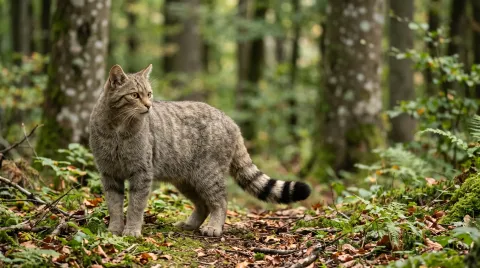
European wildcat: the cat Europe cannot count
Felis silvestris was only assessed as a species in its own right in 2022, and its official population trend is one word: unknown.
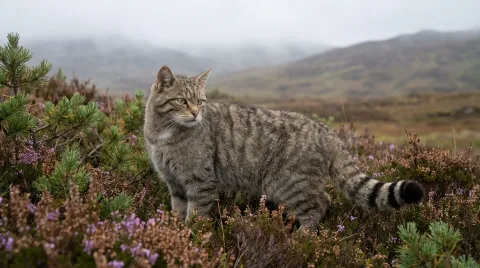
Scottish wildcat: not extinct, not a subspecies
The most-quoted fact about the Scottish wildcat misstates its own source. What the 2019 IUCN review really said, and where the cats stand in 2026.
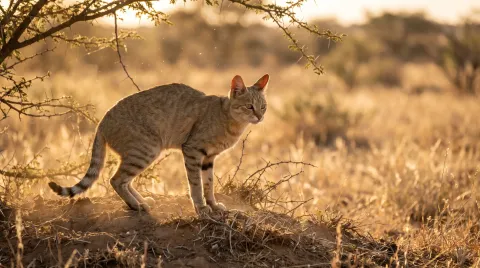
African wildcat: the real ancestor of your cat
Your cat descends from Felis lybica, a North African animal most people cannot name. In November 2025 the standard account of how it reached Europe broke.
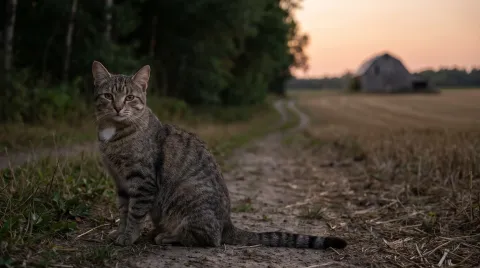
Wildcat hybridisation: how a species gets absorbed
Even a low crossbreeding rate assimilates a wildcat population past halfway inside a century. Why "only a few hybrids" is not the reassurance it sounds like.
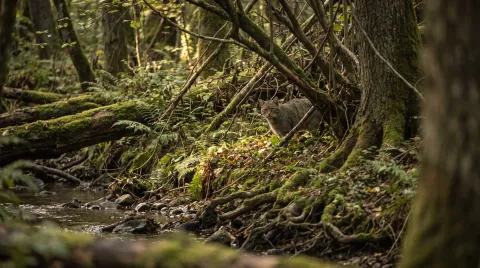
The forest a European wildcat actually needs
Woodland to shelter and den in, open edge to hunt over, and corridors between the two. What the radio-tracking and genetics really show.
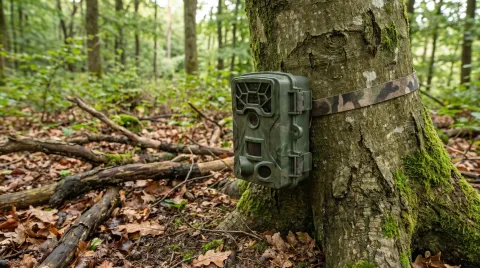
Wildcat conservation: law, cameras and cryptic extinction
How you save a species you cannot count: the law, the genetics labs, and the honest gap between what works and what is only worth trying.