The forest a European wildcat actually needs
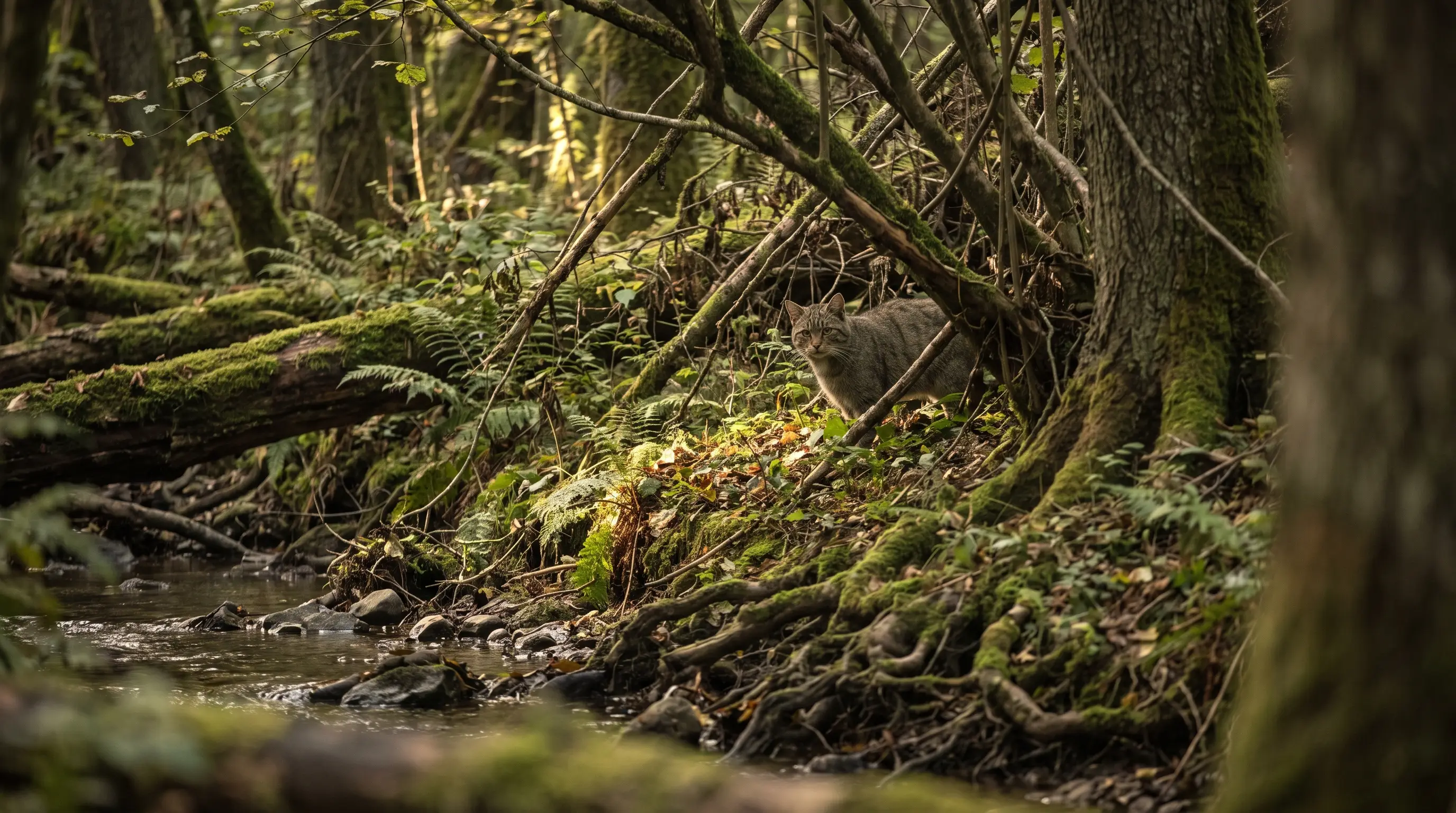
A European wildcat (Felis silvestris) needs three things sitting next to each other: woodland thick enough to shelter and den in, open ground at its edge to hunt over, and enough unbroken cover to move between patches. The clearest single measurement comes from the Eifel in western Germany, where Klar and colleagues radio-tracked cats for a 2008 study and found their locations sat a median 8 m from forest, while random points in the same landscape sat 54 m away. That gap is the whole argument in miniature. For the animal across the continent, start with the European wildcat; for who lives where, see where every wildcat species lives; and for the wider picture, this is one of Europe's wild animals worth knowing properly.
The eight-metre rule
Wildcats do not merely prefer forest, they hold to its edge with a precision you can measure. In the Eifel, Klar et al. (2008) recorded 75% of male and 91% of female radio locations inside forested habitat, and found cats sat significantly farther from villages than random points would predict, a mean 1,171 m versus 937 m, and closer to watercourses, 204 m versus 260 m. The disturbance had limits: past roughly 900 m from a village, and 200 m from single houses and roads, human structures no longer measurably shifted where the cats went.
The danger did not stop at the tree line, though. In that same study, 78% of recorded road kills fell inside modelled suitable female home-range area. The roads that carve up good habitat kill cats in the middle of it, not only at the margins.
What kind of forest a wildcat chooses
Broad-leaved and mixed forest, mostly, with people thin on the ground. The IUCN's 2015 assessment (Yamaguchi, Kitchener, Driscoll and Nussberger) places the European wildcat primarily in broad-leaved or mixed forest at low human densities, and also in Mediterranean maquis scrubland, riparian forest, along marsh boundaries and sea coasts, while areas of intensive cultivation and urbanisation are avoided. The Iberian tracking of Oliveira et al. (2018) sharpened that by sex: females stayed close to broadleaf forest and far from humanised areas, while males ranged farther from settlements but closer to permanent water, broadleaf forest and scrubland. Both sexes selected scrubland- or broadleaf-dominated ground.
It is the same broadleaf pull you see in the Italian wildcat and across Europe's other small wild cats, and it is one of the things that separates a true wildcat from any of the house cats it can be mistaken for.
Hunting happens at the edge
The forest is for hiding; the food is at its margin. Klar et al. read the wildcat's pull toward edges and rivers as prey-driven, describing cats hunting small rodents on meadows close to the forest edge and near creeks, then resting by day inside dense forest structure. Water tracks the same way. In northern Greece, Migli et al. (2025) found wildcat abundance declined sharply as distance to water sources rose, an effect that became negligible beyond 300 to 400 m.
Where the land is farmed, the shelter itself becomes the limiting factor. Jerosch et al. (2018) concluded that in agricultural landscapes shelter habitats are one of the key factors for wildcat occurrence, and that copses, hedges and wide field margins are what management should protect. Females leaned on areal shelter and avoided roads more than males, while males used more linear shelter such as watercourses and hedges. A cat working a field edge after dark is doing exactly what its eyes are built for.
Where the kittens are
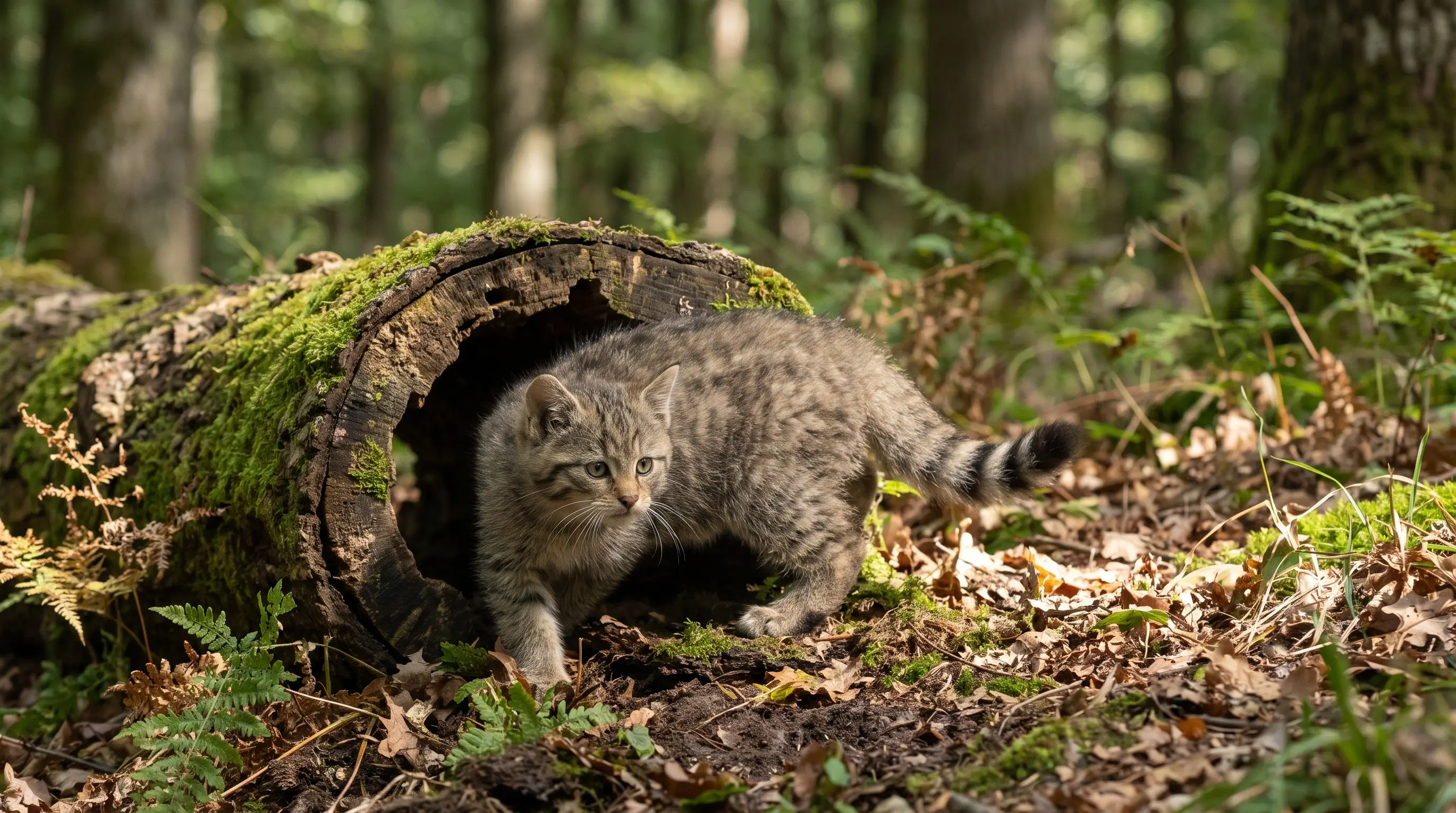
In dense, tangled cover, usually within reach of open hunting ground. The first study of wildcat breeding ecology in the wild (Ruiz-Villar, López-Bao and Palomares, 2023) found a mean litter size at weaning of two, with most observations falling between July and September, and auxiliary dens sitting mostly inside thick vegetation in the proximity of pastoral fields, though the cats occasionally used man-made structures. Two different females reared litters less than 500 m apart.
That fits the resting-site work of Jerosch and colleagues, who tracked males in the lower Harz and found dens and daytime lie-ups in bramble thickets, brushwood piles, tilted rootstocks and regeneration thickets, with shelters near forest edges preferred. A hollow log or a bramble tangle at the wood's edge is prime real estate for a mother cat.
Altitude, snow and the limits
Altitude on its own does not stop a European wildcat; lying snow does. The species has been recorded from sea level to 2,250 m in the Pyrenees (IUCN 2015, citing Palomo and Gisbert 2002), across an Iberian range spanning −14.8 °C to 36.2 °C and 243 to 1,852 mm of annual rainfall in the MITECO climate atlas. What pushes cats downhill is snow cover, not height. Mermod and Liberek (2002) watched five radio-tagged Swiss wildcats move to snow-free ground in winter and spring and return the moment it melted, using higher elevations in summer for prey and quiet.
Migli et al. (2025) put a figure on the ceiling at the range's south-eastern edge: above 800 m, relative abundance stayed low regardless of forest cover, with the optimum below about 600 m. Contrast that with the Asiatic wildcat, which ranges to 2,000 to 3,000 m, and the African wildcat, Felis lybica, found up to 3,000 m. The mountain limit is a European silvestris trait, not a wildcat one.
The Greek exception, and the honest answer
At the south-eastern edge of the range, the deep-forest story turns over. Migli et al. (2025), working 292 camera traps in northern Greece, found the highest wildcat abundance at 0 to 500 m elevation with low-to-medium forest cover of 0 to 40%. Sparsely wooded lowlands showed up to seven times the density of dense forest, and abundance was negatively associated with forest cover above 80%. Their reading was that low-to-medium-intensity farming creates diverse, well-connected country that wildcats favour.
The Cat Specialist Group says much the same more cautiously: wildcats can regularly use agricultural landscapes as long as enough forest sits within reach, and females depend on forest more than males do. So the honest answer is not deep forest only. It is forest for shelter and denning, edge and open ground for hunting, and connection between the two. What actually counts as a wildcat in the first place is a separate test, decided by wildcat DNA rather than by where a cat happens to be sitting.
Fragmentation, corridors and the hybrid problem
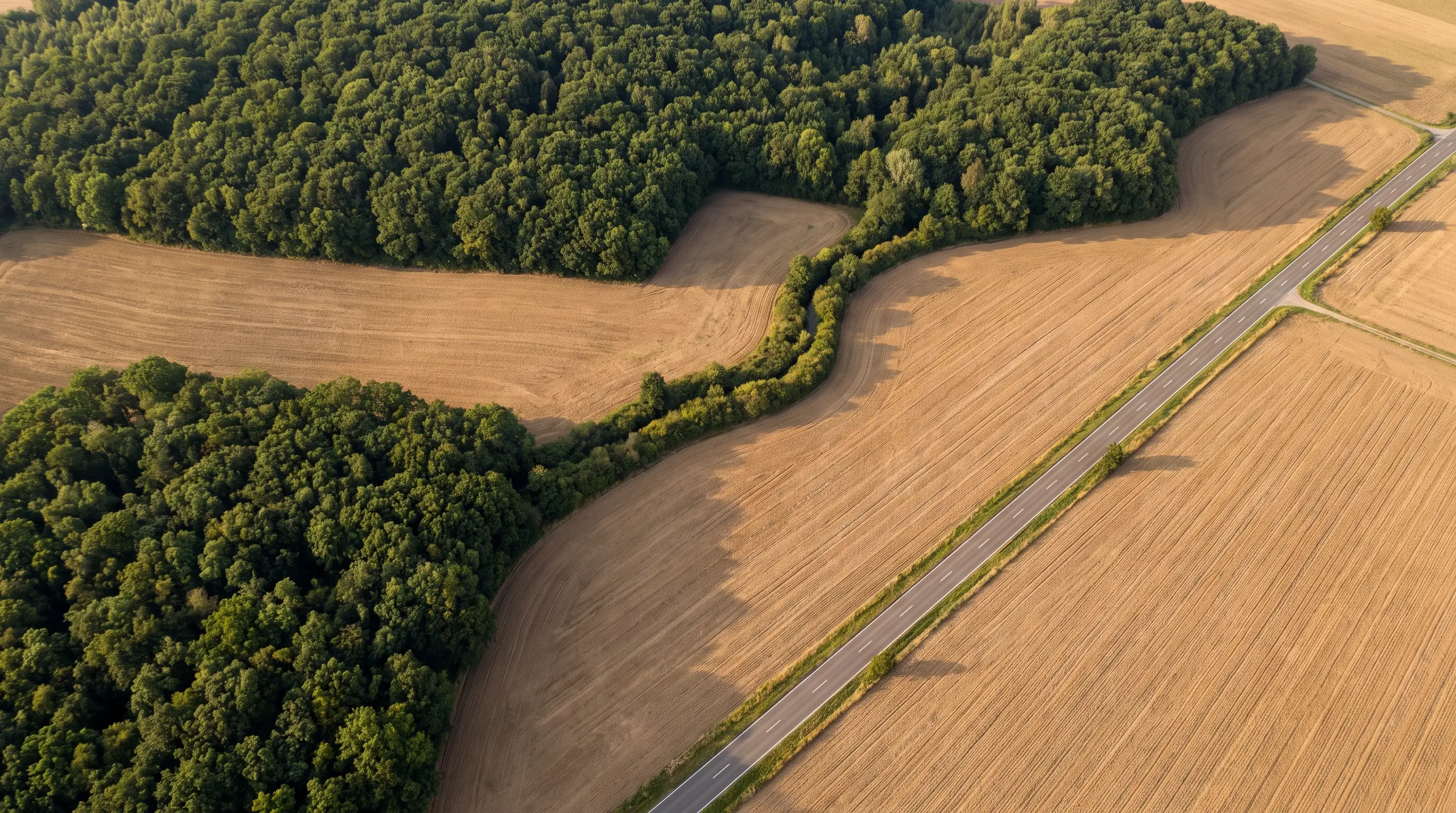
Break the habitat up and you do not only lose cats, you dilute what makes them wild. French landscape genetics from Portanier et al. (2022), based on 232 wildcats and 30 microsatellites, found arable land, pasture and lightly fragmented forest were permeable to gene flow, with distance to forest having no detectable effect. That led the authors to suggest the wildcat might be a habitat generalist, held back more by shelter and food than by forest as such. Hard infrastructure is a different matter: Say et al. (2012) showed the French population split into two genetically distinct groups either side of the Paris–Lyon motorway.
The link to hybridisation runs through habitat quality. Oliveira et al. (2018) argued that females' strict habitat requirements may buffer the population against feral and hybrid cats, which means poor, broken habitat does the opposite: it pushes wildcats onto human-dominated land and into contact with domestic cats. Switzerland shows it happening. Nussberger et al. (2024) recorded Jura occupancy doubling from 17% to 32% of sites between 2010 and 2020 as cats spread into areas of greater human, and therefore greater domestic-cat, presence, with gene flow from domestic cats rising from 0.02 to 0.03 migrants per generation in a population now around 1,100.
A feral cat, or the stray cats that gather where people leave food, or a well-fed neutered cat on the forest edge, is where a wild lineage starts to blur, which is why telling a wildcat from a feral cat matters, and why the domestic shorthair and European shorthair sharing that ground are part of the story. If you have found a stray cat near woodland, or you are feeding a neutered colony cat, that contact zone is exactly the concern.
The response in central Europe has been to rebuild the connections. BUND's Rettungsnetz Wildkatze ("Rescue Network Wildcat") has run since 2004 and its Wildkatzensprung ("Wildcat Leap") project since 2012, together yielding over 7,000 genetic samples, over 2,000 identified individual wildcats and over 2,600 volunteers. Its Wildkatzenwegeplan maps existing populations and the forest that could reconnect them, behind a generational vision of a 20,000-green-kilometre forest network. That figure is an aspiration, not built infrastructure. The recolonisation itself is real: wildcats were first seen back in the Netherlands in 2002 and the Vijlenerbos was colonised in late 2013, with secondary reporting putting perhaps 25 to 30 animals in South Limburg by 2024. What conservation actually does about all this, from law and fieldwork to how the hybrid swarm is measured and managed, are their own subjects, as is the parallel collapse of the Scottish wildcat.
Common questions
Where do wildcats live?
European wildcats (Felis silvestris) live mainly in broad-leaved and mixed forest across Europe, at low human densities, and also in Mediterranean maquis scrubland, riparian forest and along marsh boundaries and sea coasts (IUCN 2015). Other species sit elsewhere: the African wildcat, Felis lybica, ranges across Africa and south-west Asia.
Where do European wildcats live?
In forested country from Iberia and Italy through central Europe, with populations expanding again into Germany, Switzerland and the Netherlands. Radio-tracking in the Eifel by Klar et al. (2008) put 75% of male and 91% of female locations inside forest, a median 8 m from the tree line.
What do wildcats eat?
Mostly small rodents, hunted on meadows near the forest edge and along creeks, according to Klar et al. (2008). Where rabbits are abundant, as in parts of Scotland, they take those too, which is why home ranges there shrink where rabbits are plentiful.
What kind of habitat do wildcats need?
Three things together: woodland dense enough to shelter and den in, open ground at its edge to hunt over, and connectivity to move between patches. Migli et al. (2025) in northern Greece showed the balance can tip toward lightly wooded farmland at the range's edge, so it is not deep forest alone.
How much space does a wildcat need?
It varies enormously with prey and terrain. In Iberia, Oliveira et al. (2018) measured male ranges at a median 14.68 km² and females at 4.59 km²; in northern Greece, Migli et al. (2021) recorded 95% home ranges of roughly 1 to 4 km². Rewilding Britain describes a territory of at least a few hundred hectares, much of it woodland with open pasture for hunting.
Where do wildcats have their kittens?
In dense cover close to hunting ground: bramble thickets, brushwood piles, tilted rootstocks, hollow logs and regeneration thickets, with shelters near forest edges preferred (Jerosch et al.). Ruiz-Villar et al. (2023) found auxiliary dens mostly inside thick vegetation near pastoral fields, with a mean litter size at weaning of two, most seen between July and September.
See also
More in Wild
European wildcat: the cat Europe cannot count
Felis silvestris was only assessed as a species in its own right in 2022, and its official population trend is one word: unknown.
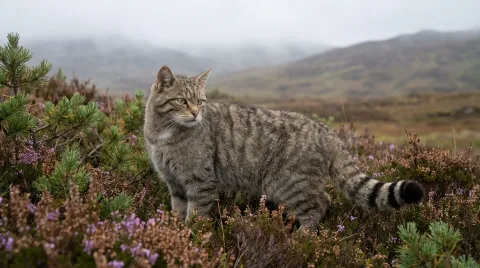
Scottish wildcat: not extinct, not a subspecies
The most-quoted fact about the Scottish wildcat misstates its own source. What the 2019 IUCN review really said, and where the cats stand in 2026.
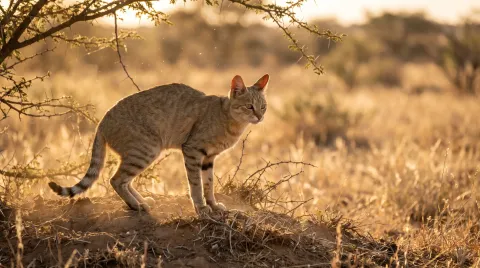
African wildcat: the real ancestor of your cat
Your cat descends from Felis lybica, a North African animal most people cannot name. In November 2025 the standard account of how it reached Europe broke.
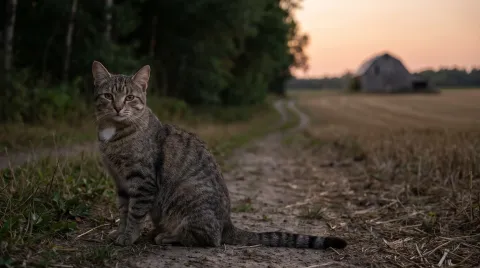
Wildcat hybridisation: how a species gets absorbed
Even a low crossbreeding rate assimilates a wildcat population past halfway inside a century. Why "only a few hybrids" is not the reassurance it sounds like.

European wildcat vs domestic cat: how to tell
You cannot do it by eye. On the same cats, coat scoring rated 0.854 and the genome 0.984, and the strict visual cut-off loses real wildcats.
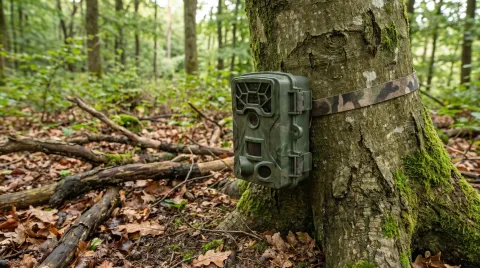
Wildcat conservation: law, cameras and cryptic extinction
How you save a species you cannot count: the law, the genetics labs, and the honest gap between what works and what is only worth trying.