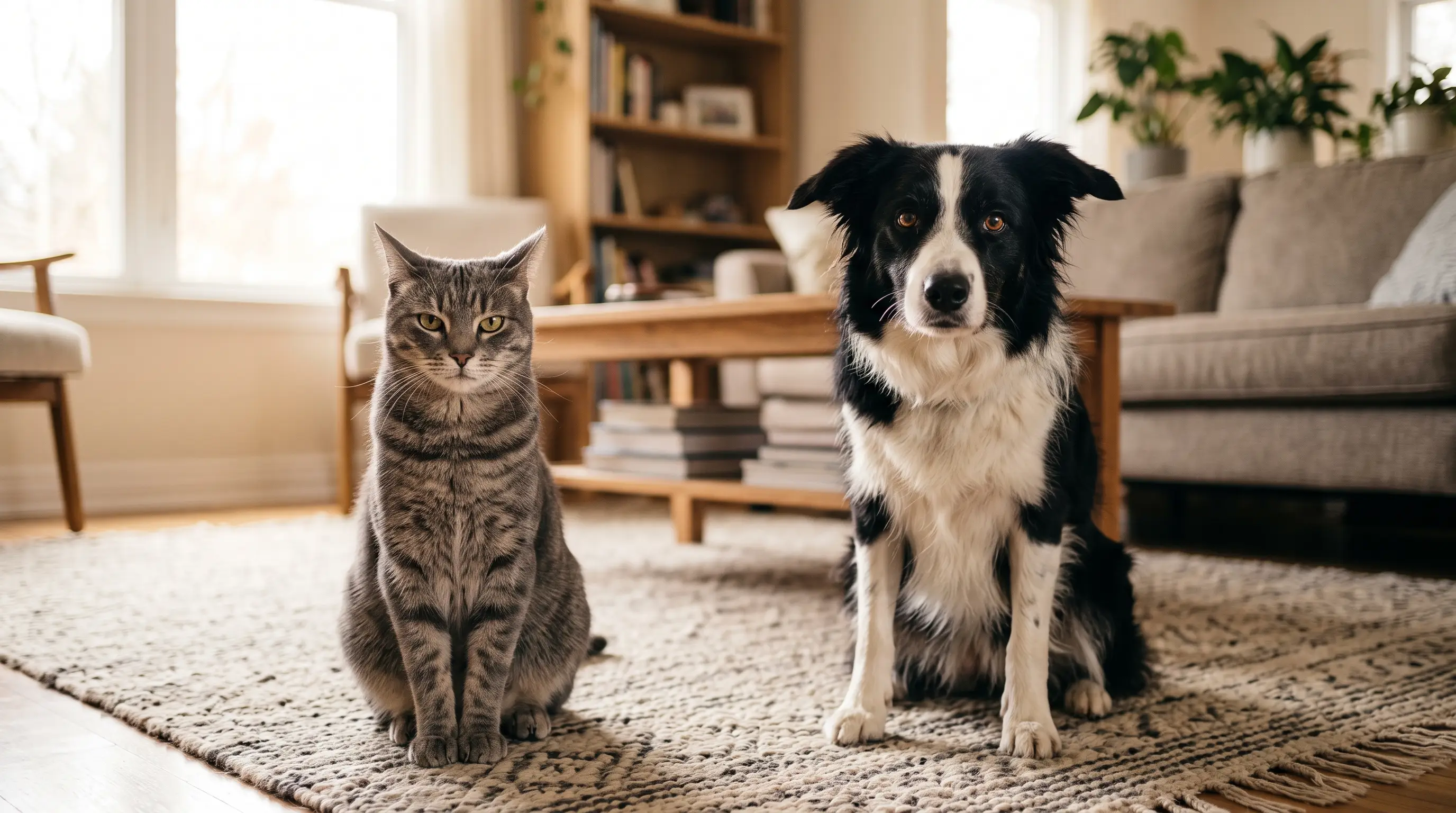
Are cats smarter than dogs? What we can actually measure
It's the pub argument of pet ownership, and both sides come armed: dog people with obedience, tricks and bomb-detection careers; cat people with the observation that their animal got the same food and shelter without working a day in its life. Science has actually weighed in — with neuron counts, cooperation studies and a long history of cats sabotaging the experiments — and the honest verdict is that the question is mostly malformed. Here's what can be measured, what the measurements miss, and why the two smartest answers are "smarter at what?" and "for whom?"
The neuron count, and what it buys
Start with the hardest number on the table. In 2017, neuroscientist Suzana Herculano-Houzel's lab counted neurons in carnivore brains and found a clear gap: around 250 million cortical neurons in a cat against roughly 430 million in a small dog and 620 million in a golden retriever — dogs carry about twice the cortical hardware, and cortical neurons are the best single proxy science has for cognitive capacity. That's a real result, run with careful methods, and cat partisans don't get to wave it away.
What it buys is less settled. Neuron counts predict capacity, not deployment — what an animal can compute, not what it bothers to compute for you. And the gap has an evolutionary logic that has nothing to do with wits: dogs are descended from cooperative pack hunters that needed social machinery for group living, and then spent tens of thousands of years being selected for working with humans. Cats descend from a solitary ambush hunter that needed exquisite senses, spatial memory and patience — and, as covered in how cats domesticated themselves, they were never bred for obedience at all. Different jobs built different brains.
The testing problem: cats plead the fifth
Here's the part that keeps this argument alive: most of what we "know" about dog intelligence comes from dogs' enthusiasm for being tested. A dog in a cognition lab works for praise, repeats trials happily, and treats the whole session as a game with its favourite species. Cats in the same paradigms have a documented habit of walking off, sitting in the apparatus, or performing the task once and declining further participation — researchers who work with cats openly describe recruiting and retaining feline subjects as the hardest part of the field. An animal that won't take the test doesn't score zero. It scores unknown.
When experiments are designed around feline temperament, the results keep landing on "same ballpark": cats follow human pointing gestures about as well as dogs, track their owner's voice and map their location by sound — the name and voice research — form secure attachments at infant-grade rates per the attachment studies, and in a 2024 experiment learned word-image associations from fewer exposures than human toddlers needed. The honest reading: where cats can be tested fairly, the gap the neuron count predicts keeps failing to show up as dramatically as it should.
What each animal is a genius at
Split intelligence into its working parts and the rankings flip by category. Social cognition: dogs, decisively — reading human faces, following gaze, learning hundreds of labels (the record-holding Border Collies run vocabularies over a thousand words), cooperating on tasks. It's what they were built and bred for. Independent problem-solving: cats hold their own and sometimes better — in classic detour and puzzle tasks, cats persist alone where dogs quickly turn to look at the human for help. Whether that glance is stupidity or social genius is exactly the kind of question that breaks the single-scale model. Spatial and observational learning: cats excel — mapping territory in the dark, as the senses tour shows, and learning by watching in a way early cat-psychology experiments (Thorndike's puzzle boxes) famously underestimated. Working memory and patience: the ambush hunter wins the waiting game every time.
Comparing them on one scale is comparing a violin to a hammer by asking which is the better tool. The violin loses every carpentry benchmark and the argument tells you nothing about music.
The answer, and the better question
So: are cats smarter than dogs? By raw cortical hardware, no — dogs carry roughly twice the neurons, and no honest account hides that. By tested performance, the race is far closer than the hardware predicts, because half the feline results are missing on principle. By category, each species holds fields the other can't touch. The single-scale question is a category error wearing a quiz-show costume, and the pub argument survives precisely because it's unfalsifiable from the sofa.
The better question is the one this whole cluster keeps answering: what is this animal actually running? A dog is a cooperative professional that wants the job, the boss and the performance review. A cat is a freelance specialist that took over the rodent contract ten thousand years ago and has renegotiated terms ever since — attached, observant, and selective about when intelligence is worth displaying, as anyone who has watched a cat ignore its own name knows from the recognition research. Live with a Border Collie and you'll swear nothing is smarter. Live with a Siamese and you'll swear the same thing at 6am, when it has once again opened the door you locked. You're both right. That's the point.
Common questions
Are cats smarter than dogs?
By cortical neuron count — the best hardware proxy science has — no: dogs carry roughly twice as many (about 430-620 million against a cat's 250 million, per Herculano-Houzel's 2017 counts). But tested performance runs far closer than the hardware predicts, partly because cats refuse tests dogs enjoy, and by cognitive category each species dominates fields the other can't touch.
Why is it so hard to test cat intelligence?
Because participation is voluntary and cats withhold it: they walk out of trials, sit in the apparatus, or perform a task once and decline repeats. Researchers describe recruiting and retaining feline subjects as the field's hardest problem. An animal that won't take the test scores unknown, not zero — which is why dog cognition is simply better documented.
What are cats more intelligent at than dogs?
Independent problem-solving (cats persist alone where dogs turn to ask the human for help), spatial mapping and navigation — including in near-darkness — observational learning, and the working patience of an ambush predator. Where tests fit feline temperament, cats also match dogs on things like following human pointing gestures.
What are dogs more intelligent at than cats?
Social cognition, by a wide margin: reading human faces and gestures, following gaze, cooperative tasks, and vocabulary — record-holding Border Collies know over a thousand word labels. Tens of thousands of years of selection for working with humans built exactly this toolkit.
How many neurons do cats and dogs have?
In the cerebral cortex — the count that best tracks cognitive capacity — roughly 250 million for cats, 430 million for a small dog and about 620 million for a golden retriever, per the 2017 Herculano-Houzel study. Dogs' bigger social brains reflect pack living and domestication for cooperation, not a verdict on feline wits.
Do cats think about their owners?
The evidence says yes: cats map their owner's location by voice, distinguish their person from strangers, form secure attachments at rates matching human infants, and adjust behaviour to their owner's attention and mood. What a cat does with those thoughts, it typically declines to demonstrate on command — which is the whole cat position in one sentence.
More in Cats
Why does my cat lick me? Grooming, love and salt
A cat's lick is mostly a compliment: you've been adopted into the grooming circle. What the sandpaper tongue is doing, why some cats overdo it, and when to gently opt out.
Why does my cat follow me everywhere, even the bathroom?
The supposedly aloof animal trailing you from room to room is behaving exactly as the attachment science predicts. Why cats shadow their person, the bathroom mystery, and the one change that needs a vet.
Why does my cat meow at night? And how to make it stop
Night calling is a solvable problem with a short list of causes: a crepuscular body clock, a lesson you accidentally taught, an unneutered announcement, or — in older cats — a medical flag that comes first.
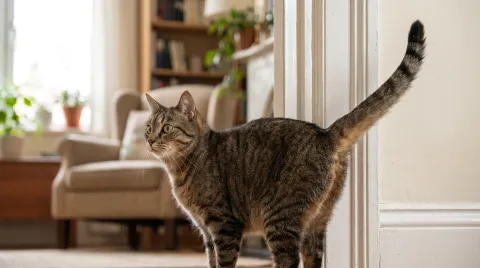
Why is my cat spraying? What it means and how to stop it
Spraying isn't a litter-box failure — it's a message about territory, written in urine. How to tell it from peeing, what's behind it, and the fixes that hold.
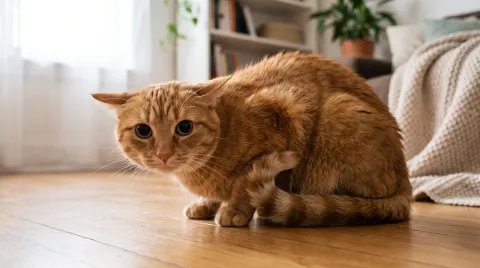
Why is my cat aggressive? Causes and how to calm it
Cat aggression isn't a personality — it's a diagnosis with about six usual suspects, and each one has a different fix. Work through them in order and the biting usually explains itself.
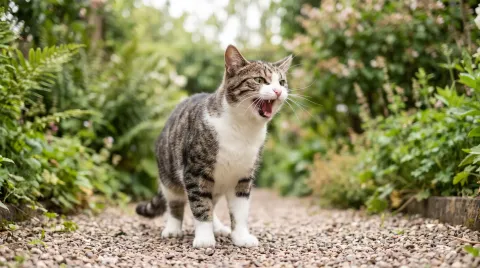
Why do cats hiss? What it means and what to do
A hiss is not an attack — it's the thing a cat does to avoid one. What the sound actually is, what triggers it, and why the polite answer is always to back off.