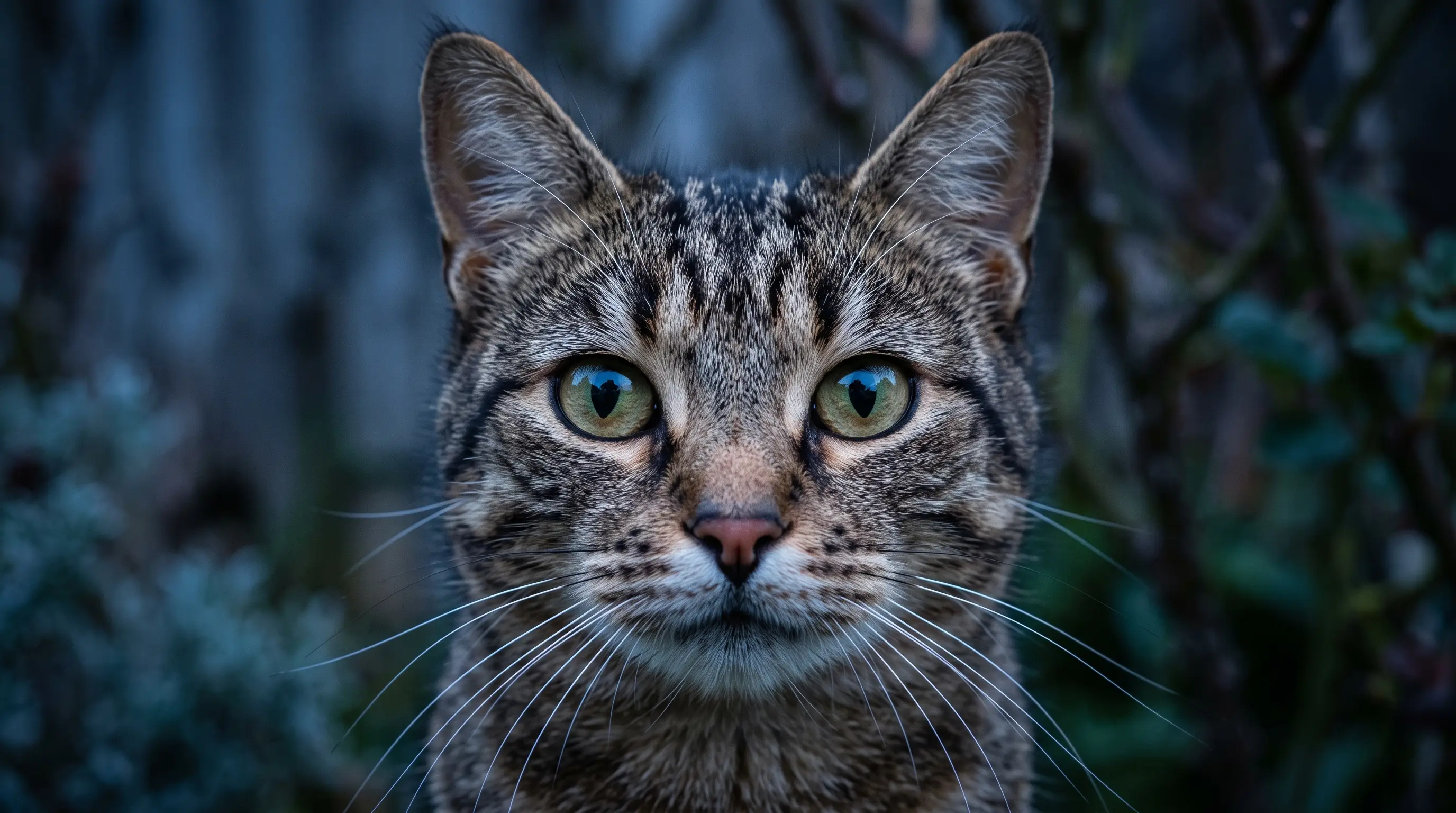
What the world looks like to a cat
Your cat lives in your flat, but not in your flat as you know it. Its eyes trade colour and sharpness for motion and darkness; its ears hear the mouse behind the wall and the ultrasonic whine of your phone charger; its nose reads a scent bulletin off the doormat that's completely invisible to you; and its whiskers map air currents the way your fingertips map braille. This is a room-by-room tour of the sensory world your cat actually occupies — and it explains a surprising amount of "weird" behaviour, from ignoring the red laser dot's colour to hating the spot where the last cat's smell still lives.
The eyes: built for dusk, not detail
Start with what a cat's eyes give up. Sharpness: a cat sees roughly 20/100 to 20/200 — what you resolve crisply at sixty metres, a cat resolves at six — and anything closer than about twenty-five centimetres is a blur, which is why your cat sniffs the treat lying right under its nose instead of looking at it. Colour: cats aren't colour-blind, but with two cone types tuned to blues and yellow-greens, reds and pinks arrive as muddy greys and greens. The red laser dot works because it moves, not because it's red.
Now what the eyes get in return. A reflective layer behind the retina — the tapetum lucidum, the same mirror that makes cat eyes glow in photos — recycles light through the photoreceptors, and a rod-packed retina plus pupils that open into full black moons let a cat function in around a sixth of the light you need. The price of those huge apertures is the slit pupil by day, and the payoff is the whole package's real job: detecting a small movement, at dawn, in cover. A cat's vision is not a worse version of yours. It's a motion detector wearing night-vision goggles, and it was never meant to read.
The ears: sonar with sixty-four thousand hertz
Human hearing tops out around 20 kHz; a cat's runs to roughly 64 kHz, past even a dog's — one of the widest ranges of any mammal, and it exists for one reason: rodents talk in ultrasound. The squeaks a mouse makes to its family are pitched far above your ceiling and land square in the middle of a cat's range, which means your cat hears conversations in your walls you will never attend. Add thirty-plus muscles per ear swivelling each one independently through nearly 180 degrees, and a cat can localise a rustle behind the skirting board to within centimetres — while facing the other way, apparently asleep.
This is why a cat "startles at nothing" (it wasn't nothing), why some cats leave the room when certain electronics are on (chargers and screens can whine in ranges you can't hear), and why the freezer door two rooms away summons an animal that ignored its own name — as established in the name research, hearing you and answering you are different departments.
The nose: the newspaper you can't read
Smell is the sense we most underrate in cats. With some two hundred million scent receptors against your five or six million, a cat's primary information channel is chemical: who passed the door, how long ago, in what condition. On top of the ordinary nose sits a second organ you don't have at all — the vomeronasal organ in the roof of the mouth, reached through that strange open-mouthed grimace called the flehmen response, which is your cat literally tasting a smell to parse its social content. The scent bulletins its own glands publish — the cheek rubs and headbutts from the marking story — are read back through this same equipment.
The practical consequences run the household. A new sofa isn't furniture, it's a scent void that needs urgent annotation. A cat returning from the vet smelling of clinic can get attacked by its own housemate — the smell is the identity. And the plug-in air freshener you barely notice is, at cat nose-scale, a fog horn that never stops. When a cat avoids a spot, sniffs a guest's shoes with forensic attention, or rubs its face on your luggage the hour you return, it's doing admin in an archive you can't open.
Whiskers, tongue and the rest of the toolkit
The whiskers are not decoration; they're measuring instruments rooted in nerve-rich follicles that read air currents, gap widths and the position of prey too close for those long-sighted eyes to focus on — which is why a cat carries prey items and toys at its mouth guided by whisker feel, and why some cats refuse deep, narrow food bowls that jam their instruments against the sides all meal long. A wide, shallow dish is a cheap courtesy. Touch runs the paws too: the pads are dense with receptors, one reason the paw-first investigation from the desk-clearing story is standard procedure.
Taste is the toolkit's stunted member: a few hundred taste buds to your nine thousand, and — famously — no working sweet receptor at all. A cat evaluating food leans on smell and texture, which is why warming food "fixes" a picky appetite (it turns the smell up) and why a cat with a blocked nose often stops eating entirely. And one sense runs on hardware you lack entirely: the vestibular gyroscope that makes the mid-air twist possible is wired into everything a cat does at height.
Running a home for a different sensory species
Put the tour together and a set of house rules falls out. Light: your cat doesn't need the lamp left on — dusk is its element — but a night-light near stairs helps very old cats whose eyes have aged. Sound: keep the volume honest; a TV at your comfortable level is louder in a cat's range, and a home theatre bass drop is an earthquake. If a cat flees "for no reason", audit the ultrasonics — chargers, dimmers, pest repellers. Smell: go easy on air fresheners, scented litter and deep-cleaning every cat-marked surface in one weekend — you're bulldozing the archive. Wash bedding in rotation, never all at once.
And use the differences instead of fighting them. Movement beats colour in toys — a drab feather that flutters outranks a bright ball that sits still. Smell beats sight in feeding — warm the food, skip the deep bowl. The window perch from the enrichment programme is better theatre than any screen because it comes with sound and scent attached. The animal on your sofa is running different instruments on the same room. Set the room up for both of you, and a lot of mystery behaviour quietly stops being mysterious.
Common questions
How do cats see the world?
Blurrier and more washed-out than you, but far better in the dark and far more sensitive to motion: roughly 20/100–20/200 acuity, two cone types that mute reds to grey-green, huge pupils and a reflective tapetum lucidum that let them function in about a sixth of the light humans need. Cat vision is a dusk-tuned motion detector, not a reading instrument.
What colors can cats see?
Blues and yellow-greens, most convincingly. Cats have two cone types (humans have three), so reds and pinks arrive as muddy greys and greens. They aren't colour-blind — but colour matters far less to them than motion and contrast, which is why a moving drab toy beats a stationary bright one.
Can cats see in complete darkness?
No — no eye can. Cats see in very dim light, needing only around a sixth of the light humans do, thanks to rod-dense retinas, wide pupils and the tapetum lucidum reflecting light back through the eye. In total darkness they navigate by whiskers, hearing and memory instead.
How good is a cat's hearing?
Among the best of any mammal: up to roughly 64 kHz, far beyond humans (~20 kHz) and beyond dogs, evolved to catch rodents' ultrasonic calls. Each ear swivels independently through nearly 180 degrees, letting cats localise faint sounds to within centimetres — including electronics that whine in ranges people can't hear.
What do cats use their whiskers for?
As measuring instruments: whiskers read air currents, gauge gaps, and locate objects too close for a cat's long-sighted eyes to focus on. That's why cats guide prey and toys by whisker feel — and why deep, narrow food bowls that press the whiskers all meal long put some cats off; a wide, shallow dish fixes it.
Why does my cat smell everything?
Because smell is its main information channel: around two hundred million receptors against your five or six million, plus the vomeronasal organ — reached via the open-mouthed flehmen grimace — for parsing social scents. Guests' shoes, your luggage, the new sofa: your cat is reading arrivals, identities and territory news you can't perceive.
More in Cats
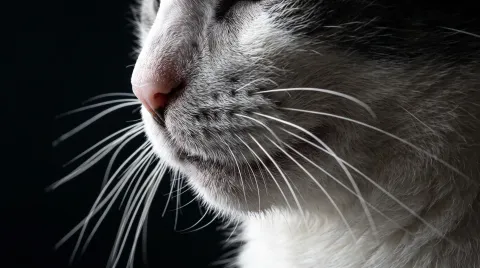
Whiskers: the instrument panel on your cat's face
Air-current radar, gap gauge, mood indicator and night-hunting sight — whiskers do jobs eyes can't. How the instruments work, what whisker positions tell you, and the honest verdict on whisker fatigue.

How cats domesticated themselves
No one set out to tame the cat. It walked into the grain stores of the first farmers about 10,000 years ago and stayed — barely changed from the wildcat it still is.

What selective breeding actually does to an animal
Choosing which animals have babies is the most powerful force in a pet’s biology. A Soviet fox experiment shows how fast it works — and how much it costs.

How we know: reading the ancient DNA of dogs and cats
The story of pet origins was rewritten in the last fifteen years — not by new bones, but by pulling readable DNA out of old ones. Here is how that actually works.
Why cats can’t taste sweetness — and dogs can
A cat is deaf to sugar because a single taste gene broke long ago. That one fact opens up the whole biology of the obligate carnivore in your kitchen.
Why does my cat lick me? Grooming, love and salt
A cat's lick is mostly a compliment: you've been adopted into the grooming circle. What the sandpaper tongue is doing, why some cats overdo it, and when to gently opt out.