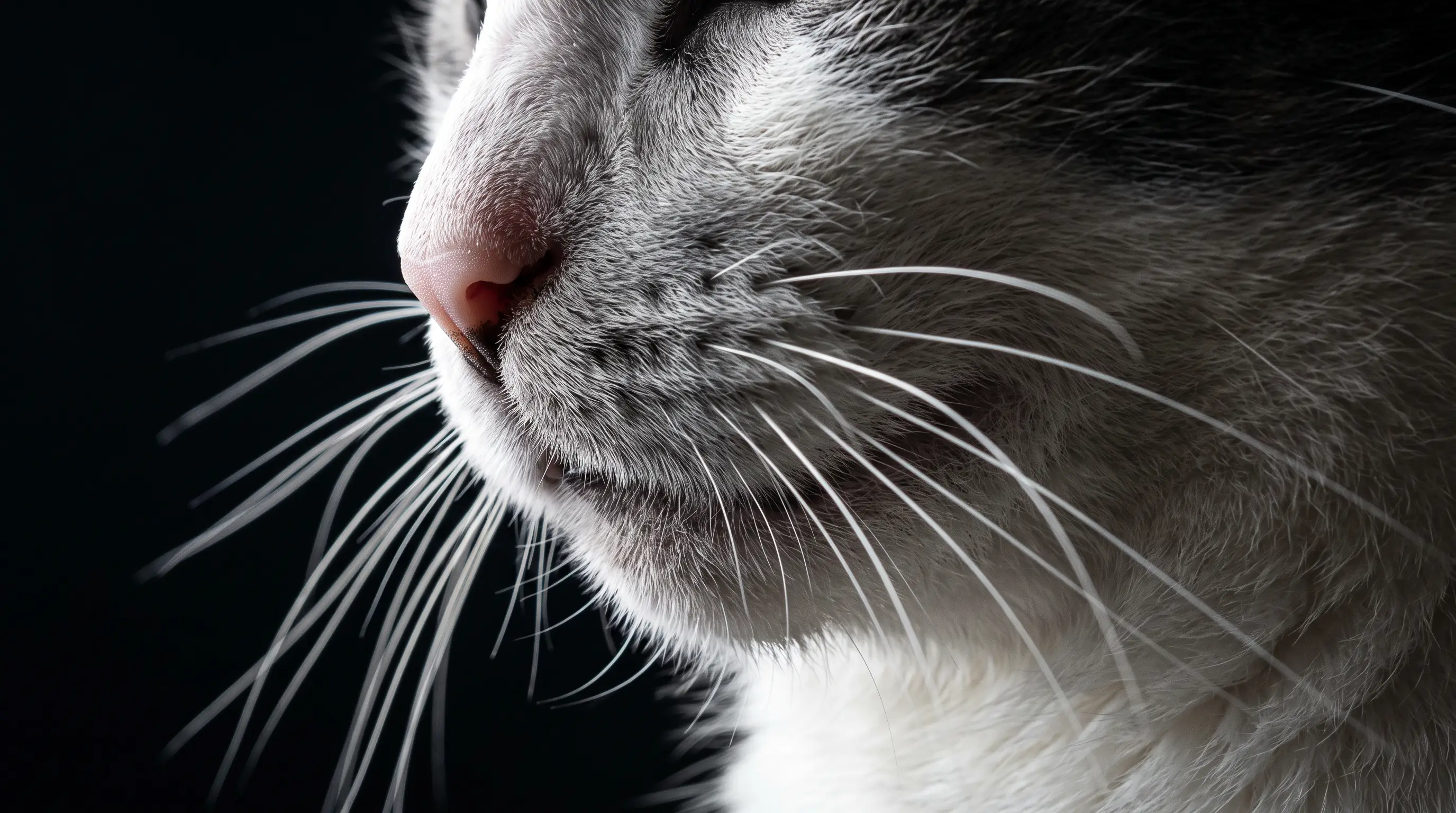
Whiskers: the instrument panel on your cat's face
Pull one hair from your arm and you feel a pinprick; a cat's whisker, by contrast, is wired like a fingertip. Each one sits in a capsule of blood and nerve endings so sensitive it reads the air itself — the wake of a moving mouse, the nearness of a wall in the dark, the exact position of prey held too close for a cat's long-sighted eyes to see. Whiskers are why a cat flows through a gap it never measured and hunts in darkness it can't see through. Here's how the instrument panel works, what it broadcasts about mood, why you must never trim it — and what's actually true about whisker fatigue.
Not hair: instruments
A whisker — vibrissa, in the anatomy books — is thicker and stiffer than ordinary hair and rooted three times deeper, in a follicle wrapped in a blood-filled capsule called a sinus. That capsule is the clever part: it works as an amplifier, turning the faintest deflection of the shaft into pressure that hundreds of nerve endings read instantly. The signal gets premium treatment in the brain, too — a disproportionate slice of a cat's sensory cortex is dedicated to whisker input, much as human cortex over-represents the fingertips.
The result is an instrument that reads what eyes can't: air currents bending around furniture in the dark, the vibration of something moving nearby, touch at a resolution fine enough to distinguish a twig from a tail. And they're not only on the muzzle — shorter sets sit above the eyes (triggering the protective blink when anything brushes them), on the chin, and on the backs of the front legs, where carpal whiskers read the movements of prey held in the paws. A cat is wearing sensors on every surface that matters to a hunter.
What the panel is for
Job one: navigation. The muzzle whiskers spread to roughly the width of the body, which turns them into a live gap gauge — if the whiskers pass untouched, the cat fits. This is also the honest core of the fat-cat joke: the whiskers don't grow when the body does, so a well-fed cat's gauge under-reports. Job two: hunting at contact range. A cat's eyes can't focus closer than about twenty-five centimetres, so in the final moment of a catch the whiskers swing forward like a net and take over from vision entirely — the carpal whiskers report whether the prey in the paws is subdued, and that forward-fanned position is why cats in mid-pounce look suddenly moustachioed in photographs.
Job three: reading the air. The wake of a scurrying mouse, the draught under a door that says a room is open, the pressure front of your hand arriving in the dark — whiskers register them all, which is a large part of how a cat operates so confidently in light levels where even its excellent eyes have given up, as covered in the senses tour.
The mood broadcast
Because whiskers are muscled and mobile, they leak state — a live gauge on the front of the face. Neutral and softly fanned to the sides: a relaxed cat. Swung forward, spread wide: interest and hunting arousal — the position of a cat greeting a toy, investigating a box, or about to pounce. Pinned back along the cheeks: fear or aggression, whiskers tucked out of harm's way exactly as the ears flatten for the same reason. It's one more dial on the dashboard read out in cat body language — and worth cross-checking against ears and tail, since whiskers alone are subtle.
The instruments also need maintenance downtime. Whiskers shed and regrow one or two at a time — finding a stray whisker on the sofa is normal; a cat losing many at once, or with broken stubble on one side, may be over-groomed by a housemate, stressed per the usual checklist, or dealing with a skin problem worth a vet look.
Never trim. And the whisker-fatigue verdict
Two practical matters, one absolute and one nuanced. The absolute: never cut, trim or "tidy" whiskers. A cat with cut whiskers isn't in pain — there are no nerves in the shaft itself — but it's a pilot with dead instruments: navigation, night confidence and close-range hunting all degrade until the whiskers regrow over weeks. This includes groomers who trim "for neatness"; if yours does, find another groomer. Kittens chewing off each other's whiskers, a real and odd habit some littermates develop, resolves itself; scissors don't get that excuse.
The nuanced: whisker fatigue — the claim that deep, narrow food bowls, which press a cat's whiskers against the sides at every mouthful, stress cats into picky eating, food-flinging or bowl-avoidance. The honest reading of the evidence: plausible mechanism, thin proof. The one controlled study to date found cats did prefer a wide, flat dish for food, but showed no dramatic welfare difference, and "fatigue" is likely the wrong word for what is at most a mild, constant annoyance. The practical verdict writes itself, though, because the fix is free: a wide, shallow dish or a flat plate costs nothing, removes the annoyance if it exists, and several of the behaviours blamed on whisker fatigue — scooping food out with a paw, leaving the last third of the bowl — quietly stop in some cats. Low stakes, cheap fix, no need to overclaim. That's the whole file.
Instruments the family shares
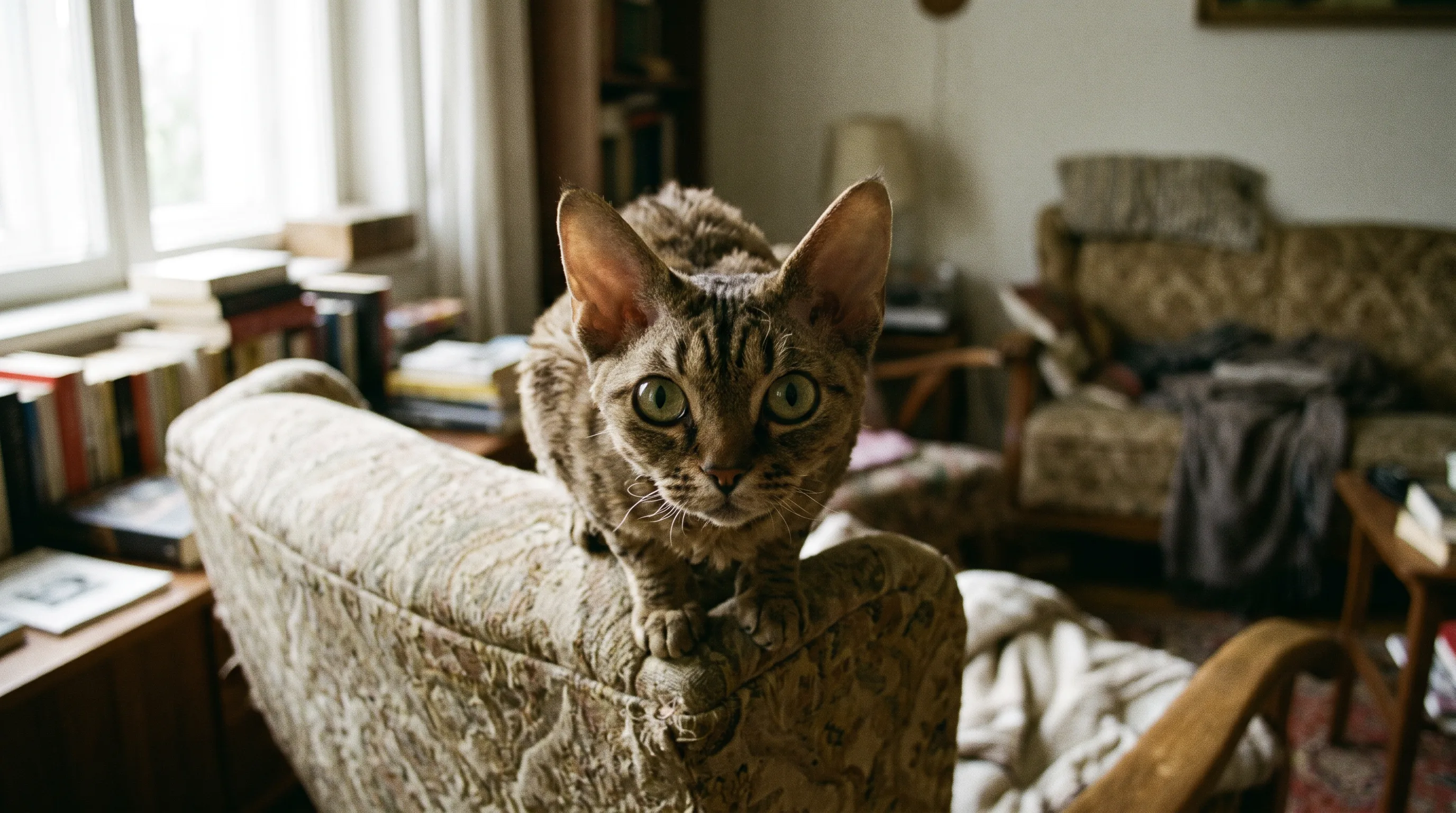
The whisker system is old family equipment. The wildcats in our wild coverage run the same instruments over the same jobs — night navigation, contact-range prey control — which is exactly why the panel comes factory-fitted on your sofa predator. Breeding has mostly left whiskers alone, with one telling exception: curly-coated breeds like the Devon Rex carry the coat mutation into their vibrissae, ending up with short, crinkled, brittle whiskers that break easily — a small, honest reminder that when we breed for looks, function sometimes pays.
Day to day, the instrument panel asks almost nothing of you: don't trim, serve dinner on flat ground, read the forward fan as excitement and the pinned-back set as a warning, and accept the occasional shed whisker on the rug as scheduled maintenance. In return you get an animal that pours itself through the dark of your home at 3am — see the zoomies’ favourite hour — without touching a thing. Usually.
Common questions
What do cat whiskers actually do?
Three jobs: navigation (spread to body width, they gauge whether a gap fits), close-range hunting (eyes can't focus nearer than ~25 cm, so whiskers fan forward and take over in the final moment, with carpal whiskers on the forelegs reading prey in the paws), and air reading — registering currents and vibrations that let a cat move confidently in near-darkness.
Is it OK to trim a cat's whiskers?
No — never. Cutting doesn't hurt (the shaft has no nerves) but it blinds the instruments: navigation, night confidence and close hunting all degrade until regrowth over weeks. There is no grooming reason to trim whiskers; a groomer who does it for neatness is one to replace.
Is whisker fatigue real?
The mechanism is plausible, the evidence thin. Deep, narrow bowls do press whiskers at every mouthful, and the one controlled study found cats prefer wide, flat dishes — but no dramatic welfare effect. Since the fix is a flat dish that costs nothing, the practical answer is: serve food shallow and skip the debate.
Why is my cat losing whiskers?
One or two at a time is normal shedding — whiskers cycle like other hairs, just more slowly. Many at once, broken stubble, or one-sided loss suggests over-grooming by a housemate, stress, or a skin condition, and is worth a vet conversation.
Do cat whiskers grow back?
Yes. A shed or broken whisker regrows over several weeks to a couple of months, and a cut whisker regrows the same way. The cat's instruments are degraded in the meantime, which is why trimming is off-limits even though regrowth is reliable.
What does it mean when a cat's whiskers point forward?
Interest and arousal: the forward fan is the hunting position, deployed at toys, prey and anything worth investigating — cats mid-pounce look suddenly moustachioed for exactly this reason. Whiskers pinned back along the cheeks signal fear or aggression, the same message as flattened ears.
More in Cats
What the world looks like to a cat
Blurry up close, washed-out in colour, six times brighter at night — and smelling like a newspaper you can't read. A tour of your home through your cat's senses, and what it changes about how you run it.
How cats domesticated themselves
No one set out to tame the cat. It walked into the grain stores of the first farmers about 10,000 years ago and stayed — barely changed from the wildcat it still is.

What selective breeding actually does to an animal
Choosing which animals have babies is the most powerful force in a pet’s biology. A Soviet fox experiment shows how fast it works — and how much it costs.

How we know: reading the ancient DNA of dogs and cats
The story of pet origins was rewritten in the last fifteen years — not by new bones, but by pulling readable DNA out of old ones. Here is how that actually works.
Why cats can’t taste sweetness — and dogs can
A cat is deaf to sugar because a single taste gene broke long ago. That one fact opens up the whole biology of the obligate carnivore in your kitchen.
Why does my cat lick me? Grooming, love and salt
A cat's lick is mostly a compliment: you've been adopted into the grooming circle. What the sandpaper tongue is doing, why some cats overdo it, and when to gently opt out.